Cultic Studies Journal, Vol. 12, No. 1, 1995, page 37
outcomes of group membership are not planned or desired by some, but rather emanate as
unintended consequences of group processes gone wrong.
While I cannot say beyond a shadow of doubt which of these two models is superior, I can
unequivocally point out that Janis‟s groupthink model cannot account for both points of
view. As a consequence, we may, when using the groupthink model to explain decision
making in cults, find that the absence of strategic behaviors does not permit an open
scrutiny of all possible explanations.
In line with the evolution rather than the conscious manipulation of the antecedents in
Janis‟s groupthink model is the fourth and final assumption--namely that group problem
solving or decision making is and ought to be a rational, linear, and scientific-like set of
procedures. In Janis‟s model, this rational process is presaged by the selection of articulated
goals, the gradual and careful elimination of the less than maximizing alternatives, and a
thorough-going information search. Janis employs a notion of decision-making rationality
which, he insists, not only lessens the possibility of going astray in the making of decisions,
but also is the one actually used in healthy or functional decision-making groups. One may
not want to quarrel with the assertion that scientific-like procedures in decision-making
processes by groups lessen the probability of error however, it is a far jump from this
assertion to the assumption that healthy groups actually use these procedures. Janis has, I
feel, articulated a notion of decision-making rationality which is too unrealistic to be helpful
in most applied settings, never mind in the area of cults. Indeed, Janis‟s depiction of
decision making, while a valued classroom heuristic, may be used, even in very healthy
decision groups, far less than Janis leads us to believe.
One thing is certain, when groups use retrospective sense making to tell others how they
made their decisions, they will, on the whole, overemphasize the rational and sequential
stepwise way in which they arrived at the decision. This “hindsight bias” will, for obvious
reasons, be most pronounced when the outcome of the decision is aligned with the group‟s
goals or, stated another way, when the problem confronted by the problem-solving group is
solved. However, cults are not problem-solving groups. Moreover, cults make, at least to
nonmembers, weak rationality claims. Groups with a strong set of rationality claims are
those that have as their aims future goals highly desired by the dominant society or
mainstream and attempt to achieve these with approved-of and efficient means or
processes. Since cults by their very definition march to a different drummer and seem
rather proud of this fact, it would be odd to use the canons of rationality so evident in
Janis‟s groupthink model to make sense of cult decision making.
Modifying the Groupthink Model
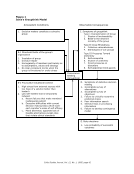
To meet the problems of cults and cultic decision making, serious modifications in Janis‟s
groupthink model are required. Moorhead and Montanari (1986) point out that empirical
studies on varying groups are in agreement on just one thing. The antecedents--group
cohesiveness, structural faults, and the existence of a crisis or provocative context--are the
particular weak part of the model. This, I believe, is particularly so if we seek to apply
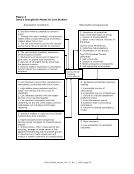
Janis‟s groupthink model to understand erratic decisions made in cults. In Figure 2 (at end
of article), “Janis‟s Groupthink Model for Cult Studies” (at end of article), I outline four key
areas where modification of the original groupthink model (see Fig. 1) is required to suit the
four difficulties discussed in the previous section.
Janis defined groupthink as “a mode of thinking that people engage in when they are deeply
involved in a cohesive group, when the members‟ strivings for unanimity override their
motivation to realistically appraise alternative courses of action” (1972, p. 9). As Longley
and Pruitt (1980) point out, this definition is confusing not only because it is tautological or
defines the process itself by its antecedents, but also because it is so insistent that group
cohesiveness explains so much of the process. Indeed, upon closer scrutiny it becomes
outcomes of group membership are not planned or desired by some, but rather emanate as
unintended consequences of group processes gone wrong.
While I cannot say beyond a shadow of doubt which of these two models is superior, I can
unequivocally point out that Janis‟s groupthink model cannot account for both points of
view. As a consequence, we may, when using the groupthink model to explain decision
making in cults, find that the absence of strategic behaviors does not permit an open
scrutiny of all possible explanations.
In line with the evolution rather than the conscious manipulation of the antecedents in
Janis‟s groupthink model is the fourth and final assumption--namely that group problem
solving or decision making is and ought to be a rational, linear, and scientific-like set of
procedures. In Janis‟s model, this rational process is presaged by the selection of articulated
goals, the gradual and careful elimination of the less than maximizing alternatives, and a
thorough-going information search. Janis employs a notion of decision-making rationality
which, he insists, not only lessens the possibility of going astray in the making of decisions,
but also is the one actually used in healthy or functional decision-making groups. One may
not want to quarrel with the assertion that scientific-like procedures in decision-making
processes by groups lessen the probability of error however, it is a far jump from this
assertion to the assumption that healthy groups actually use these procedures. Janis has, I
feel, articulated a notion of decision-making rationality which is too unrealistic to be helpful
in most applied settings, never mind in the area of cults. Indeed, Janis‟s depiction of
decision making, while a valued classroom heuristic, may be used, even in very healthy
decision groups, far less than Janis leads us to believe.
One thing is certain, when groups use retrospective sense making to tell others how they
made their decisions, they will, on the whole, overemphasize the rational and sequential
stepwise way in which they arrived at the decision. This “hindsight bias” will, for obvious
reasons, be most pronounced when the outcome of the decision is aligned with the group‟s
goals or, stated another way, when the problem confronted by the problem-solving group is
solved. However, cults are not problem-solving groups. Moreover, cults make, at least to
nonmembers, weak rationality claims. Groups with a strong set of rationality claims are
those that have as their aims future goals highly desired by the dominant society or
mainstream and attempt to achieve these with approved-of and efficient means or
processes. Since cults by their very definition march to a different drummer and seem
rather proud of this fact, it would be odd to use the canons of rationality so evident in
Janis‟s groupthink model to make sense of cult decision making.
Modifying the Groupthink Model
To meet the problems of cults and cultic decision making, serious modifications in Janis‟s
groupthink model are required. Moorhead and Montanari (1986) point out that empirical
studies on varying groups are in agreement on just one thing. The antecedents--group
cohesiveness, structural faults, and the existence of a crisis or provocative context--are the
particular weak part of the model. This, I believe, is particularly so if we seek to apply
Janis‟s groupthink model to understand erratic decisions made in cults. In Figure 2 (at end
of article), “Janis‟s Groupthink Model for Cult Studies” (at end of article), I outline four key
areas where modification of the original groupthink model (see Fig. 1) is required to suit the
four difficulties discussed in the previous section.
Janis defined groupthink as “a mode of thinking that people engage in when they are deeply
involved in a cohesive group, when the members‟ strivings for unanimity override their
motivation to realistically appraise alternative courses of action” (1972, p. 9). As Longley
and Pruitt (1980) point out, this definition is confusing not only because it is tautological or
defines the process itself by its antecedents, but also because it is so insistent that group
cohesiveness explains so much of the process. Indeed, upon closer scrutiny it becomes