Cultic Studies Journal, Vol. 12, No. 1, 1995, page 28
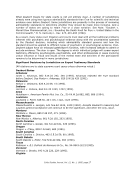
Cotton v. Virginia, 451 S.E.2d 673, 675 (Va. Ct. App. 1994). The Virginia Supreme Court
rejected Frye in Spencer v. Virginia, 393 S.E.2d 609 (1990), cert. denied, 498 U.S. 908
(1990). Spencer test emphasizes reliability.
West Virginia
Wilt v. Buracker, 443 S.E.2d 196, 203 (1993).
Wisconsin
Wisconsin v. Peters, 534 N.W.2d 867, 872 (Wis. App. 1995). Wisconsin rejected the Frye
standard before Daubert. See Watson v. Wisconsin 219 N.W.2d 398, 403 (1974).
Wyoming
Springfield v. Wyoming, 860 P.2d 435, 442, 443 (1993).
Frye States
Alaska
Mattox v. Alaska Revenue Dept, 875 P.2d 763, 764 (1994). General scientific acceptance is
a statutory requirement for admissibility of technical tests in paternity cases. The court uses
Alaska Statute and a common law requirement for scientific evidence where no statute
governs. Cited Pulakios v. Alaska 476 P.2d 474 (1970) (adopting Frye).
California
California v. Leahy, 882 P.2d 321, 331 (1994). The Kelly/Frye standard survives Daubert.
District of Columbia
Taylor v. United States, 661 A.2d 636, 651, 652 (1995).
Florida
Flanagan v. Florida, 625 So. 2d 827, 829 (1993).
Kansas
Kansas v. Warden, 891 P.2d 1074, 1085 (1995). “This court has adopted the Frye test
concerning the admissibility of scientific evidence.” See Kansas v. Witte, 836 P.2d 1110
(1992).
Maryland
Hutton v. Maryland, 663 A.2d 1289, 1296 (1995). Uses Frye/Reed standard. See Reed v.
Maryland, 391 A.2d 364 (1978).
Nebraska
Nebraska v. Dean, 523 N.W.2d 681, 692 (1994).
New York
New York v. Wesley, 633 N.E.2d 451 (1994). Concurring opinion states that all judges
agreed to follow Frye.
Washington
Washington v. Gentry, 888 P.2d 1105, 1117 (1995).
No Decision by a State Supreme Court
Arizona
Arizona v. Bible, 858 P.2d 1152, 1183 (1993). We leave Daubert for another day and apply
Frye.
Colorado
Lindsey v. Colorado, 892 P.2d 281, 288 (1995). Uses Frye standard. The court did not
consider Daubert because the issue was not raised.
Connecticut
Connecticut v. Sivri, 646 A.2d 169, 189 (1994). Uses Frye because neither party asked the
court to change.
Georgia
Orkin Exterminating Co. v. McIntosh, 452 S.E.2d 159, 165 (Ga. App. 1994). “Daubert
involves the application of FRE 702, which has not been adopted in Georgia. The applicable
law in Georgia is OCGA §24-9-67, which provides: „[t]he opinions of experts on any
question of science, skill, trade or like questions shall always be admissible.‟”
Cultic Studies Journal, Vol. 12, No. 1, 1995, page 29
Illinois
Dotto v. Okan, 646 N.E.2d 1277, 1279 (Ill. App. Ct. 1995). Adopts Daubert general
acceptance test is no longer proper.
Kentucky
Tungate v. Kentucky, 901 S.W.2d 41, 43 (1995). Uses Frye.
Michigan
Michigan v. Lee, 537 N.W.2d 233, 248, 249 (Mich. App. 1995). Follows Davis/Frye standard.
See Michigan v. Davis, 72 N.W.2d 269 (1955).
Minnesota
Minnesota v. Klawitter, 518 N.W.2d 577, 578 (1994). “We express no opinion on the
continued validity of the Frye rule in Mn.”
Missouri
Missouri v. Hill, 865 S.W.2d 702, 703 (Mo. App. 1993). Follows Frye.
New Hampshire
New Hampshire v. Cavaliere, 663 A.2d 96, 97 (1995). Court used Daubert standard, but did
not decide whether Frye is still valid.
New Jersey
Bahrle v. Exxon Corp., 652 A.2d 178, 192 (Super. Ct. App. Div. 1995). Follows Daubert.
Ohio
Ohio v. Martens, 629 N.E.2d 462, 466 (Ohio App. 1993). Follows own test: Ohio v. Thomas,
423 N.E.2d 137 (1981). The test asks whether the expert‟s theory is commonly accepted in
the scientific community.
Oklahoma
Taylor v. Oklahoma, 889 P.2d 319, 328 (Ok. Crim. App. 1995). Abandons Frye and adopts
Daubert.
Pennsylvania
Pennsylvania v. Crews, 640 A.2d 395, 400 (1994). Whether Daubert will supersede Frye in
Pa. is left to another day.
Utah
Dikeou v. Osborn, 881 P.2d 943, 946 (Utah App. 1994).
˜˜˜
Acknowledgments
This research project was prepared by the American Bar Association‟s Commission on
Mental and Physical Disability Law (CMPDL) for the American Family Foundation (AFF) and
the Cult Aware-ness Network (CAN). The primary author was David Hominik, CMPDL
director. John Parry provided editorial assistance Laurie Lewis assisted in research. David J.
Bardin of Arent Fox Kintner Plotkin &Kahn, Washington, D.C., guided the project‟s focus
and provided significant editorial comments. Herbert L. Rosedale of Parker Chapin Flattau &
Klimpl, New York City, and William Rehling of Chicago also provided constructive
suggestions during the course of the project. Funding was provided by AFF, CAN, and the
Cult Hot Line and Clinic of the Jewish Board of Family &Children‟s Services (NYC).
The contents of this document are not to be construed as the official policy of the American
Bar Association, the Association‟s Commission on Mental and Physical Disability Law, the
American Family Foundation, or the Cult Awareness Network.
Reproduction of this document in whole or in part may be made without permission
provided no fees or handling costs of any kind are charged. Copies can be obtained by
contacting CMPDL at (202) 662-1575 or at 740 15th Street, N.W., Washington, D.C.
20005-1009 ($10.00 plus postage per individual copy with discounts for multiple copies
available). Copies can also be obtained at the same rate by writing: AFF, P.O. Box 2265,
Previous Page Next Page