Cultic Studies Journal, Vol. 12, No. 1, 1995, page 34
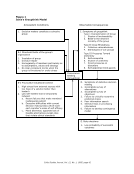
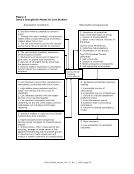
In accordance with Janis‟s model (see Fig. 1, D), the symptoms of defective decision making
by groups with a propensity toward concurrence seeking are couched in procedural terms.
Janis views the six key defects as the group‟s failure to (1) engage in a careful and
complete survey of decision alternatives, (2) complete a survey of the group‟s aims and
objectives prior to making the decision, (3) critically highlight and reexamine the group‟s
preferred choice, (4) engage in a robust information search, (5) remain impartial and clear-
headed in processing information, and (6) develop a contingency model in which
modifications to the decision are made dependent on alternate scenarios. In the groupthink
model, groups that make risky, poor-quality decisions do so not only because they are
cohesive, structurally flawed, and in provocative or stressful situations, but also, because of
these antecedents, group members fail to follow basic procedural logic for making high-
quality decisions.
The groupthink model initially developed by Janis and reviewed in Figure 1 has not only
gained widespread acceptance in academic studies, but the groupthink concept has become
common in everyday parlance as well. Aldag and Fuller, in a review of the idea of
groupthink for professional psychologists, write that “in recent years, acceptance of the
groupthink phenomenon has become almost universal, and the term groupthink has entered
the popular vocabulary” (1993, p. 533). To support their claim, Aldag and Fuller point out
that the Social Sciences Citation Index showed a phenomenally high entry of more than 700
citations of Janis‟s work for the period of January 1989 through June 1992. In a more
popular vein, articles focusing primarily on the dangers of groupthink regularly appear in
such outlets as Psychology Today (Janis, 1971), Nation’s Business (Cerami, 1972), and
Christianity Today (Buss, 1993) and in such professional or applied outlets as the Canadian
Medical Association Journal (Henderson, 1987), the Journal of Nursing Administration
(Rosenblum, 1982), Supervision (Sanders, 1980), and the Journal of Business Ethics (Sims,
1992).
The broad diffusion of Janis‟s model as the model that explains decision-making fiascoes by
groups is caused by four factors. The model is plausibly grounded in real-life situations like
The Bay of Pigs invasion or, more contemporaneously, the Irangate debacle endured by the
Reagan administration (Hart, 1990). Second, it has been argued that the widespread
acceptance of the groupthink model arises from its considerable heuristic value. Aldag and
Fuller (1993) argue that Janis‟s groupthink model, much like Maslow‟s need hierarchy,
provides a highly generalizable but precise and deterministic sequence of stages that can
suit many circumstances.
A third reason for the extensive diffusion of Janis‟s model is its counterintuitive insistence
that group cohesiveness can and does lead to a particular kind of group pathology. Several
social analysts (McCauley, 1989 Neck &Manz, 1994) make it clear that Janis‟s model hits
upon an ambivalence buried deep in the struggle between the ideologies of individualism
harkening back to the frontier thesis and the newly emergent heralding of groups or teams
as the salvation of a crumbling American competitiveness in industry. The view of
groupthink as one of an undesirable phenomenon, its very name evocative of Orwellian
“doublethink,” suggests that Americans have much to fear in losing their hard-won
individualism in the face of what, in Janis‟s hands, can turn out to be the tyranny of a
cohesive and overly conformist majority.
The fourth and last reason for the extensive diffusion or success of the groupthink model is
related to the third reason: the tension in the American psyche between critical forms of
individualism and a longing for the productive efficiency and security of cohesive teams.
Janis‟s indisputable view that groupthink is an undesirable phenomenon is modified by
Janis‟s rather practical suggestion that there exist simple but strong and useful techniques
to minimize the dysfunctional consequences of groupthink. The most pertinent among these
are the following: the group leader should facilitate the group members‟ airing of doubts
In accordance with Janis‟s model (see Fig. 1, D), the symptoms of defective decision making
by groups with a propensity toward concurrence seeking are couched in procedural terms.
Janis views the six key defects as the group‟s failure to (1) engage in a careful and
complete survey of decision alternatives, (2) complete a survey of the group‟s aims and
objectives prior to making the decision, (3) critically highlight and reexamine the group‟s
preferred choice, (4) engage in a robust information search, (5) remain impartial and clear-
headed in processing information, and (6) develop a contingency model in which
modifications to the decision are made dependent on alternate scenarios. In the groupthink
model, groups that make risky, poor-quality decisions do so not only because they are
cohesive, structurally flawed, and in provocative or stressful situations, but also, because of
these antecedents, group members fail to follow basic procedural logic for making high-
quality decisions.
The groupthink model initially developed by Janis and reviewed in Figure 1 has not only
gained widespread acceptance in academic studies, but the groupthink concept has become
common in everyday parlance as well. Aldag and Fuller, in a review of the idea of
groupthink for professional psychologists, write that “in recent years, acceptance of the
groupthink phenomenon has become almost universal, and the term groupthink has entered
the popular vocabulary” (1993, p. 533). To support their claim, Aldag and Fuller point out
that the Social Sciences Citation Index showed a phenomenally high entry of more than 700
citations of Janis‟s work for the period of January 1989 through June 1992. In a more
popular vein, articles focusing primarily on the dangers of groupthink regularly appear in
such outlets as Psychology Today (Janis, 1971), Nation’s Business (Cerami, 1972), and
Christianity Today (Buss, 1993) and in such professional or applied outlets as the Canadian
Medical Association Journal (Henderson, 1987), the Journal of Nursing Administration
(Rosenblum, 1982), Supervision (Sanders, 1980), and the Journal of Business Ethics (Sims,
1992).
The broad diffusion of Janis‟s model as the model that explains decision-making fiascoes by
groups is caused by four factors. The model is plausibly grounded in real-life situations like
The Bay of Pigs invasion or, more contemporaneously, the Irangate debacle endured by the
Reagan administration (Hart, 1990). Second, it has been argued that the widespread
acceptance of the groupthink model arises from its considerable heuristic value. Aldag and
Fuller (1993) argue that Janis‟s groupthink model, much like Maslow‟s need hierarchy,
provides a highly generalizable but precise and deterministic sequence of stages that can
suit many circumstances.
A third reason for the extensive diffusion of Janis‟s model is its counterintuitive insistence
that group cohesiveness can and does lead to a particular kind of group pathology. Several
social analysts (McCauley, 1989 Neck &Manz, 1994) make it clear that Janis‟s model hits
upon an ambivalence buried deep in the struggle between the ideologies of individualism
harkening back to the frontier thesis and the newly emergent heralding of groups or teams
as the salvation of a crumbling American competitiveness in industry. The view of
groupthink as one of an undesirable phenomenon, its very name evocative of Orwellian
“doublethink,” suggests that Americans have much to fear in losing their hard-won
individualism in the face of what, in Janis‟s hands, can turn out to be the tyranny of a
cohesive and overly conformist majority.
The fourth and last reason for the extensive diffusion or success of the groupthink model is
related to the third reason: the tension in the American psyche between critical forms of
individualism and a longing for the productive efficiency and security of cohesive teams.
Janis‟s indisputable view that groupthink is an undesirable phenomenon is modified by
Janis‟s rather practical suggestion that there exist simple but strong and useful techniques
to minimize the dysfunctional consequences of groupthink. The most pertinent among these
are the following: the group leader should facilitate the group members‟ airing of doubts