Cultic Studies Journal, Vol. 12, No. 1, 1995, page 14
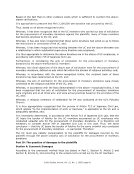
religion clause simultaneously prevents a judge from reaching a decision based on the truth
or falsity of the defendant‟s religious beliefs themselves.
Restrictions on court examination of the veracity of religious beliefs has resulted in the
courts‟ generally finding no liability for fraud-based actions founded solely on statements of
religious belief. The courts will, however, consider statements of a secular nature, including
deceitful concealment of religious affiliation as unprotected by the free exercise clause.
The rights of individuals in society protected by tort law and the rights of individuals in that
society as protected by the freedom to exercise religion clause can collide. With a similar
approach to that taken when considering legislative infringements on religious institutions or
practices, courts in free exercise clause cases have frequently adopted a balancing test-
weighing the state‟s legitimate interest in protecting the public against the legitimate
interest to protect an individual‟s right to religious freedom. Factors in the balancing test
vary. Alleged fraudulent conduct frequently does not fall simply on one side of the scale or
the other, but rests between the religious and secular. The scale itself may be tipped, often
depending on the uniqueness of the institution or its doctrines. But the courts‟ focus should
not be on the truth or falsity of the beliefs nor on the unique or even illogical character of
the beliefs. The inquiry should be on whether the teachings are of the type generally
afforded First Amendment protection. In short, while guideposts have been marked, in
many decisions the determining factors have been the specific factual circumstances of the
case as presented, more than on results from any established constitutional litmus tests.
In 1940, the United States Supreme Court provided an authoritative interpretation of the
freedom to exercise religion clause of the First Amendment which has been adopted in many
tort actions. Cantwell v. Connecticut, 310 U.S. 296 (1940). The Cantwell court found that
the First Amendment‟s protection of religious freedom embraces two essential yet distinct
concepts: (1) the freedom to believe and (2) the freedom to act. The Court further found
that the freedom to believe is absolute, protected from all and any challenges. The freedom
to act on those beliefs, however, has no such absolute protection.
In 1963, the United States Supreme Court in Sherbert v. Verner, 374 U.S. 398 (1963)
expounded on the constitutional protections provided for the free exercise of religion.
Reviewing a state law that prohibited unemployment benefits to persons unavailable to
work every day of the week except Sundays, the Court held that laws which pressure
individuals to abandon their religious precepts must demonstrate that the burdens imposed
on the individuals are the least restrictive means for the state to achieve a compelling
governmental interest.
The Sherbert “compelling state interest” test, with minor interpretations, remained the
standard for evaluating the constitutionality of laws that burdened the free exercise of
religion until 1990. In 1990, a divided Supreme Court abandoned the compelling state
interest standard, at least in part. Employment Div., Dep’t of Human Resources of Oregon v.
Smith, 494 U.S. 872 (1990), reh’ring denied, 110 S. Ct. 2605. The Court held that except in
cases where the law at issue burdens another constitutional right in addition to the free
exercise of religion or where unemployment benefits are conditioned on an applicant‟s
willingness to work under conditions violating his religious beliefs, the lower rational
relationship standard should be substituted for the compelling state interest standard. The
matter before the Employment v. Smith court related to the denial of unemployment
compensation to two Native Americans who were fired from a private drug and alcohol
rehabilitation facility after admitting use of peyote as a sacrament during a religious
ceremony in their Native American Church. The minority disputed the Court‟s attempt to
justify distinguishing between the types of protection provided the freedom to exercise
religion.
religion clause simultaneously prevents a judge from reaching a decision based on the truth
or falsity of the defendant‟s religious beliefs themselves.
Restrictions on court examination of the veracity of religious beliefs has resulted in the
courts‟ generally finding no liability for fraud-based actions founded solely on statements of
religious belief. The courts will, however, consider statements of a secular nature, including
deceitful concealment of religious affiliation as unprotected by the free exercise clause.
The rights of individuals in society protected by tort law and the rights of individuals in that
society as protected by the freedom to exercise religion clause can collide. With a similar
approach to that taken when considering legislative infringements on religious institutions or
practices, courts in free exercise clause cases have frequently adopted a balancing test-
weighing the state‟s legitimate interest in protecting the public against the legitimate
interest to protect an individual‟s right to religious freedom. Factors in the balancing test
vary. Alleged fraudulent conduct frequently does not fall simply on one side of the scale or
the other, but rests between the religious and secular. The scale itself may be tipped, often
depending on the uniqueness of the institution or its doctrines. But the courts‟ focus should
not be on the truth or falsity of the beliefs nor on the unique or even illogical character of
the beliefs. The inquiry should be on whether the teachings are of the type generally
afforded First Amendment protection. In short, while guideposts have been marked, in
many decisions the determining factors have been the specific factual circumstances of the
case as presented, more than on results from any established constitutional litmus tests.
In 1940, the United States Supreme Court provided an authoritative interpretation of the
freedom to exercise religion clause of the First Amendment which has been adopted in many
tort actions. Cantwell v. Connecticut, 310 U.S. 296 (1940). The Cantwell court found that
the First Amendment‟s protection of religious freedom embraces two essential yet distinct
concepts: (1) the freedom to believe and (2) the freedom to act. The Court further found
that the freedom to believe is absolute, protected from all and any challenges. The freedom
to act on those beliefs, however, has no such absolute protection.
In 1963, the United States Supreme Court in Sherbert v. Verner, 374 U.S. 398 (1963)
expounded on the constitutional protections provided for the free exercise of religion.
Reviewing a state law that prohibited unemployment benefits to persons unavailable to
work every day of the week except Sundays, the Court held that laws which pressure
individuals to abandon their religious precepts must demonstrate that the burdens imposed
on the individuals are the least restrictive means for the state to achieve a compelling
governmental interest.
The Sherbert “compelling state interest” test, with minor interpretations, remained the
standard for evaluating the constitutionality of laws that burdened the free exercise of
religion until 1990. In 1990, a divided Supreme Court abandoned the compelling state
interest standard, at least in part. Employment Div., Dep’t of Human Resources of Oregon v.
Smith, 494 U.S. 872 (1990), reh’ring denied, 110 S. Ct. 2605. The Court held that except in
cases where the law at issue burdens another constitutional right in addition to the free
exercise of religion or where unemployment benefits are conditioned on an applicant‟s
willingness to work under conditions violating his religious beliefs, the lower rational
relationship standard should be substituted for the compelling state interest standard. The
matter before the Employment v. Smith court related to the denial of unemployment
compensation to two Native Americans who were fired from a private drug and alcohol
rehabilitation facility after admitting use of peyote as a sacrament during a religious
ceremony in their Native American Church. The minority disputed the Court‟s attempt to
justify distinguishing between the types of protection provided the freedom to exercise
religion.