Cultic Studies Review, Vol. 1, No. 2, 2002, Page 124
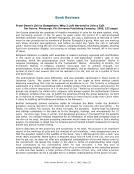
Despite some serious shortcomings, the book does reflect increased understanding from a
variety of scholarly perspectives. Before I consider some of the specific strengths and flaws
of Misunderstanding Cults, here is my summary evaluation of its major characteristics on a
scale from A to F: Objectivity --B+ Readability --C+ Editing --C- and References --A-.
Psychologist Benjamin Beit-Hallahmi‘s excellent chapter on recent failures by distinguished
scholars to maintain integrity is followed by Robbins‘ defense of those who say they
advocate balance and fairness toward controversial new religions.
Sociologist Susan J. Palmer confesses that her ethnographic studies of the Rajneeshes, the
Family, and other groups were fueled by a passion to learn about them in depth. In
contrast, sociologist and former cultist Janja Lalich highlights clearly and comprehensively
some of the difficulties in studying ―charisma, power, …secrets, and obfuscation.‖
Zablocki, after 35 years observing communes, makes an eloquent case for a scientific
theory of brainwashing. Forensic and clinical psychologist Dick Anthony responds at length
(42 footnotes!), redundantly, and as if in court by dubbing Zablocki‘s testable hypotheses
―pseudoscience.‖ (I wished for a rejoinder by Margaret Singer or Robert Lifton.) In a clearly
written, concise examination of the two theories, brainwashing and conversion, sociologist
David Bromley shows how research on new religions can serve political objectives that
distort objectivity.
After years of observing the Family/Children of God and Scientology, sociologist Stephen
Kent summarizes documented instances of severe physical harm to the adolescent children
of cult members accompanied by ―brainwashing programs.‖ In response, sociologist Lorne L.
Dawson alleges that Kent and Zablocki misrepresented information obtained from biased
―apostates.‖ Sociologist and former therapy cult member Amy Siskind describes graphically
the abuse of children raised in five totalist groups.
Sociologist Julius H. Rubin is persuasive in his presentation of a case study: the conflict
between the Bruderhof (a pacifist Christian group) and its critics. Author and educator
Jeffrey Kaplan‘s chapter on religious violence in America concludes the volume. In his view,
the incidents of murder or/and suicide at Waco, Jonestown, Heaven‘s Gate, and in Christian
far-right groups were basically defensive rather than expansionary.
These chapters vary in readability. Readers unversed in sociological jargon might find some
chapters tedious. When no supportive data accompanied theory or interpretation, my
interest drooped.
Misunderstanding Cults enhanced my appreciation for ethnography, observation, and
narrative as methods for uncovering the complexities of the new religions. If, however,
there is a second edition, I recommend further editing: Add an index proofread for sloppy
errors (e.g., ―Anson Schupe‖ instead of ―Shupe,‖ p. 513) encourage contributors to
respond directly to one another rather than solely to previous publications that the reader
may not have at hand. And make sure all the authors specify possible sources of bias. Use
this reviewer as an example. That I am the father of a former ―missionary‖ for the
Unification Church, a secular Christian, and a psychologist influence my perspectives.
Finally, a less technical and more reader-friendly approach might extend the book‘s value.
The book‘s references and appendix are invaluable to serious scholars. These elements
include some of the best work from the various perspectives, and they are balanced. For
instance, cult critics cited the early research of Eileen Barker and John Lofland. And the cult
sympathizers frequently mentioned the Cultic Studies Journal and Robert Lifton. Such
examples represent a step toward understanding.
Arthur A. Dole, Ph.D., A.B.P.P.
Trenton, Maine
Despite some serious shortcomings, the book does reflect increased understanding from a
variety of scholarly perspectives. Before I consider some of the specific strengths and flaws
of Misunderstanding Cults, here is my summary evaluation of its major characteristics on a
scale from A to F: Objectivity --B+ Readability --C+ Editing --C- and References --A-.
Psychologist Benjamin Beit-Hallahmi‘s excellent chapter on recent failures by distinguished
scholars to maintain integrity is followed by Robbins‘ defense of those who say they
advocate balance and fairness toward controversial new religions.
Sociologist Susan J. Palmer confesses that her ethnographic studies of the Rajneeshes, the
Family, and other groups were fueled by a passion to learn about them in depth. In
contrast, sociologist and former cultist Janja Lalich highlights clearly and comprehensively
some of the difficulties in studying ―charisma, power, …secrets, and obfuscation.‖
Zablocki, after 35 years observing communes, makes an eloquent case for a scientific
theory of brainwashing. Forensic and clinical psychologist Dick Anthony responds at length
(42 footnotes!), redundantly, and as if in court by dubbing Zablocki‘s testable hypotheses
―pseudoscience.‖ (I wished for a rejoinder by Margaret Singer or Robert Lifton.) In a clearly
written, concise examination of the two theories, brainwashing and conversion, sociologist
David Bromley shows how research on new religions can serve political objectives that
distort objectivity.
After years of observing the Family/Children of God and Scientology, sociologist Stephen
Kent summarizes documented instances of severe physical harm to the adolescent children
of cult members accompanied by ―brainwashing programs.‖ In response, sociologist Lorne L.
Dawson alleges that Kent and Zablocki misrepresented information obtained from biased
―apostates.‖ Sociologist and former therapy cult member Amy Siskind describes graphically
the abuse of children raised in five totalist groups.
Sociologist Julius H. Rubin is persuasive in his presentation of a case study: the conflict
between the Bruderhof (a pacifist Christian group) and its critics. Author and educator
Jeffrey Kaplan‘s chapter on religious violence in America concludes the volume. In his view,
the incidents of murder or/and suicide at Waco, Jonestown, Heaven‘s Gate, and in Christian
far-right groups were basically defensive rather than expansionary.
These chapters vary in readability. Readers unversed in sociological jargon might find some
chapters tedious. When no supportive data accompanied theory or interpretation, my
interest drooped.
Misunderstanding Cults enhanced my appreciation for ethnography, observation, and
narrative as methods for uncovering the complexities of the new religions. If, however,
there is a second edition, I recommend further editing: Add an index proofread for sloppy
errors (e.g., ―Anson Schupe‖ instead of ―Shupe,‖ p. 513) encourage contributors to
respond directly to one another rather than solely to previous publications that the reader
may not have at hand. And make sure all the authors specify possible sources of bias. Use
this reviewer as an example. That I am the father of a former ―missionary‖ for the
Unification Church, a secular Christian, and a psychologist influence my perspectives.
Finally, a less technical and more reader-friendly approach might extend the book‘s value.
The book‘s references and appendix are invaluable to serious scholars. These elements
include some of the best work from the various perspectives, and they are balanced. For
instance, cult critics cited the early research of Eileen Barker and John Lofland. And the cult
sympathizers frequently mentioned the Cultic Studies Journal and Robert Lifton. Such
examples represent a step toward understanding.
Arthur A. Dole, Ph.D., A.B.P.P.
Trenton, Maine