Cultic Studies Review, Vol. 1, No. 2, 2002, Page 122
9. Finally, this grouping includes five articles about ―witch cults.‖ Ritual killing and witch
trials are the central focus. Wicca and neo-Paganism are excluded from the group except for
a reference to the ―stereotypical witches of the 17th century being vastly different from
those of the 20th century.‖ Further separation of such harmless ―new religions‖ from ―killer
cults‖ would have been helpful.
The book concludes with a ―webography‖ of Internet Websites a ―select bibliography‖ of
relevant books published from 1807 to 1996 and an 11-page, two-column, combined name
and subject index.
The value of this book is mainly in its many case studies. Its major weakness is a lack of
information about the psychology and personality dynamics of cult leaders and their
followers.
Frank MacHovec, Ph.D.
Center for the Study of the Self
Gloucester, Virginia
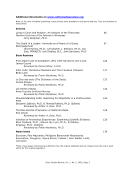
Le Dico des sectes (The Dictionary of the Sects)
Edited by Annick Drogou. Toulouse, France: Editions Milan, 1998, 255
pages.
This pocket-sized, paperback ―dictionary of the sects‖ is edited by Annick Drogou who is
Director of Publications of the Roger Ikor Centre, founded in 1981 to study ―mental
manipulation‖ by cults and sects. The dictionary defines cults as new religions it defines
sects as separatist minorities in more established religions. Terms in the dictionary are
arranged in alphabetical order from AAO, an Austrian group, to Zetetique, a spin-off of
Pyrrhonist skepticism. Many groups listed are obscure or known mainly in France.
The book is unusual in that it lists major historical religious movements along with recent,
sometimes strictly French, cult groups. This combination over-reaches and weakens the
content. The reference would be more useful had it spent additional space on major and
some minor cults and cult-like groups, and less on diverse terms such as agnosticism,
atheism, fundamentalism, heresy, and schism. Other terms, such as anthropology,
apparition, Bible, Brahmanism, confession, contemplation, fundamentalism, heresy,
Internet, jargon, meditation, and vegetarianism, could have been omitted. Some specialized
clinical terms, such as depersonalization, depression, and fetishism, are defined.
The Cathari and Manicheism are listed, but these two of many early Christian heresies,
along with alchemy, Druidism, and Theosophy, are not widely encountered today. Some
readers also might take exception to the inclusion of the terms Amish, Mormonism, and
Taoism and of therapies such as Lowen‘s bioenergetics, biofeedback, Janov‘s primal
scream, and Perl‘s gestalt therapy. graphology and numerology are included but have little
relevance to current cult practices.
On the positive side, the book does describe recent cult-like behaviors such as those
observed in David Koresh‘s Davidians and Heaven‘s Gate followers but it does not say
anything about the Peoples‘ Temple. Other terms are appropriate and their definitions
helpful, such as auditing (Scientology) and deprogramming. The book includes a 2-page
bibliography of French publications (1980 to 1998), and a useful 14-page, two-column
index.
Overall, the book covers too much ground too briefly and it is published only in French
reserves access to a limited audience.
Frank MacHovec, Ph.D.
9. Finally, this grouping includes five articles about ―witch cults.‖ Ritual killing and witch
trials are the central focus. Wicca and neo-Paganism are excluded from the group except for
a reference to the ―stereotypical witches of the 17th century being vastly different from
those of the 20th century.‖ Further separation of such harmless ―new religions‖ from ―killer
cults‖ would have been helpful.
The book concludes with a ―webography‖ of Internet Websites a ―select bibliography‖ of
relevant books published from 1807 to 1996 and an 11-page, two-column, combined name
and subject index.
The value of this book is mainly in its many case studies. Its major weakness is a lack of
information about the psychology and personality dynamics of cult leaders and their
followers.
Frank MacHovec, Ph.D.
Center for the Study of the Self
Gloucester, Virginia
Le Dico des sectes (The Dictionary of the Sects)
Edited by Annick Drogou. Toulouse, France: Editions Milan, 1998, 255
pages.
This pocket-sized, paperback ―dictionary of the sects‖ is edited by Annick Drogou who is
Director of Publications of the Roger Ikor Centre, founded in 1981 to study ―mental
manipulation‖ by cults and sects. The dictionary defines cults as new religions it defines
sects as separatist minorities in more established religions. Terms in the dictionary are
arranged in alphabetical order from AAO, an Austrian group, to Zetetique, a spin-off of
Pyrrhonist skepticism. Many groups listed are obscure or known mainly in France.
The book is unusual in that it lists major historical religious movements along with recent,
sometimes strictly French, cult groups. This combination over-reaches and weakens the
content. The reference would be more useful had it spent additional space on major and
some minor cults and cult-like groups, and less on diverse terms such as agnosticism,
atheism, fundamentalism, heresy, and schism. Other terms, such as anthropology,
apparition, Bible, Brahmanism, confession, contemplation, fundamentalism, heresy,
Internet, jargon, meditation, and vegetarianism, could have been omitted. Some specialized
clinical terms, such as depersonalization, depression, and fetishism, are defined.
The Cathari and Manicheism are listed, but these two of many early Christian heresies,
along with alchemy, Druidism, and Theosophy, are not widely encountered today. Some
readers also might take exception to the inclusion of the terms Amish, Mormonism, and
Taoism and of therapies such as Lowen‘s bioenergetics, biofeedback, Janov‘s primal
scream, and Perl‘s gestalt therapy. graphology and numerology are included but have little
relevance to current cult practices.
On the positive side, the book does describe recent cult-like behaviors such as those
observed in David Koresh‘s Davidians and Heaven‘s Gate followers but it does not say
anything about the Peoples‘ Temple. Other terms are appropriate and their definitions
helpful, such as auditing (Scientology) and deprogramming. The book includes a 2-page
bibliography of French publications (1980 to 1998), and a useful 14-page, two-column
index.
Overall, the book covers too much ground too briefly and it is published only in French
reserves access to a limited audience.
Frank MacHovec, Ph.D.