Cultic Studies Review, Vol. 1, No. 2, 2002, Page 12
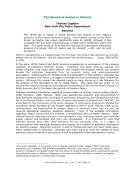
The Spread of Ásatrú in Vinland
Thomas Coghlan
New York City Police Department
Abstract
The 1970s saw a rebirth in North America and Iceland of the religious
practices of pre-historic Northern Europe. This modern version of the faith,
known as Ásatrú, has grown significantly since its rebirth, although it has
struggled with and been vilified because of destructive tendencies within the
faith. This paper seeks to illuminate the historical and ideological differences
between the benign faith of Ásatrú and its racialist1, cultic, and terrorist
deviations.
Wotan’s reawakening is a stepping back into the past the stream was dammed up and has
broken into its old channel. But the obstruction will not last forever... (Jung, 1936/1978,
p. 192)
In the early 1970s Iceland and North America experienced an emergence of the religious
traditions of prehistoric Northern Europe. Extending into South America, Canada, the
United Kingdom, and many other nations, this religion has enjoyed rebirth and renewal
despite the vilification stemming from its terrorist, cultic, and white-supremacist
associations. Unfortunately for its adherents, the defamation of this religion‘s character has
become a shadow from which it struggles to emerge into the conventional light of American
society. Although this religion has adopted nearly as many names as it has followers, for
the purpose of this discussion it will be called Ásatrú. This paper has two goals: (1) to
explore the historical emergence and dogmatic polarization of the various Ásatrú factions in
North America, and (2) to depict the diversity of modern Ásatrú.
Although academic information regarding modern Ásatrú is lacking, several authors (Byock,
1988 Davidson, 1988 Metzner, 1994) have detailed the evolution and diversification of
Indo-European theology from its origins in prehistory, through the pre-Christian era and the
fall of the Roman Empire, and up to the Christian conversion of Iceland circa 1000 AD. An
exact date for this conversion is not given, because ―a controversy exists as to whether the
conversion should be dated by our modern calendar to 999 or 1000‖ (Byock, 1988, p.11).
Unfortunately, the examination of modern Ásatrú is relatively novel and has not yet
received substantial objective, academic attention. Much of the available information
regarding Ásatrú comes from the Internet, a troublesome and unreliable medium. While
Internet sources have been utilized in this discussion, they have been drawn upon with the
proper caution and foresight that their use necessitates. It is important to note that
Internet sources have been used primarily for two purposes: first, as a means of
communication with individual believers, and second, as a method of gathering intelligence
on existing groups. Electronic sources in and of themselves have not been relied upon,
either academically or otherwise. Attempts have been made to verify the validity of those
electronic sources that were used due to a lack of availability of the document(s) in print.
1 The word "racialism" is a common term in heathen political circles. Kaplan (1997) and other
authorities use it liberally. The difference between ―racialism‖ and ―racist‖ is more than simply
semantic. Racialism is a specific belief that only those of certain bloodlines either a) should be allowed
to practice Germanic or Northern Paganism, or b) have the ability (related to a belief in a religious
collective unconscious) to interface with the gods.
The Spread of Ásatrú in Vinland
Thomas Coghlan
New York City Police Department
Abstract
The 1970s saw a rebirth in North America and Iceland of the religious
practices of pre-historic Northern Europe. This modern version of the faith,
known as Ásatrú, has grown significantly since its rebirth, although it has
struggled with and been vilified because of destructive tendencies within the
faith. This paper seeks to illuminate the historical and ideological differences
between the benign faith of Ásatrú and its racialist1, cultic, and terrorist
deviations.
Wotan’s reawakening is a stepping back into the past the stream was dammed up and has
broken into its old channel. But the obstruction will not last forever... (Jung, 1936/1978,
p. 192)
In the early 1970s Iceland and North America experienced an emergence of the religious
traditions of prehistoric Northern Europe. Extending into South America, Canada, the
United Kingdom, and many other nations, this religion has enjoyed rebirth and renewal
despite the vilification stemming from its terrorist, cultic, and white-supremacist
associations. Unfortunately for its adherents, the defamation of this religion‘s character has
become a shadow from which it struggles to emerge into the conventional light of American
society. Although this religion has adopted nearly as many names as it has followers, for
the purpose of this discussion it will be called Ásatrú. This paper has two goals: (1) to
explore the historical emergence and dogmatic polarization of the various Ásatrú factions in
North America, and (2) to depict the diversity of modern Ásatrú.
Although academic information regarding modern Ásatrú is lacking, several authors (Byock,
1988 Davidson, 1988 Metzner, 1994) have detailed the evolution and diversification of
Indo-European theology from its origins in prehistory, through the pre-Christian era and the
fall of the Roman Empire, and up to the Christian conversion of Iceland circa 1000 AD. An
exact date for this conversion is not given, because ―a controversy exists as to whether the
conversion should be dated by our modern calendar to 999 or 1000‖ (Byock, 1988, p.11).
Unfortunately, the examination of modern Ásatrú is relatively novel and has not yet
received substantial objective, academic attention. Much of the available information
regarding Ásatrú comes from the Internet, a troublesome and unreliable medium. While
Internet sources have been utilized in this discussion, they have been drawn upon with the
proper caution and foresight that their use necessitates. It is important to note that
Internet sources have been used primarily for two purposes: first, as a means of
communication with individual believers, and second, as a method of gathering intelligence
on existing groups. Electronic sources in and of themselves have not been relied upon,
either academically or otherwise. Attempts have been made to verify the validity of those
electronic sources that were used due to a lack of availability of the document(s) in print.
1 The word "racialism" is a common term in heathen political circles. Kaplan (1997) and other
authorities use it liberally. The difference between ―racialism‖ and ―racist‖ is more than simply
semantic. Racialism is a specific belief that only those of certain bloodlines either a) should be allowed
to practice Germanic or Northern Paganism, or b) have the ability (related to a belief in a religious
collective unconscious) to interface with the gods.