Cultic Studies Journal, Vol. 6, No. 1, 1989, Page 74
leave a reader with a smorgasbord of bits and pieces of theories and the feeling that
Galanter does not consistently analyze his material, especially as he hesitates early on in
the book to deal with the known, active recruiting tactics of the groups he has studied.
Before commenting on his efforts to apply many theories without truly seeming to
understand how social influence actually operates, and offering little or no grasp of its
“psychology,” which he contends is his goal in the book, it is well to inspect his
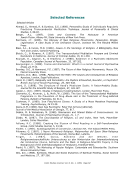
“bibliography” (which actually is a reference list). The citings are relatively outdated.
Eighty percent were published before 1980. This is a real defect since the fields he purports
to draw upon (systems theory, sociobiology, drug and alcohol abuse, and cult and terrorist
studies) are each fast-developing fields with vast literatures accruing since 1980. Beyond
being outdated, the references reflect a narrow and selective coverage of the fields. He
cites only one reference on terrorists and fails to include a single work written by an ex-
member of any cult. Further, from the vast array of books about cults, he notes only
Conway and Siegelman. Thus, his references are dated, narrow, and nonrepresentative of
the areas he purports to consider. In analyzing his premises and theses, one comes to see
that in order to apply his selected ideas from theoretical fields, he had to avoid
acknowledging a vast literature or he would have had quite a different book.
The index contains no headings labeled “cults, coercion, faith, or healing” the terms in the
book title. In the text he applies the term “cult” only to small groups with little threat
power, (the Word of God, p.108), writes of cults in the abstract, or labels now defunct
groups such as the Peoples Temple, MOVE, the Manson Family, and Black Jesus as cults
(p.192). Knowing the threat power of some of the large groups he terms sects, almost any
author and publisher today attempts to avoid pre- and post-publication legal harassments.
Perhaps now the terms sect or even charismatic group will become touchy ones.
Galanter writes in the preface that he found the study of “contemporary charismatic groups”
compelling “because of the remarkable ability of these groups to exert influence on the
thought and behavior of their members, often greater than our most potent treatments. An
understanding of the „cult‟ phenomenon might offer valuable insights in areas as diverse as
the treatment of mental illness and the understanding of group violence.” He then outlines
the various theories and paradigms he used in his work, such as systems theory,
sociobiology, and ethology.
Each of the above theories is based on a process-oriented, transactional vantage point. In
studying a process, it is essential to heed the time, the circumstances, and the context in
which any transaction between persons or systems occurs. A researcher must remain
aware of where in an ongoing process he/she begins observing. Each theory Galanter relies
on assumes a researcher is aware that he/she is cutting into an ongoing transactional
process in which the researcher must take into account the prior states of the components
of the system and the interaction process that begins upon contact. Sociobiology, systems
theory, etc. each assumes a researcher has accurately noted the process between
components at the point the researcher begins his observations and deals with the
interaction effects one upon the other among the components. Once committed to his
notion of the “relief effect,” Galanter absolves the group from any active part in getting the
member into the group. Thus, to Galanter, the new member was a distressed seeker who
found a group. Let us look at an analogy.
Assume a woman is home watching television. The doorbell rings and an encyclopedia
salesman introduces himself and his wares. Assume further that the salesman is able to sell
a set of encyclopedias to the woman. Any analysis of this transaction or process, be it by
the man next door, a systems theorist, a sociobiologist, etc., will note the salesman initiated
the transaction. The woman did not go out seeking an encyclopedia salesman. Yet
Galanter begins most of his analyses of membership in “charismatic groups” after a person
leave a reader with a smorgasbord of bits and pieces of theories and the feeling that
Galanter does not consistently analyze his material, especially as he hesitates early on in
the book to deal with the known, active recruiting tactics of the groups he has studied.
Before commenting on his efforts to apply many theories without truly seeming to
understand how social influence actually operates, and offering little or no grasp of its
“psychology,” which he contends is his goal in the book, it is well to inspect his
“bibliography” (which actually is a reference list). The citings are relatively outdated.
Eighty percent were published before 1980. This is a real defect since the fields he purports
to draw upon (systems theory, sociobiology, drug and alcohol abuse, and cult and terrorist
studies) are each fast-developing fields with vast literatures accruing since 1980. Beyond
being outdated, the references reflect a narrow and selective coverage of the fields. He
cites only one reference on terrorists and fails to include a single work written by an ex-
member of any cult. Further, from the vast array of books about cults, he notes only
Conway and Siegelman. Thus, his references are dated, narrow, and nonrepresentative of
the areas he purports to consider. In analyzing his premises and theses, one comes to see
that in order to apply his selected ideas from theoretical fields, he had to avoid
acknowledging a vast literature or he would have had quite a different book.
The index contains no headings labeled “cults, coercion, faith, or healing” the terms in the
book title. In the text he applies the term “cult” only to small groups with little threat
power, (the Word of God, p.108), writes of cults in the abstract, or labels now defunct
groups such as the Peoples Temple, MOVE, the Manson Family, and Black Jesus as cults
(p.192). Knowing the threat power of some of the large groups he terms sects, almost any
author and publisher today attempts to avoid pre- and post-publication legal harassments.
Perhaps now the terms sect or even charismatic group will become touchy ones.
Galanter writes in the preface that he found the study of “contemporary charismatic groups”
compelling “because of the remarkable ability of these groups to exert influence on the
thought and behavior of their members, often greater than our most potent treatments. An
understanding of the „cult‟ phenomenon might offer valuable insights in areas as diverse as
the treatment of mental illness and the understanding of group violence.” He then outlines
the various theories and paradigms he used in his work, such as systems theory,
sociobiology, and ethology.
Each of the above theories is based on a process-oriented, transactional vantage point. In
studying a process, it is essential to heed the time, the circumstances, and the context in
which any transaction between persons or systems occurs. A researcher must remain
aware of where in an ongoing process he/she begins observing. Each theory Galanter relies
on assumes a researcher is aware that he/she is cutting into an ongoing transactional
process in which the researcher must take into account the prior states of the components
of the system and the interaction process that begins upon contact. Sociobiology, systems
theory, etc. each assumes a researcher has accurately noted the process between
components at the point the researcher begins his observations and deals with the
interaction effects one upon the other among the components. Once committed to his
notion of the “relief effect,” Galanter absolves the group from any active part in getting the
member into the group. Thus, to Galanter, the new member was a distressed seeker who
found a group. Let us look at an analogy.
Assume a woman is home watching television. The doorbell rings and an encyclopedia
salesman introduces himself and his wares. Assume further that the salesman is able to sell
a set of encyclopedias to the woman. Any analysis of this transaction or process, be it by
the man next door, a systems theorist, a sociobiologist, etc., will note the salesman initiated
the transaction. The woman did not go out seeking an encyclopedia salesman. Yet
Galanter begins most of his analyses of membership in “charismatic groups” after a person