Cultic Studies Journal, Vol. 13, No. 1, 1996, page 40
patient recollections of abuse from the therapeutic context to interactions with persons
meaningfully involved with the patient outside therapy. Given the fictive nature of the
narrative developed in psychotherapy (Spence, 1982), this is simplistic, naïve, and
unfortunate.
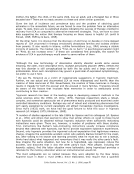
Psychotherapy is an influence process. Whether we talk of that influence process in terms of
transference or the social psychology of persuasion and attitude change, it remains an
intense dialogue in which a doctor seeks to influence the patient, and frequently succeeds.
In what Perls (1965) called the “safe emergency” of the therapeutic encounter, the patient
often seeks to please the doctor. An obvious way to please doctors is to adopt their view of
one‟s problems. The pressure on patients to do so is ordinarily far more long-lasting and
often more intense than that found in investigative contexts. After all, the patient and
therapist will be back together next week and the patient has to confront the doctor then as
well as now. So demand characteristics and expectancy effects play major parts in
determining what information the patient will provide (Orne, 1970). It is an old therapy
adage that Freudian patients dream Freudian dreams, Jungian patients dream Jungian
dreams, and behavior therapy patients don‟t dream. Similarly, patients of recovered
memory therapists dream about and/or remember ICA.
Satanic Ritual Abuse and Early Incestuous Child Abuse: Iatrogenic Fantasies?
Recently, Harvey and Herman (1994) distinguished three prototypical groups of patients.
Patients in the first group report “largely intact and continuous remembrance of their abuse
experiences.... and a lifting, not of amnesia, but of the veil of denial and minimization that
enabled them to preserve secrecy and illusion.” The second type of patient has spotty
memories of abuse. The onset of abuse, its escalation, and the entire period of early
childhood are likely targets of amnesia. Finally, the third type of patient begins therapy with
no memories of abuse. When memory is “recovered,” such patients report “severe and
repeated sexual and physical abuse, beginning in early childhood and continuing into early
adolescence.... Most reported witnessing family violence as well and many reported abuse
by more than one perpetrator” (Harvey &Herman, 1994, pp. 302B303).
While this nosology remains unproven and is certainly incomplete (cf. Pezdek, 1994),
problems with the interpretation of data from each group can be identified if the nosology is
momentarily accepted as a heuristic device. For example, the reinterpretation required by
the first group raises the question of how such interpretation shall be accomplished and by
whom. Similarly, when the second group tries to fill in critical gaps in memory, the
possibility that hypnosis and similar techniques will produce confabulation is high and the
situation becomes rife with the possibility of iatrogenic memory creation based on
suggestion, demand, and expectancy effects. That is, in both cases the credible extension of
memories into detailed events is likely to result in pseudoconfirmation of ambiguous
thoughts and ambivalent feelings as memories of ICA.
Joan Borawick belongs in the third group, apparently reporting both a history of total
amnesia and bizarre memories of satanic ritual abuse (SRA), multiple perpetrators, and
early incestuous abuse. Recent, clear memories may constrain fantasies to some degree,
but as an event becomes more remote and memory more vague and/or spotty, there is
more room for confabulation. Lack of any memory for an event provides a blank screen on
which one can project anything (Loftus &Ketcham, 1994). Thus, if the amnesia is more
pervasive, more questions are raised by those concerned with false memories (cf. Dawes,
1992 Frankel, 1993 Loftus, 1993 Tavris, 1993). This is not to say that patients reporting
more spotty amnesia are not confabulating and fantasizing. Many certainly are. But when
hypnosis has been used to elicit memories for which the patient was originally totally
amnesic, even greater concern arises about iatrogenic factors. Borderline personality,
multiple personality disorder (MPD), multiple perpetrators, SRA, and memories of very early
patient recollections of abuse from the therapeutic context to interactions with persons
meaningfully involved with the patient outside therapy. Given the fictive nature of the
narrative developed in psychotherapy (Spence, 1982), this is simplistic, naïve, and
unfortunate.
Psychotherapy is an influence process. Whether we talk of that influence process in terms of
transference or the social psychology of persuasion and attitude change, it remains an
intense dialogue in which a doctor seeks to influence the patient, and frequently succeeds.
In what Perls (1965) called the “safe emergency” of the therapeutic encounter, the patient
often seeks to please the doctor. An obvious way to please doctors is to adopt their view of
one‟s problems. The pressure on patients to do so is ordinarily far more long-lasting and
often more intense than that found in investigative contexts. After all, the patient and
therapist will be back together next week and the patient has to confront the doctor then as
well as now. So demand characteristics and expectancy effects play major parts in
determining what information the patient will provide (Orne, 1970). It is an old therapy
adage that Freudian patients dream Freudian dreams, Jungian patients dream Jungian
dreams, and behavior therapy patients don‟t dream. Similarly, patients of recovered
memory therapists dream about and/or remember ICA.
Satanic Ritual Abuse and Early Incestuous Child Abuse: Iatrogenic Fantasies?
Recently, Harvey and Herman (1994) distinguished three prototypical groups of patients.
Patients in the first group report “largely intact and continuous remembrance of their abuse
experiences.... and a lifting, not of amnesia, but of the veil of denial and minimization that
enabled them to preserve secrecy and illusion.” The second type of patient has spotty
memories of abuse. The onset of abuse, its escalation, and the entire period of early
childhood are likely targets of amnesia. Finally, the third type of patient begins therapy with
no memories of abuse. When memory is “recovered,” such patients report “severe and
repeated sexual and physical abuse, beginning in early childhood and continuing into early
adolescence.... Most reported witnessing family violence as well and many reported abuse
by more than one perpetrator” (Harvey &Herman, 1994, pp. 302B303).
While this nosology remains unproven and is certainly incomplete (cf. Pezdek, 1994),
problems with the interpretation of data from each group can be identified if the nosology is
momentarily accepted as a heuristic device. For example, the reinterpretation required by
the first group raises the question of how such interpretation shall be accomplished and by
whom. Similarly, when the second group tries to fill in critical gaps in memory, the
possibility that hypnosis and similar techniques will produce confabulation is high and the
situation becomes rife with the possibility of iatrogenic memory creation based on
suggestion, demand, and expectancy effects. That is, in both cases the credible extension of
memories into detailed events is likely to result in pseudoconfirmation of ambiguous
thoughts and ambivalent feelings as memories of ICA.
Joan Borawick belongs in the third group, apparently reporting both a history of total
amnesia and bizarre memories of satanic ritual abuse (SRA), multiple perpetrators, and
early incestuous abuse. Recent, clear memories may constrain fantasies to some degree,
but as an event becomes more remote and memory more vague and/or spotty, there is
more room for confabulation. Lack of any memory for an event provides a blank screen on
which one can project anything (Loftus &Ketcham, 1994). Thus, if the amnesia is more
pervasive, more questions are raised by those concerned with false memories (cf. Dawes,
1992 Frankel, 1993 Loftus, 1993 Tavris, 1993). This is not to say that patients reporting
more spotty amnesia are not confabulating and fantasizing. Many certainly are. But when
hypnosis has been used to elicit memories for which the patient was originally totally
amnesic, even greater concern arises about iatrogenic factors. Borderline personality,
multiple personality disorder (MPD), multiple perpetrators, SRA, and memories of very early