Cultic Studies Journal, Vol. 13, No. 1, 1996, page 18
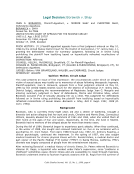
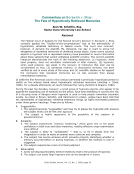
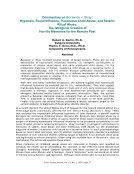
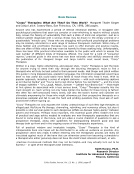
Commentary on Borawick v. Shay:
The Fate of Hypnotically Retrieved Memories
Alan W. Scheflin, Esq.
Santa Clara University Law School
Abstract
The Federal Court of Appeals for the Second Circuit‟s decision in Borawick v. Shay
correctly applied the “totality-of-the-circumstances” test to the admissibility of
hypnotically refreshed testimony in federal courts. The court was incorrect,
however, in denying the plaintiff, Ms. Borawick, her day in court to prove her
allegations of repressed memories of childhood sexual abuse. Some overly cautious
experts in hypnosis and in repressed memory have presented to courts information
about these subjects that cannot withstand scientific scrutiny. The current scientific
literature demonstrates the truth of the following assertions: (1) hypnosis, when
used properly, does not inevitably contaminate or alter memory, (2) hypnosis,
when used properly, can assist in the recovery of memories that later can be
corroborated as true, (3) repressed memory, or dissociative amnesia, has been
verified as real in every study of the issue, and (4) scientific studies so far support
the conclusion that repressed memories are no less accurate than always
remembered memories.
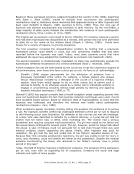
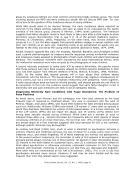
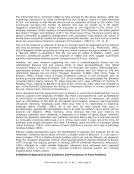
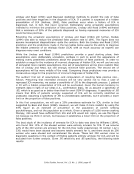
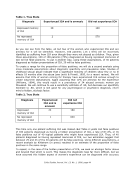
In 1968 the first American court in this century permitted a previously hypnotized person to
testify on the witness stand about hypnotically refreshed memories (Harding v. State,
1968). For a decade afterwards, all courts followed this ruling (Scheflin &Shapiro, 1989).
During the past two decades, however, a small group of hypnosis experts, who appear to be
against the expanding use of hypnosis by the police, have been testifying in court to the risk
of a dizzying array of dangers when hypnosis is used to help people remember traumatic
events. As noted in Brown, Scheflin, and Hammond (in press), judges have been told that
the admissibility of hypnotically refreshed testimony brings up eight interrelated problems
under three generic headings. These are as follows:
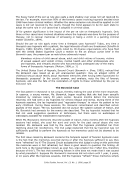
A. Suggestibility
1. The subject becomes “suggestible” and may try to please the hypnotist with answers
the subject thinks will be met with approval
2. The subject is highly responsive to the possibility of the creation of
pseudomemories
B. Reliability
3. The subject experiences “memory hardening,” which gives him or her great
confidence in both true and false memories, making effective cross-examination
more difficult
4. The subject is likely to “confabulate” --that is, to fill in details from the
imagination in order to make an answer more coherent and complete
5. The subject has source amnesia which prevents properly identifying whether a
memory occurred before or during hypnosis, or whether the memory is real or
suggested
6. The subject experiences a loss of critical judgment
C. Believability
7. Juries will disproportionately believe testimony that is the product of hypnosis
8. The subject can easily feign hypnosis and can be deceptive in trance
Commentary on Borawick v. Shay:
The Fate of Hypnotically Retrieved Memories
Alan W. Scheflin, Esq.
Santa Clara University Law School
Abstract
The Federal Court of Appeals for the Second Circuit‟s decision in Borawick v. Shay
correctly applied the “totality-of-the-circumstances” test to the admissibility of
hypnotically refreshed testimony in federal courts. The court was incorrect,
however, in denying the plaintiff, Ms. Borawick, her day in court to prove her
allegations of repressed memories of childhood sexual abuse. Some overly cautious
experts in hypnosis and in repressed memory have presented to courts information
about these subjects that cannot withstand scientific scrutiny. The current scientific
literature demonstrates the truth of the following assertions: (1) hypnosis, when
used properly, does not inevitably contaminate or alter memory, (2) hypnosis,
when used properly, can assist in the recovery of memories that later can be
corroborated as true, (3) repressed memory, or dissociative amnesia, has been
verified as real in every study of the issue, and (4) scientific studies so far support
the conclusion that repressed memories are no less accurate than always
remembered memories.
In 1968 the first American court in this century permitted a previously hypnotized person to
testify on the witness stand about hypnotically refreshed memories (Harding v. State,
1968). For a decade afterwards, all courts followed this ruling (Scheflin &Shapiro, 1989).
During the past two decades, however, a small group of hypnosis experts, who appear to be
against the expanding use of hypnosis by the police, have been testifying in court to the risk
of a dizzying array of dangers when hypnosis is used to help people remember traumatic
events. As noted in Brown, Scheflin, and Hammond (in press), judges have been told that
the admissibility of hypnotically refreshed testimony brings up eight interrelated problems
under three generic headings. These are as follows:
A. Suggestibility
1. The subject becomes “suggestible” and may try to please the hypnotist with answers
the subject thinks will be met with approval
2. The subject is highly responsive to the possibility of the creation of
pseudomemories
B. Reliability
3. The subject experiences “memory hardening,” which gives him or her great
confidence in both true and false memories, making effective cross-examination
more difficult
4. The subject is likely to “confabulate” --that is, to fill in details from the
imagination in order to make an answer more coherent and complete
5. The subject has source amnesia which prevents properly identifying whether a
memory occurred before or during hypnosis, or whether the memory is real or
suggested
6. The subject experiences a loss of critical judgment
C. Believability
7. Juries will disproportionately believe testimony that is the product of hypnosis
8. The subject can easily feign hypnosis and can be deceptive in trance