Cultic Studies Review, Vol. 5, No. 1, 2006, Page 20
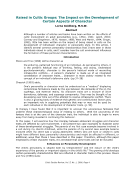
The Children of God/The Family: A Discussion of Recent
Research (1998-2005)
Susan Raine
Abstract
The Children of God/The Family has provoked much debate and discussion
among scholars over many years. These debates have centered upon
numerous issues including sexual sharing, Flirty Fishing (FFing), adult-child
sex, childcare, education, and discipline. The academic polarization of
perspectives on these topics has been persistent and has not well served
newer researchers. The purpose of this article is to provide an examination of
contemporary literature on COG/The Family that scholars and ex-members
have produced since 1998. I take a holistic approach to the research and
attempt to bring together the findings to produce a more complete picture of
COG/The Family‘s history and current manifestation. As a result, I address
some of the specific divisive issues that pervade approaches to this NRM.
Additionally, I provide a summary of some of the concordant and discordant
research findings.
In January 2005, Ricky Rodriguez killed Angela Smith, who until recently was the executive
secretary to Rodriguez's mother, Karen Zerby (Maria), the spiritual leader of The Family
International. Rodriguez then drove to the California border town of Blythe, where he killed
himself with a single shot from a semiautomatic handgun (Goodstein, 2005). The murder-
suicide propelled the Children of God/The Family back into the spotlight and ignited a new
wave of popular media attention.1 Although popular media coverage of the group tends to
appear only during periods of intense controversy, academic scholarship on this new
religious movement (NRM) has been continuous over the years.
The Children of God/The Family (COG/The Family hereafter) has engendered many debates
among scholars. Some of these debates have centered upon Rodriguez (known as Davidito
in the group) and whether one of the group‘s publications about him (The Story of Davidito)
sanctioned adult-child sex. Sexual sharing, Flirty Fishing (FFing),2 childcare, education, and
discipline have all been subject to academic scrutiny, as well. The academic polarization of
perspectives on these topics has been persistent and has not well served newer
researchers. Navigating the divergent perspectives sometimes leaves one frustrated
because it is difficult to find an approach that fairly and fully discusses both the positive and
negative aspects of this enduring movement. Hence, one faces the arduous task of trying to
reconcile what at times are exceedingly disparate research findings.
With these difficulties in mind, the purpose of this article is to provide an examination of
contemporary literature on COG/The Family that scholars and ex-members have produced
since 1998.3 I take a holistic approach to the research and attempt to bring together the
findings to produce a more complete picture of COG/The Family‘s history and current
manifestation. In this way, I address some of the specific divisive issues that pervade
approaches to this NRM.
Discussing each work by its publication format, I begin with an analysis of recent books,
followed by book chapters and, finally, academic journal articles. James D. Chancellor‘s Life
in the Family: An Oral History of the Children of God (2000) traces the development of the
The Children of God/The Family: A Discussion of Recent
Research (1998-2005)
Susan Raine
Abstract
The Children of God/The Family has provoked much debate and discussion
among scholars over many years. These debates have centered upon
numerous issues including sexual sharing, Flirty Fishing (FFing), adult-child
sex, childcare, education, and discipline. The academic polarization of
perspectives on these topics has been persistent and has not well served
newer researchers. The purpose of this article is to provide an examination of
contemporary literature on COG/The Family that scholars and ex-members
have produced since 1998. I take a holistic approach to the research and
attempt to bring together the findings to produce a more complete picture of
COG/The Family‘s history and current manifestation. As a result, I address
some of the specific divisive issues that pervade approaches to this NRM.
Additionally, I provide a summary of some of the concordant and discordant
research findings.
In January 2005, Ricky Rodriguez killed Angela Smith, who until recently was the executive
secretary to Rodriguez's mother, Karen Zerby (Maria), the spiritual leader of The Family
International. Rodriguez then drove to the California border town of Blythe, where he killed
himself with a single shot from a semiautomatic handgun (Goodstein, 2005). The murder-
suicide propelled the Children of God/The Family back into the spotlight and ignited a new
wave of popular media attention.1 Although popular media coverage of the group tends to
appear only during periods of intense controversy, academic scholarship on this new
religious movement (NRM) has been continuous over the years.
The Children of God/The Family (COG/The Family hereafter) has engendered many debates
among scholars. Some of these debates have centered upon Rodriguez (known as Davidito
in the group) and whether one of the group‘s publications about him (The Story of Davidito)
sanctioned adult-child sex. Sexual sharing, Flirty Fishing (FFing),2 childcare, education, and
discipline have all been subject to academic scrutiny, as well. The academic polarization of
perspectives on these topics has been persistent and has not well served newer
researchers. Navigating the divergent perspectives sometimes leaves one frustrated
because it is difficult to find an approach that fairly and fully discusses both the positive and
negative aspects of this enduring movement. Hence, one faces the arduous task of trying to
reconcile what at times are exceedingly disparate research findings.
With these difficulties in mind, the purpose of this article is to provide an examination of
contemporary literature on COG/The Family that scholars and ex-members have produced
since 1998.3 I take a holistic approach to the research and attempt to bring together the
findings to produce a more complete picture of COG/The Family‘s history and current
manifestation. In this way, I address some of the specific divisive issues that pervade
approaches to this NRM.
Discussing each work by its publication format, I begin with an analysis of recent books,
followed by book chapters and, finally, academic journal articles. James D. Chancellor‘s Life
in the Family: An Oral History of the Children of God (2000) traces the development of the