Cultic Studies Review, Vol. 4, No. 2, 2005, Page 99
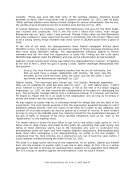
attempts to practice brainwashing and with what effect. The brainwashing model asserts
twelve hypotheses about the role of brainwashing in the production of uncritical obedience.
These hypotheses are all empirically testable.
This model begins with an assumption that charismatic leaders are capable of creating
organizations that are easy and attractive to enter (even though they may later turn out to
be difficult and painful to leave). There are no hypotheses, therefore, to account for how
charismatic cults obtain members. It is assumed that an abundant pool of potential recruits
to such groups is always available. The model assumes that charismatic leaders, using
nothing more than their own intrinsic attractiveness and persuasiveness, are initially able to
gather around them a corps of disciples sufficient for the creation of an attractive social
movement. Many ethnographies have shown how easy it is for such small movement
organizations to attract new members from the general pool of anomic ―seekers‖ that can
always be found within the population of an urbanized mobile society.
The model does attempt to account for how some percentage of these ordinary members
are turned into deployable agents. The initial attractiveness of the group, its vision of the
future and/or its capacity to bestow seemingly limitless amounts of love and esteem on the
new member are sufficient inducements in some cases to motivate a new member to
voluntarily undergo this difficult and painful process of resocialization.
H1. Ideological totalism is a necessary but not sufficient condition for the brainwashing
process. Brainwashing will be attempted only in groups that are structured totalistically.
However, not all ideologically totalist groups will attempt to brainwash their members. It
should be remembered that brainwashing is merely a mechanism for producing deployable
agents. Some cults may not want deployable agents or have other ways of producing them.
Others may want them but feel uncomfortable about using brainwashing methods to obtain
them or may not have discovered the existence of brainwashing methods.
H2. The exact nature of this resocialization process will differ from group to group but, in
general, will be similar to the resocialization process that Robert Lifton and Edgar Schein
observed in Communist re-education centers in the 1950s. For whatever reasons, these
methods seem to come fairly intuitively to charismatic leaders and their staffs. Although the
specific steps and their exact ordering differ from group to group, their common elements
involve a stripping away of the vestiges of an old identity, the requirement that repeated
confessions be made either orally or in writing, and a somewhat random and ultimately
debilitating alternation of the giving and the withholding of ―unconditional‖ love and
approval. H2 further states that the maintenance of this program involves the expenditure
of a measurable quantity of the collectivity‘s resources. This quantity is known as C, where
C equals the cost of the program and should be measurable at least at an ordinal level.
This resocialization process has baffled many observers, in my opinion because it proceeds
simultaneously along two distinct but parallel tracks one involving cognitive functioning and
the other involving emotional networking. These two tracks lead to the attainment of states
of hyper credulity and relational enmeshment respectively. The group member learns to
accept with suspended critical judgment the often shifting beliefs espoused by the
charismatic leader. At the same time, the group member becomes strongly attached to and
emotionally dependent upon the charismatic leader and (often especially) the other group
members and cannot bear to be shunned by them.
H3. Those who go through the process will be more likely than those who do not to reach a
state of hyper credulity. This involves the shedding of old convictions and the assumption of
a zealous loyalty to these beliefs of the moment, uncritically seized upon, so that all such
beliefs become not mere ―beliefs‖ but deeply held convictions.
attempts to practice brainwashing and with what effect. The brainwashing model asserts
twelve hypotheses about the role of brainwashing in the production of uncritical obedience.
These hypotheses are all empirically testable.
This model begins with an assumption that charismatic leaders are capable of creating
organizations that are easy and attractive to enter (even though they may later turn out to
be difficult and painful to leave). There are no hypotheses, therefore, to account for how
charismatic cults obtain members. It is assumed that an abundant pool of potential recruits
to such groups is always available. The model assumes that charismatic leaders, using
nothing more than their own intrinsic attractiveness and persuasiveness, are initially able to
gather around them a corps of disciples sufficient for the creation of an attractive social
movement. Many ethnographies have shown how easy it is for such small movement
organizations to attract new members from the general pool of anomic ―seekers‖ that can
always be found within the population of an urbanized mobile society.
The model does attempt to account for how some percentage of these ordinary members
are turned into deployable agents. The initial attractiveness of the group, its vision of the
future and/or its capacity to bestow seemingly limitless amounts of love and esteem on the
new member are sufficient inducements in some cases to motivate a new member to
voluntarily undergo this difficult and painful process of resocialization.
H1. Ideological totalism is a necessary but not sufficient condition for the brainwashing
process. Brainwashing will be attempted only in groups that are structured totalistically.
However, not all ideologically totalist groups will attempt to brainwash their members. It
should be remembered that brainwashing is merely a mechanism for producing deployable
agents. Some cults may not want deployable agents or have other ways of producing them.
Others may want them but feel uncomfortable about using brainwashing methods to obtain
them or may not have discovered the existence of brainwashing methods.
H2. The exact nature of this resocialization process will differ from group to group but, in
general, will be similar to the resocialization process that Robert Lifton and Edgar Schein
observed in Communist re-education centers in the 1950s. For whatever reasons, these
methods seem to come fairly intuitively to charismatic leaders and their staffs. Although the
specific steps and their exact ordering differ from group to group, their common elements
involve a stripping away of the vestiges of an old identity, the requirement that repeated
confessions be made either orally or in writing, and a somewhat random and ultimately
debilitating alternation of the giving and the withholding of ―unconditional‖ love and
approval. H2 further states that the maintenance of this program involves the expenditure
of a measurable quantity of the collectivity‘s resources. This quantity is known as C, where
C equals the cost of the program and should be measurable at least at an ordinal level.
This resocialization process has baffled many observers, in my opinion because it proceeds
simultaneously along two distinct but parallel tracks one involving cognitive functioning and
the other involving emotional networking. These two tracks lead to the attainment of states
of hyper credulity and relational enmeshment respectively. The group member learns to
accept with suspended critical judgment the often shifting beliefs espoused by the
charismatic leader. At the same time, the group member becomes strongly attached to and
emotionally dependent upon the charismatic leader and (often especially) the other group
members and cannot bear to be shunned by them.
H3. Those who go through the process will be more likely than those who do not to reach a
state of hyper credulity. This involves the shedding of old convictions and the assumption of
a zealous loyalty to these beliefs of the moment, uncritically seized upon, so that all such
beliefs become not mere ―beliefs‖ but deeply held convictions.