Cultic Studies Review, Vol. 4, No. 2, 2005, Page 27
Through the use of ―sharing‖ exercises, ―confessions,‖ and skillful
individualized probing, the group [leader(s)] assesses the recruit‘s strengths
and weaknesses.
Through testimonies of group members, the denigration of the group‘s
―competitors‖ (e.g., other religious groups, other therapists), the tactful
accentuation of the recruit‘s shameful memories and other weaknesses, and
the gradual indoctrination of the recruit into a closed, nonfalsifiable belief
system, the group‘s superiority is affirmed as a fundamental assumption.
Members‘ testimonies, positive reinforcement of the recruit‘s expressions of
trust in the group, discrete reminders about the recruit‘s weaknesses, and
various forms of group pressure induce the recruit to acknowledge that
his/her future well-being depends upon adherence to the group‘s belief
system, more specifically its ―change program.‖
These same influence techniques are joined by a subtle undermining of the
recruit‘s self-esteem (e.g., by exaggerating the ―sinfulness‖ of experiences
the recruit is encouraged to confess‖), the suppression or weakening of
critical thinking through fatiguing activity, near-total control of the recruit‘s
time, trance-induction exercises (e.g., chanting), and the repetitive message
that only disaster results from not following the group‘s ―change program.‖
These manipulations induce the recruit to declare allegiance to the group and
to commit to change him/herself as directed by the group. He or she can now
be considered a convert embarking on a path of ―purification,‖
―enlightenment,‖ ―self-actualization,‖ ―higher consciousness,‖ or whatever.
The recruit‘s dependency on the group is established and implicitly, if not
explicitly, acknowledged. Moreover, he/she has accepted the group‘s
authority in defining what is true and good, within the convert‘s heart and
mind as well as in the world.
Although, like my most of my colleagues, I have avoided the term ―brainwashing,‖ if
pressed, I would say that the above bulleted statements more or less describe the first
phase of what one might call ―brainwashing.‖ This process does not make ―robots.‖ It does
not eliminate choice, the capacity to make decisions. The process manipulates choice,
resulting in what Dr. Janja Lalich, in a new theoretical formulation, calls ―bounded choice‖
(Lalich, 2004). Moreover, the tension inherent in yielding to group pressures—what some
have called a ―pseudo-identity‖ (West &Martin, 1996)—sets the stage for future conflicts
and disillusionment, which may eventually lead to departure from the group. Why most
members of most groups eventually leave, while others remain is a question for which we
still don‘t have an adequate answer, in my opinion. My impression is that there are many
answers, reflecting many kinds of interactions between individuals and powerful
environments.
Scholarship on the “Anti-Cult Movement” (ACM)
Kropveld (2003) summarizes the main problem with sociological research on the so-called
ACM:
The sociological literature on the ―anti-cult movement‖ repeatedly makes the
mistake of presuming that all organizations and individuals, who express
concerns about cults, have uniform objectives, a common agenda, and close,
interlinking relationships. In fact, there are numerous differences, and most
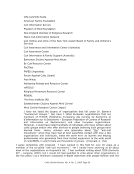
―ACM‖ groups know very little about other groups and individuals. Here is a
partial list of organizations that Dr. Barker might categorize as ―cult
awareness groups‖ (all are from North America unless otherwise indicated):
Through the use of ―sharing‖ exercises, ―confessions,‖ and skillful
individualized probing, the group [leader(s)] assesses the recruit‘s strengths
and weaknesses.
Through testimonies of group members, the denigration of the group‘s
―competitors‖ (e.g., other religious groups, other therapists), the tactful
accentuation of the recruit‘s shameful memories and other weaknesses, and
the gradual indoctrination of the recruit into a closed, nonfalsifiable belief
system, the group‘s superiority is affirmed as a fundamental assumption.
Members‘ testimonies, positive reinforcement of the recruit‘s expressions of
trust in the group, discrete reminders about the recruit‘s weaknesses, and
various forms of group pressure induce the recruit to acknowledge that
his/her future well-being depends upon adherence to the group‘s belief
system, more specifically its ―change program.‖
These same influence techniques are joined by a subtle undermining of the
recruit‘s self-esteem (e.g., by exaggerating the ―sinfulness‖ of experiences
the recruit is encouraged to confess‖), the suppression or weakening of
critical thinking through fatiguing activity, near-total control of the recruit‘s
time, trance-induction exercises (e.g., chanting), and the repetitive message
that only disaster results from not following the group‘s ―change program.‖
These manipulations induce the recruit to declare allegiance to the group and
to commit to change him/herself as directed by the group. He or she can now
be considered a convert embarking on a path of ―purification,‖
―enlightenment,‖ ―self-actualization,‖ ―higher consciousness,‖ or whatever.
The recruit‘s dependency on the group is established and implicitly, if not
explicitly, acknowledged. Moreover, he/she has accepted the group‘s
authority in defining what is true and good, within the convert‘s heart and
mind as well as in the world.
Although, like my most of my colleagues, I have avoided the term ―brainwashing,‖ if
pressed, I would say that the above bulleted statements more or less describe the first
phase of what one might call ―brainwashing.‖ This process does not make ―robots.‖ It does
not eliminate choice, the capacity to make decisions. The process manipulates choice,
resulting in what Dr. Janja Lalich, in a new theoretical formulation, calls ―bounded choice‖
(Lalich, 2004). Moreover, the tension inherent in yielding to group pressures—what some
have called a ―pseudo-identity‖ (West &Martin, 1996)—sets the stage for future conflicts
and disillusionment, which may eventually lead to departure from the group. Why most
members of most groups eventually leave, while others remain is a question for which we
still don‘t have an adequate answer, in my opinion. My impression is that there are many
answers, reflecting many kinds of interactions between individuals and powerful
environments.
Scholarship on the “Anti-Cult Movement” (ACM)
Kropveld (2003) summarizes the main problem with sociological research on the so-called
ACM:
The sociological literature on the ―anti-cult movement‖ repeatedly makes the
mistake of presuming that all organizations and individuals, who express
concerns about cults, have uniform objectives, a common agenda, and close,
interlinking relationships. In fact, there are numerous differences, and most
―ACM‖ groups know very little about other groups and individuals. Here is a
partial list of organizations that Dr. Barker might categorize as ―cult
awareness groups‖ (all are from North America unless otherwise indicated):