Cultic Studies Review, Vol. 4, No. 2, 2005, Page 62
Additional documents on www.culticstudiesreview.org
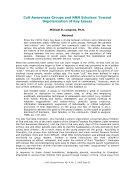
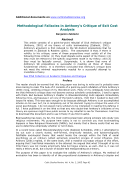
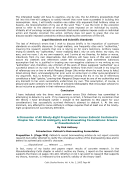
Methodological Fallacies in Anthony’s Critique of Exit Cost
Analysis
Benjamin Zablocki
Abstract
This article consists of a point-by-point rebuttal of Dick Anthony‘s critique
(Anthony, 2001) of my theory of cultic brainwashing (Zablocki, 2001).
Anthony‘s argument is first reduced to the 98 distinct propositions that he
presents in Zablocki &Robbins (2001). The assumption is that, if there is
validity to his critique, some of these propositions must satisfy all of the
following three criteria: (1) they must dispute some aspect of my theory (2)
they must be relevant to the specific arguments made in my theory and (3)
they must be factually correct. Surprisingly, it is shown that none of
Anthony‘s 98 propositions is successful in meeting all three of these
fundamental criteria. It is therefore concluded that Anthony‘s critique does
not meet the minimal requirements needed for a successful attempt to
invalidate a theory.
See ICSA Collection on Academic Disputes and Dialogue
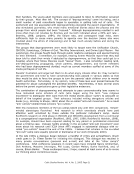
Preface
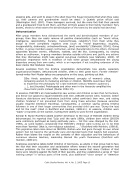
The reader should be warned that this long paper was boring to write and is probably even
more boring to read. The bulk of it consists of a point-by-point refutation of Dick Anthony‘s
(2001) long, rambling critique of my theoretical work. Many of my colleagues have advised
me that Anthony‘s critique does not deserve serious scholarly consideration. I tend to agree
with them. But because Anthony‘s chapter in Misunderstanding Cults appears immediately
following mine, and because I am one of the book‘s editors, I felt that I needed to deal with
issues he raises. This was easy enough to do because although Anthony is an accomplished
scholar on his own turf, he is completely out of his element trying to critique the work of a
social psychologist. I do not expect many scholars to be interested in reading this defense in
full. I have published it on the Web so that any who doubt that Anthony‘s criticisms of my
theory are specious might have public access to my rebuttal to see for themselves. Feel free
to download this document and to use it freely if you find it useful.
Brainwashing has been, by far, the most controversial topic among scholars who study new
religious movements. My purpose here today is not to convince you that brainwashing
happens in New Religious Movements (NRMs), but merely that a theory exists that we can
use to determine empirically whether or not it does.
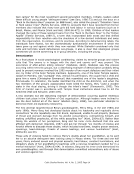
In a recent book called Misunderstanding Cults (Zablocki &Robbins, 2001), I attempted to
lay out such a clearly stated, well-formed, empirically testable, and epistemologically
falsifiable sociological theory that would locate the concept within the field of social
psychology as an ordinary (albeit extremely powerful) process of social influence. Dick
Anthony (2001) replied, in the same book, with a massive 103-page critique of this effort,
arguing that I had failed miserably in the attempt. He argued that what I thought of as my
little theory was not merely empirically false but bogus science, as well—that is, it was not
really a theory at all, but a bunch of double-talk masquerading as a theory.
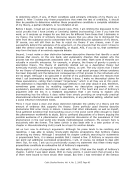
The purpose of this paper is to evaluate the validity of Anthony‘s critique. My method of
evaluation has been to identify all of the propositional statements in Anthony‘s chapter and
Additional documents on www.culticstudiesreview.org
Methodological Fallacies in Anthony’s Critique of Exit Cost
Analysis
Benjamin Zablocki
Abstract
This article consists of a point-by-point rebuttal of Dick Anthony‘s critique
(Anthony, 2001) of my theory of cultic brainwashing (Zablocki, 2001).
Anthony‘s argument is first reduced to the 98 distinct propositions that he
presents in Zablocki &Robbins (2001). The assumption is that, if there is
validity to his critique, some of these propositions must satisfy all of the
following three criteria: (1) they must dispute some aspect of my theory (2)
they must be relevant to the specific arguments made in my theory and (3)
they must be factually correct. Surprisingly, it is shown that none of
Anthony‘s 98 propositions is successful in meeting all three of these
fundamental criteria. It is therefore concluded that Anthony‘s critique does
not meet the minimal requirements needed for a successful attempt to
invalidate a theory.
See ICSA Collection on Academic Disputes and Dialogue
Preface
The reader should be warned that this long paper was boring to write and is probably even
more boring to read. The bulk of it consists of a point-by-point refutation of Dick Anthony‘s
(2001) long, rambling critique of my theoretical work. Many of my colleagues have advised
me that Anthony‘s critique does not deserve serious scholarly consideration. I tend to agree
with them. But because Anthony‘s chapter in Misunderstanding Cults appears immediately
following mine, and because I am one of the book‘s editors, I felt that I needed to deal with
issues he raises. This was easy enough to do because although Anthony is an accomplished
scholar on his own turf, he is completely out of his element trying to critique the work of a
social psychologist. I do not expect many scholars to be interested in reading this defense in
full. I have published it on the Web so that any who doubt that Anthony‘s criticisms of my
theory are specious might have public access to my rebuttal to see for themselves. Feel free
to download this document and to use it freely if you find it useful.
Brainwashing has been, by far, the most controversial topic among scholars who study new
religious movements. My purpose here today is not to convince you that brainwashing
happens in New Religious Movements (NRMs), but merely that a theory exists that we can
use to determine empirically whether or not it does.
In a recent book called Misunderstanding Cults (Zablocki &Robbins, 2001), I attempted to
lay out such a clearly stated, well-formed, empirically testable, and epistemologically
falsifiable sociological theory that would locate the concept within the field of social
psychology as an ordinary (albeit extremely powerful) process of social influence. Dick
Anthony (2001) replied, in the same book, with a massive 103-page critique of this effort,
arguing that I had failed miserably in the attempt. He argued that what I thought of as my
little theory was not merely empirically false but bogus science, as well—that is, it was not
really a theory at all, but a bunch of double-talk masquerading as a theory.
The purpose of this paper is to evaluate the validity of Anthony‘s critique. My method of
evaluation has been to identify all of the propositional statements in Anthony‘s chapter and