Cultic Studies Review, Vol. 4, No. 2, 2005, Page 4
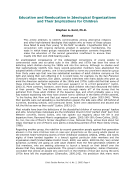
Education and Reeducation in Ideological Organizations
and Their Implications for Children
Stephen A. Kent, Ph.D.
Abstract
This article attempts to identify commonalities among alternative religions
and other high-demand ideologies that explain why so many of these groups
have failed to keep their young ―in the faith‖ as adults. I hypothesize that, in
conjunction with ongoing demands entailed in sectarian membership, the
ways in which these groups resocialize first-generation converts frequently
make the education of the second generation insufficient to ensure their
loyalty into their own child-bearing years.
An unanticipated consequence of the widespread conversions of young people to
controversial sects and so-called cults in the 1960s and 1970s has been the wave of
defecting adult children during the 1990s and into this century. Although no studies exist
that systematically identify how many second-generation members have abandoned the
adopted beliefs of their parents, one is hard pressed to name any prominent sectarian group
from thirty years ago that now has substantial numbers of adult children carrying on the
faith and raising their own offspring in it. A recent book, for example, by the San Francisco
Chronicle‘s religion reporter, Don Lattin, contains interviews with many adults who grew up
amid the American sectarian explosion of the 1960s and 1970s. Lattin did find that some of
these individuals had ―kept the faith and even passed it on to a third generation‖ (Lattin,
2003:3). More common, however, were those adult children who had renounced the faiths
of their parents. The ―one theme that runs through nearly all‖ of the stories that he
gathered from those adult children of the Aquarian Age, and which probably goes a long
way toward explaining why they have chosen not to continue in the faiths of their parents,
―is the feeling that Mom and Dad just weren‘t around enough‖ (Lattin 2003:240). ―While
their parents were out spreading a counterculture gospel, the kids were often left behind at
nurseries, boarding schools, and communal farms. Some were abandoned and abused and
left the fold as soon as they could‖ (Lattin, 2003:2-3).
Most notable have been the defections of the dissatisfied children of various groups‘ leaders
and elite. Among these individuals are the Unification Church‘s first ―perfect child‖ born from
Western converts, Donna Collins, who has spoken out regularly about her life in and
departure from, Reverend Moon‘s organization (Lattin, 2003:189-199 Orme-Collins, 2002).
So, too, has one of Moon‘s former daughters-in-law, Nansook Hong, whose book about her
tragic marriage to one of Moon‘s sons paints a disturbing portrait of the Moon family (Hong,
1998).
Regarding another group, the rebellion by second-generation people against first-generation
abusers in the Hare Krishnas took on near-epic proportions as the young adults placed on
the Internet heart-wrenching stories of their childhood violations (VOICE, 1996), and nearly
eighty of them banded together in a lawsuit against particular older members and the
organization itself (United States District Court, 2000 see Lattin, 2003:81-95). Very similar
dynamics currently are going on with adult children from the first-generation Children of
God members, who are seeking attorneys to launch a lawsuit on their behalf over the
abuses that they allegedly experienced. The group‘s recent biographer, James Chancellor,
concluded that almost all people who were born in the Children of God sect during the early
1970s have left the organization (Chancellor, 2000:242). His prediction that many more
Education and Reeducation in Ideological Organizations
and Their Implications for Children
Stephen A. Kent, Ph.D.
Abstract
This article attempts to identify commonalities among alternative religions
and other high-demand ideologies that explain why so many of these groups
have failed to keep their young ―in the faith‖ as adults. I hypothesize that, in
conjunction with ongoing demands entailed in sectarian membership, the
ways in which these groups resocialize first-generation converts frequently
make the education of the second generation insufficient to ensure their
loyalty into their own child-bearing years.
An unanticipated consequence of the widespread conversions of young people to
controversial sects and so-called cults in the 1960s and 1970s has been the wave of
defecting adult children during the 1990s and into this century. Although no studies exist
that systematically identify how many second-generation members have abandoned the
adopted beliefs of their parents, one is hard pressed to name any prominent sectarian group
from thirty years ago that now has substantial numbers of adult children carrying on the
faith and raising their own offspring in it. A recent book, for example, by the San Francisco
Chronicle‘s religion reporter, Don Lattin, contains interviews with many adults who grew up
amid the American sectarian explosion of the 1960s and 1970s. Lattin did find that some of
these individuals had ―kept the faith and even passed it on to a third generation‖ (Lattin,
2003:3). More common, however, were those adult children who had renounced the faiths
of their parents. The ―one theme that runs through nearly all‖ of the stories that he
gathered from those adult children of the Aquarian Age, and which probably goes a long
way toward explaining why they have chosen not to continue in the faiths of their parents,
―is the feeling that Mom and Dad just weren‘t around enough‖ (Lattin 2003:240). ―While
their parents were out spreading a counterculture gospel, the kids were often left behind at
nurseries, boarding schools, and communal farms. Some were abandoned and abused and
left the fold as soon as they could‖ (Lattin, 2003:2-3).
Most notable have been the defections of the dissatisfied children of various groups‘ leaders
and elite. Among these individuals are the Unification Church‘s first ―perfect child‖ born from
Western converts, Donna Collins, who has spoken out regularly about her life in and
departure from, Reverend Moon‘s organization (Lattin, 2003:189-199 Orme-Collins, 2002).
So, too, has one of Moon‘s former daughters-in-law, Nansook Hong, whose book about her
tragic marriage to one of Moon‘s sons paints a disturbing portrait of the Moon family (Hong,
1998).
Regarding another group, the rebellion by second-generation people against first-generation
abusers in the Hare Krishnas took on near-epic proportions as the young adults placed on
the Internet heart-wrenching stories of their childhood violations (VOICE, 1996), and nearly
eighty of them banded together in a lawsuit against particular older members and the
organization itself (United States District Court, 2000 see Lattin, 2003:81-95). Very similar
dynamics currently are going on with adult children from the first-generation Children of
God members, who are seeking attorneys to launch a lawsuit on their behalf over the
abuses that they allegedly experienced. The group‘s recent biographer, James Chancellor,
concluded that almost all people who were born in the Children of God sect during the early
1970s have left the organization (Chancellor, 2000:242). His prediction that many more