Cultic Studies Review, Vol. 4, No. 2, 2005, Page 91
Zablocki’s Admission Brainwashing Not Testable/Falsifiable
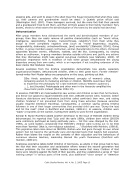
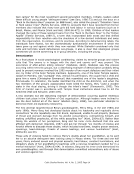
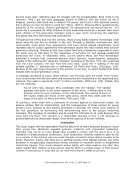
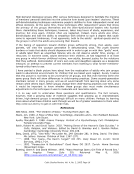
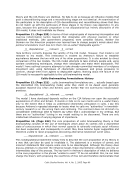
Proposition 75. (Page 272) Surprisingly, even Zablocki, towards the end of his second
brainwashing article, acknowledges that he has failed to make good on his original intent to
demonstrate that his exit costs interpretation of the brainwashing idea is a testable scientific
concept. In his 1998 article, pg. 227, he admits that so-called scientific ―conjectures‖ such
as the brainwashing concept, are not testable after all and are merely ―plausible...‖
X disputational X relevant correct
This proposition stems from Anthony‘s confounding of my conjectural speculations on why
and how brainwashing works, on the one hand, with my simple social psychological theory
that demonstrates, on the other hand, that brainwashing works. I‘ve made my argument
clear in numerous places about this distinction. Only the theory that brainwashing exists
and has certain measurable effects is currently a falsifiable theory. I would love to be able
to put forth a more powerful theory that explains exactly how and why brainwashing works,
but, at present, I am unable to do so. This I have freely admitted so I don‘t understand why
Anthony chortles over this fact as if he had caught me out in some sneaky maneuver.
Explanations of how and why remain at the conjectural level. At various times in my writing,
I have experimented with psychoanalytic explanations, rational-choice-theory explanations,
neuropsychological theories, addictive models, and so on. I think that all of these
approaches are intriguing, but none, as yet, rises to the level of a true falsifiable theory.
Anthony‘s critical method of ransacking all of my published works that range over more
than 30 years, without contextual regard as to whether I am speculating conjecturally or
laying out a falsifiable theory, only breeds confusion. I don‘t think the fault is mine because,
at least in my writing in the past ten years, I have always clearly labeled explanations as
being either conjectural or theoretical according to whether I believe they rise to the level of
testability.
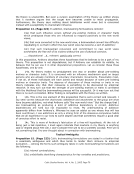
Proposition 76. (Page 272) Zablocki apparently has come to believe that there is a
well-recognized difference in the epistemological requirements for scientific conjectures as
opposed to scientific theories, whereby the former must only tell a ―plausible story‖ whereas
actual scientific theories must be falsifiable or testable.
X disputational relevant correct
See my comments on proposition 75. Science is full of instances in which it is known that a
phenomenon exists and has certain measurable effects, but it is not yet known how or why
the phenomenon works. The theory of electricity was in this situation in the nineteenth
century. Standard scientific operating procedure in such instances involves measuring the
phenomenon while offering conjectures that tell a plausible story as to why it might have
the effects it does. Sometimes, as science progresses, one or more of these conjectures
might graduate and become a testable theory.
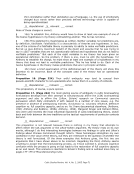
Proposition 77. (Page 273f) In Popper‘s use of these terms, there is no real difference
between the concepts of conjectures and theories, nor between falsifiability and testability.
disputational relevant X correct
There is no difference between falsifiability and testability. On this point Anthony and I are
agreed. I don‘t ever claim that there is a difference. As to conjectures and theories, I have
explained the distinction in the way I use these terms, and this distinction conforms to
normal scientific usage.
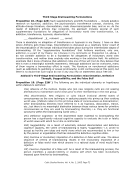
Proposition 78 (Page 274) ...with respect to the term and concept of plausibility, I have
been unable to find this term used as one which is relevant to differentiating scientific from
pseudo-scientific concepts in any of Popper‘s works.
Zablocki’s Admission Brainwashing Not Testable/Falsifiable
Proposition 75. (Page 272) Surprisingly, even Zablocki, towards the end of his second
brainwashing article, acknowledges that he has failed to make good on his original intent to
demonstrate that his exit costs interpretation of the brainwashing idea is a testable scientific
concept. In his 1998 article, pg. 227, he admits that so-called scientific ―conjectures‖ such
as the brainwashing concept, are not testable after all and are merely ―plausible...‖
X disputational X relevant correct
This proposition stems from Anthony‘s confounding of my conjectural speculations on why
and how brainwashing works, on the one hand, with my simple social psychological theory
that demonstrates, on the other hand, that brainwashing works. I‘ve made my argument
clear in numerous places about this distinction. Only the theory that brainwashing exists
and has certain measurable effects is currently a falsifiable theory. I would love to be able
to put forth a more powerful theory that explains exactly how and why brainwashing works,
but, at present, I am unable to do so. This I have freely admitted so I don‘t understand why
Anthony chortles over this fact as if he had caught me out in some sneaky maneuver.
Explanations of how and why remain at the conjectural level. At various times in my writing,
I have experimented with psychoanalytic explanations, rational-choice-theory explanations,
neuropsychological theories, addictive models, and so on. I think that all of these
approaches are intriguing, but none, as yet, rises to the level of a true falsifiable theory.
Anthony‘s critical method of ransacking all of my published works that range over more
than 30 years, without contextual regard as to whether I am speculating conjecturally or
laying out a falsifiable theory, only breeds confusion. I don‘t think the fault is mine because,
at least in my writing in the past ten years, I have always clearly labeled explanations as
being either conjectural or theoretical according to whether I believe they rise to the level of
testability.
Proposition 76. (Page 272) Zablocki apparently has come to believe that there is a
well-recognized difference in the epistemological requirements for scientific conjectures as
opposed to scientific theories, whereby the former must only tell a ―plausible story‖ whereas
actual scientific theories must be falsifiable or testable.
X disputational relevant correct
See my comments on proposition 75. Science is full of instances in which it is known that a
phenomenon exists and has certain measurable effects, but it is not yet known how or why
the phenomenon works. The theory of electricity was in this situation in the nineteenth
century. Standard scientific operating procedure in such instances involves measuring the
phenomenon while offering conjectures that tell a plausible story as to why it might have
the effects it does. Sometimes, as science progresses, one or more of these conjectures
might graduate and become a testable theory.
Proposition 77. (Page 273f) In Popper‘s use of these terms, there is no real difference
between the concepts of conjectures and theories, nor between falsifiability and testability.
disputational relevant X correct
There is no difference between falsifiability and testability. On this point Anthony and I are
agreed. I don‘t ever claim that there is a difference. As to conjectures and theories, I have
explained the distinction in the way I use these terms, and this distinction conforms to
normal scientific usage.
Proposition 78 (Page 274) ...with respect to the term and concept of plausibility, I have
been unable to find this term used as one which is relevant to differentiating scientific from
pseudo-scientific concepts in any of Popper‘s works.