Cultic Studies Journal, Vol. 3, No. 2, 1986 Page 75
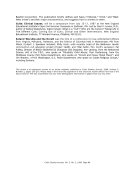
Why Cults Succeed Where the Church Fails By Ronald M. Enroth and J. Gordon
Melton. Brethren Press. Elgin, Minois. 1985. 133 pages. Paperback. $4.95.
Reviewed by Rev. Walter Debold
Seton Hall College
The tide of this book is one that might generate sales among the many people involved in
the ―cult problem.‖ Everyone -parents, counselors, clergy, and former members -is
mystified about the ability of cults to attract young people who come from a religious
background. All are confused about the apparent failure of the churches to inspire the same
dedication that seems to characterize the members of cults.
Are these groups doing something right? Are the churches and synagogues doing something
wrong? Should the churches be learning a lesson? Is there something that they should be
imitating? Or should they be carrying on a more effective educational campaign to warn
their members about the evil of cults? Is cult involvement to be seen merely as a stage
which one goes through on the path to maturity? Or, on the other hand, should the
parishioners of the mainline churches become resigned to the fact that the cults are ―new
religions,‖ here to stay and deserving of respect?
The co-authors of this small book met in the offices of Christianity Today and carried on the
dialogue which is presented here in six chapters and an appendix. Enroth is a professor of
sociology at Westmont College in Santa Barbara. Melton is the director of the Institute for
the Study of American Religion in Evanston, Illinois. Each has a long list of publications to
his credit Each of them would describe himself as an ―evangelical,‖ but they differ in many
ways. Enroth, for example, admits that he is usually seen as being in the ―anti-cult camp‖
(p. 1). Melton, on the other hand, resists the very use of the word, ―cult,‖ which he regards
as obsolete (p. 5), a catchword for religions that deviate from the norms of a given culture.
It is his judgment that the groups described by the term are neither particularly good nor
particularly bad (p. 12).
Both men are very patient with one another in the discussion-. one of the most forceful
statements is made by Enroth, who says, ―You seem to neglect or gloss over what I
consider to be the negative dimensions of cultic life‖ (p. 14).
Furthermore, Melton is severely critical of anti-cult organizations like the American Family
Foundation and the Citizens Freedom Foundation (the Cult Awareness Network).
The discussion next turned to ―deprogramming.‖ Apparently Enroth and Melton were not in
too great a hurry to tackle the question which constitutes the tide of the book. Both men
interpret deprogramming to be a ―forcible retrieval‖ of a cult victim. Both oppose it. Melton
says, ―I think of deprogrammers in the same way I think of rapists ...(p. 23)
[deprogramming is] a violation of everything we stand for in this country in terms of
freedom and rights‖ (p. 24). He sees no evidence that an individual cult member has been
―lured‖ into the group without freely choosing to join. He abhors the anti-cult book,
Snapping, which he labels .anti-Christian.‖ On the matter of manipulation, Enroth politely
disagrees with Melton: ―I think there is a high degree of influence, control, and harmful
manipulation in cultic organizations‖ (p. 40).
The reader begins to be impatient to get to the discussion of the problem posed in the title.
He is curious to see what positions the authors will take. Has the Church failed? Are the
cults succeeding, or are they merely a novelty that ―I pass? The third chapter approaches
the issue with the question, ―Is there any good in cults?‖ Enroth feels that there has been
an erosion of authority in our society leaving a vacuum. He suggests that the cult leader
becomes a surrogate authority figure in the place of God (p. 48). The cult ―offers
Why Cults Succeed Where the Church Fails By Ronald M. Enroth and J. Gordon
Melton. Brethren Press. Elgin, Minois. 1985. 133 pages. Paperback. $4.95.
Reviewed by Rev. Walter Debold
Seton Hall College
The tide of this book is one that might generate sales among the many people involved in
the ―cult problem.‖ Everyone -parents, counselors, clergy, and former members -is
mystified about the ability of cults to attract young people who come from a religious
background. All are confused about the apparent failure of the churches to inspire the same
dedication that seems to characterize the members of cults.
Are these groups doing something right? Are the churches and synagogues doing something
wrong? Should the churches be learning a lesson? Is there something that they should be
imitating? Or should they be carrying on a more effective educational campaign to warn
their members about the evil of cults? Is cult involvement to be seen merely as a stage
which one goes through on the path to maturity? Or, on the other hand, should the
parishioners of the mainline churches become resigned to the fact that the cults are ―new
religions,‖ here to stay and deserving of respect?
The co-authors of this small book met in the offices of Christianity Today and carried on the
dialogue which is presented here in six chapters and an appendix. Enroth is a professor of
sociology at Westmont College in Santa Barbara. Melton is the director of the Institute for
the Study of American Religion in Evanston, Illinois. Each has a long list of publications to
his credit Each of them would describe himself as an ―evangelical,‖ but they differ in many
ways. Enroth, for example, admits that he is usually seen as being in the ―anti-cult camp‖
(p. 1). Melton, on the other hand, resists the very use of the word, ―cult,‖ which he regards
as obsolete (p. 5), a catchword for religions that deviate from the norms of a given culture.
It is his judgment that the groups described by the term are neither particularly good nor
particularly bad (p. 12).
Both men are very patient with one another in the discussion-. one of the most forceful
statements is made by Enroth, who says, ―You seem to neglect or gloss over what I
consider to be the negative dimensions of cultic life‖ (p. 14).
Furthermore, Melton is severely critical of anti-cult organizations like the American Family
Foundation and the Citizens Freedom Foundation (the Cult Awareness Network).
The discussion next turned to ―deprogramming.‖ Apparently Enroth and Melton were not in
too great a hurry to tackle the question which constitutes the tide of the book. Both men
interpret deprogramming to be a ―forcible retrieval‖ of a cult victim. Both oppose it. Melton
says, ―I think of deprogrammers in the same way I think of rapists ...(p. 23)
[deprogramming is] a violation of everything we stand for in this country in terms of
freedom and rights‖ (p. 24). He sees no evidence that an individual cult member has been
―lured‖ into the group without freely choosing to join. He abhors the anti-cult book,
Snapping, which he labels .anti-Christian.‖ On the matter of manipulation, Enroth politely
disagrees with Melton: ―I think there is a high degree of influence, control, and harmful
manipulation in cultic organizations‖ (p. 40).
The reader begins to be impatient to get to the discussion of the problem posed in the title.
He is curious to see what positions the authors will take. Has the Church failed? Are the
cults succeeding, or are they merely a novelty that ―I pass? The third chapter approaches
the issue with the question, ―Is there any good in cults?‖ Enroth feels that there has been
an erosion of authority in our society leaving a vacuum. He suggests that the cult leader
becomes a surrogate authority figure in the place of God (p. 48). The cult ―offers