Cultic Studies Journal, Vol. 3, No. 2, 1986 Page 63
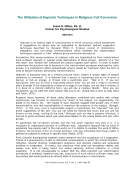
The Utilization of Hypnotic Techniques in Religious Cult Conversion
Jesse S. Miller, Ph. D.
Center for Psychological Studies
Abstract
Hypnosis is an altered state of consciousness in which conscious critical assessment
of suggestions by others may be suspended or diminished. Indirect suggestive
techniques described by therapist Milton H. Erickson consist of implications,
metaphors, and non-verbal communications which resemble the indoctrination
techniques reported in ―new‖ religious group conversion procedures.
Accusations that young members of religious cults are hypnotized by their indoctrinators
have surfaced regularly in popular press descriptions of these groups. Reports of a ―ten
mile stare‖ and ―zombie-like‖ behaviors are used to support such claims. In order to better
understand the putative role of hypnosis in the indoctrination processes employed by cultic
groups, it is important to define operationally what is meant by ―hypnosis‖ when the term is
used to explain dramatic personality transformations.
Hypnosis is popularly seen as a uniform process which creates a simple state of subject
obedience to command. It is believed that a person is hypnotized just as he is given a
haircut, or fed an orange, or thrown into a swimming pool. That is it. If you are
hypnotized, then you do what a hypnotized person does. You act like a Trilby to someone
else‘s Svengali If the hypnotizing is done on a stage in Las Vegas, you act like a chicken if
it is done on a remote California farm, you act like a religious fanatic. Once you are
hypnotized, you do what the other person tells you to do. Would that it were so easy (Star
and Tobin, 1970).
Research about hypnosis, all done under laboratory conditions and usually with college
sophomores, has focused on describing the ―state‖ of the subject, his suggestibility, the
depth of his trance, etc. The results of such research suggest that people vary in their
hypnotizability, and that hypnotizability is somehow the property of the subject (Spiegel,
1972). In this view, once a hypnotizable subject is hypnotized, the ―operator‖ can give
direct suggestions of the sort ―you will not sleep for twenty-two hours and you will sell
flowers on the street, smiling all the time.‖ Although such an idea is patently ridiculous, it
has led to great confusion about just what does happen to the young adults who join cultic
groups.
To appreciate the conversion process and the role which hypnosis may play in it, it is
necessary to understand hypnosis in a different way. Laboratory research has its limits in
explaining how people react in the real world, so it is helpful to consider the work of Milton
Erickson, the foremost writer on clinical hypnosis, who has articulated techniques useful in
getting his subjects to behave in specific ways (Haley, 1973).
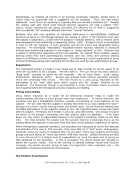
First, Erickson distinguishes between trance behavior and the acceptance of a suggestion.
Trance is a phenomenon of split or distracted consciousness in which the critical faculties--
reflection, rational thinking, independent judgment, and decision making--are somewhat
modified or suspended. In trance, the conscious mind does not incessantly chatter and
obsess over what is being heard, but listens passively without reflection or critical
judgment. It is not unreasonable to expect that the often-reported cult indoctrination
procedures of endlessly repetitive lectures, long hours of work without sufficient sleep, and
low protein diet would produce an altered state of consciousness in most people.
The Utilization of Hypnotic Techniques in Religious Cult Conversion
Jesse S. Miller, Ph. D.
Center for Psychological Studies
Abstract
Hypnosis is an altered state of consciousness in which conscious critical assessment
of suggestions by others may be suspended or diminished. Indirect suggestive
techniques described by therapist Milton H. Erickson consist of implications,
metaphors, and non-verbal communications which resemble the indoctrination
techniques reported in ―new‖ religious group conversion procedures.
Accusations that young members of religious cults are hypnotized by their indoctrinators
have surfaced regularly in popular press descriptions of these groups. Reports of a ―ten
mile stare‖ and ―zombie-like‖ behaviors are used to support such claims. In order to better
understand the putative role of hypnosis in the indoctrination processes employed by cultic
groups, it is important to define operationally what is meant by ―hypnosis‖ when the term is
used to explain dramatic personality transformations.
Hypnosis is popularly seen as a uniform process which creates a simple state of subject
obedience to command. It is believed that a person is hypnotized just as he is given a
haircut, or fed an orange, or thrown into a swimming pool. That is it. If you are
hypnotized, then you do what a hypnotized person does. You act like a Trilby to someone
else‘s Svengali If the hypnotizing is done on a stage in Las Vegas, you act like a chicken if
it is done on a remote California farm, you act like a religious fanatic. Once you are
hypnotized, you do what the other person tells you to do. Would that it were so easy (Star
and Tobin, 1970).
Research about hypnosis, all done under laboratory conditions and usually with college
sophomores, has focused on describing the ―state‖ of the subject, his suggestibility, the
depth of his trance, etc. The results of such research suggest that people vary in their
hypnotizability, and that hypnotizability is somehow the property of the subject (Spiegel,
1972). In this view, once a hypnotizable subject is hypnotized, the ―operator‖ can give
direct suggestions of the sort ―you will not sleep for twenty-two hours and you will sell
flowers on the street, smiling all the time.‖ Although such an idea is patently ridiculous, it
has led to great confusion about just what does happen to the young adults who join cultic
groups.
To appreciate the conversion process and the role which hypnosis may play in it, it is
necessary to understand hypnosis in a different way. Laboratory research has its limits in
explaining how people react in the real world, so it is helpful to consider the work of Milton
Erickson, the foremost writer on clinical hypnosis, who has articulated techniques useful in
getting his subjects to behave in specific ways (Haley, 1973).
First, Erickson distinguishes between trance behavior and the acceptance of a suggestion.
Trance is a phenomenon of split or distracted consciousness in which the critical faculties--
reflection, rational thinking, independent judgment, and decision making--are somewhat
modified or suspended. In trance, the conscious mind does not incessantly chatter and
obsess over what is being heard, but listens passively without reflection or critical
judgment. It is not unreasonable to expect that the often-reported cult indoctrination
procedures of endlessly repetitive lectures, long hours of work without sufficient sleep, and
low protein diet would produce an altered state of consciousness in most people.