78 International Journal of Cultic Studies ■ Vol. 1, No. 1, 2010
(complications, negative participation of
characters beyond the cult’s environment) 3) “I
have found the truth in the group/God/true
friends—I am happy” (positive solution and
positive characters within the cult’s
environment).
Inner Dialogues
According to the “dialogical self” conception,
different self-narrative plots create so-called “I”
positions (Hermans &Kempen, 1993 Hermans,
1999) or subpersonalities (Rowan, 1990), which
are defined perspectives of understanding,
feeling, and activity. A collection of all
possessed subpersonalities (representing
different life-story plots) defines a person’s
identity. The so-called “internal democracy” or
inner dialogues between subpersonalities
determine strong identity and psychic health.
The conduction of inner dialogues enables the
integration of many, sometimes contradictory
plots into one, “multi-plot” self-narration.
In contrast, lack of dialogue between
subpersonalities (lack of questions or answers,
agreement or disagreement, negotiation, or
reference to each other) is evidence of pathology
and disintegration of identity. Limitation in the
range of one’s conducting inner dialogues makes
it difficult to incorporate different life plots into
one narrative whole. A relatively cohesive
conception of oneself is maintained then by a
domination (dictatorship) of an individual “one-
plot” self-narration. It seems that a totalitarian
cult environment that offers ideological “ready-
made matrices” for composing complex
experiences definitely imposes inner dialogue
limitations on its followers. That environment
therefore favors identity fragmentation, which
makes it difficult for an individual to integrate
the coexisting dominant “cult identity” and the
latent “pre-cult identity” (see Hassan, 1988,
2000) because of the different editorial origin
(external versus internal composing) —see
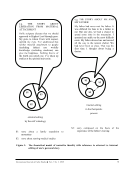
figure 1 on the following page.
(complications, negative participation of
characters beyond the cult’s environment) 3) “I
have found the truth in the group/God/true
friends—I am happy” (positive solution and
positive characters within the cult’s
environment).
Inner Dialogues
According to the “dialogical self” conception,
different self-narrative plots create so-called “I”
positions (Hermans &Kempen, 1993 Hermans,
1999) or subpersonalities (Rowan, 1990), which
are defined perspectives of understanding,
feeling, and activity. A collection of all
possessed subpersonalities (representing
different life-story plots) defines a person’s
identity. The so-called “internal democracy” or
inner dialogues between subpersonalities
determine strong identity and psychic health.
The conduction of inner dialogues enables the
integration of many, sometimes contradictory
plots into one, “multi-plot” self-narration.
In contrast, lack of dialogue between
subpersonalities (lack of questions or answers,
agreement or disagreement, negotiation, or
reference to each other) is evidence of pathology
and disintegration of identity. Limitation in the
range of one’s conducting inner dialogues makes
it difficult to incorporate different life plots into
one narrative whole. A relatively cohesive
conception of oneself is maintained then by a
domination (dictatorship) of an individual “one-
plot” self-narration. It seems that a totalitarian
cult environment that offers ideological “ready-
made matrices” for composing complex
experiences definitely imposes inner dialogue
limitations on its followers. That environment
therefore favors identity fragmentation, which
makes it difficult for an individual to integrate
the coexisting dominant “cult identity” and the
latent “pre-cult identity” (see Hassan, 1988,
2000) because of the different editorial origin
(external versus internal composing) —see
figure 1 on the following page.