5
Vickie Howard, Amina Adan, Charles Attwood |Escaping the Narcissist’s Worldview
IDT also emphasizes the role of interactional synchrony,
which involves the coordinated, reciprocal exchange of
behaviors between individuals. Narcissists often mirror
their partner’s emotions and behaviors to build rapport
and gain trust. This mirroring can make the partner
feel understood and connected, further entrenching the
deceptive relationship. Over time, the narcissist fine-
tunes this synchrony to maintain control, ensuring that
their partner remains emotionally and psychologically
dependent.
Deception in narcissistic abuse is often characterized
by incremental escalation. Initially, the lies may
be small and seemingly inconsequential, but over
time, they grow in complexity and significance. This
gradual increase makes it harder for the victim to
detect the deception, as they become accustomed to
a reality shaped by the narcissist’s manipulations. The
incremental nature of deception also makes it more
challenging for the victim to extricate, as they may feel
complicit or too deeply enmeshed in the false narrative
to break free.
Pathological lying, which is a common behavior among
narcissists, involves habitual or compulsive deception
without clear purpose or benefit (Dike, Baranoski, &
Griffith, 2005). Narcissists use this form of lying to
manipulate their partners, inflate their self-image, and
deflect blame. By weaving a web of lies, they create a
distorted reality that makes it difficult for their partners
to trust their own judgment, thereby isolating them
further from support networks. This manipulation
through deception is a powerful tool that amplifies
cognitive dissonance (Festinger, 1957). Caught between
contradictory beliefs or values, victims experience
psychological discomfort as they struggle to reconcile
the narcissist’s falsehoods with their own perceptions
of reality. As the lies accumulate, the victim’s confusion
and self-doubt intensify, leaving them more vulnerable
to the narcissist’s control. Thus, pathological lying not
only deceives but also serves to heighten the cognitive
dissonance experienced by victims, deepening their
emotional entrapment.
A study we (Howard &Adan, 2022) conducted found
deception to be one of the most distressing consequences
of women’s narcissistic abuse experiences. Examining
women’s use of Internet memes and associated posts
relating to distress and support-seeking from narcissistic
abuse experiences, we found underlying processes of
deception featured prominently in the main themes
we identified. These themes included the narcissistic
individual using gaslighting as the dominant deceptive
technique to “inform” the victim that they do not
really feel what they are feeling or think what they are
thinking, and then to replace the victim’s feelings and
thoughts with what they should actually feel and think
(from the narcissist’s coercive insistence).
A powerful discourse we identified in the data around
the theme of hidden grief described the recognition of
the narcissist portraying a false self to the victim (i.e.,
another deceptive act), which had enabled a strong
victim bond to the narcissist that was not built on who
they really are, but rather a representation of a false self
that ingratiated themselves to the victim. Consequently,
the victim feels that once the narcissistic individual
had departed from their lives, they were left “mourning
the living dead” (Clough, 2019) as the person they
had loved was “not real.” Victim-survivors expressed
a realization that the narcissist had been determined
to remove the victims’ sense of self through actions of
betrayal, dishonesty, and complete disregard for their
experiences and well-being.
Recognizing behaviors from narcissistic individuals is
important for victim-survivors to make sense of their
abuse experiences (Marsden, Humphreys, &Hegarty,
2022). However, complex challenges exist regarding
intricate and insidious deception processes that victims
do not perceive and that their families and friends may
have facilitated. Campbell and Miller (2011) examined
specific deceptive strategies used by narcissists,
finding that they are adept at crafting believable lies
and manipulating others’ perceptions to maintain
their desired self-images and control. McMullan
(2021) highlighted that deception is common in
various forms of abuse, and its strategic and pervasive
nature in narcissistic abuse is particularly damaging.
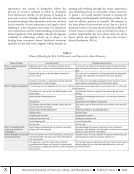
The following section explicitly identifies deceptive
processes to build upon existing psychological theory
to identify parallels within cult deception techniques
and proposes their relevance when contemplating
counterpart deceptive mechanisms that occur in
narcissistic abuse.