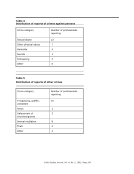
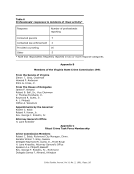
Cultic Studies Journal, Vol. 8, No. 2, 1991, Page 75
point of reference, origins, values, and goals of two so-called satanic religions may contrast
completely. “Satanism” has now been adopted by many as a term of reference for various
individuals or groups espousing beliefs in magic, witchcraft, or any of the other belief systems
mentioned above. Such application is inaccurate and unproductive. Further, the identification
of these groups (or the members thereof) as inherently criminal is a fallacy that will not be
perpetuated here. A sweeping generalization regarding unpopular or unconventional belief
systems is neither an accurate portrayal nor an effective method for assessing perpetration of
ritual crime. Consequently, this report will not examine these many individual belief systems
in-depth (please note, however, that the appended reference list will direct interested parties
to other sources that do so). Rather, focus will be directed toward criminal activity that may
be traceable to particular ritual practices.
A broadly used classification scheme has evolved that places adherents of these belief
systems into one of four distinct categories. The categories are:
1. Dabblers: Those who exhibit superficial, and usually transitory, interest in a belief
system but have neither developed a significant understanding of it nor become
substantially committed to it. Alternatively, the dabbler may exhibit superficial interest in
the occult generally (as opposed to a single belief system).
2. Self-stylists: Those who exhibit a greater degree of interest in one or more belief
systems but have generally not developed a significant knowledge and understanding of
the respective systems. Individuals who fall into this category develop personal belief
systems encompassing elements of multiple religions, embellished with their own ideas
and concepts.
3. Religious Traditionalists: Members of an established church or religion that is legally
recognized and does not formally advocate criminal activities.
4. “Cult” Members: Those who adhere to an established belief system and belong to an
organization that advocates and encourages certain criminal activities. By necessity their
practices are typically covert.
Depending upon the particular advocate the category title may differ, though these are the
most popular. The accompanying characteristics also may deviate somewhat from one
speaker to the next. Again, the definitions provided here approximate those most frequently
offered. Persons being characterized in this manner may not fit exclusively into a single
category or may cross lines from one to another. For example, dabblers, due to their relative
ignorance and lack of commitment, often assume the characteristics of a self-stylist.
Nevertheless, a self-stylist is generally regarded as more involved and more dangerous than a
dabbler. In fact, some authorities contend that the self-stylist is the most dangerous of the
four types because he is wholly unpredictable and may exploit selective elements of various
belief systems as justification for violent or criminal conduct. An extreme example of this
archetype is viewed by some as possessing severe personality problems and mental
instability.
The religious traditionalists are labeled as such by virtue of their reliance upon an established
religion. Members of this group may or may not belong to a recognized church. They will,
however, possess a reasonable level of knowledge about, and commitment to, a given belief
system. In either case, their practices are legitimate insofar as they decline to advocate illegal
activities. Some authorities on ritual crime contend that members of apparently legitimate
religious organizations actually engage in covert criminal conduct contrary to the stated
position, but with the sanction, of their church.
This scheme of categorizing individuals has a number of drawbacks, not least of which is the
implicit delegitimization of any organization placed in the third category (the mere mention of
a given belief system in this context tends to lend to it a negative connotation). The focus is