Cultic Studies Journal, Vol. 8, No. 2, 1991, Page 58
at the twilight of the gods” armed with a Thirteen-Year Plan” aimed at nothing less than the
triumph of the “Demonic Revolution” by the year 2002.
The growing fusion of some neo-Nazis and Satanists strikes another blow at the image of
the benevolent Satanist. Indeed, fascination with Nazi occultism is a common feature of the
“recognized Satanic churches,” such as Michael Aquino‟s Temple of Set, described in the
CSER report as being “focused on a disciplined approach to magic as a means for
succeeding in life.”68 In a recent exchange with some wary neo-pagans over the Magicknet
computer network, Aquino chides those whose “cozy little house of black and white
morality” prevents them from appreciating the “good and praiseworthy parts of Nazi
ideology.”69 Discussion of such a topic, Aquino sniffs,
“presumes a definition of “goodness” on which we all agree. I doubt that if
you and Heinrich Himmler were discussing morals over coffee, you would be
able to get very far, because what he would perceive as moral behavior would
be quite alien to your notions on the subject. As one indoctrinated by the
social morality of the political and social groups who defeated the Nazis in the
1940s, you assume that your standards are the standards -that, like the
Judaeo-Christian “God,” you know “good” and “evil” because you have the
exclusive prerogative to define them. [And how blasphemous it was when
Set/”Satan” (or in the aforementioned illustration, Himmler) assumed this
same prerogative, much less offered it to humanity! Assuredly deserving of
condemnation and punishment!] In perhaps another 100 years, the profane
world will be ready to consider objectively whether there is anything “good or
praiseworthy” about Nazism ...”70
In the meantime, Aquino suggests, “those who want to see reassuringly 100% evil comic-
book Nazis should go to Indiana Jones movies.”71
Or maybe just rent a video of the Nuremberg trials. Assuming, of course, that one is not too
distressed at all the condemnation and punishment heaped upon those poor, misunderstood
Nazis who had “offered” their peculiar conception of moral behavior to the world.
CSER’s Appendices
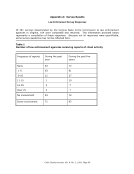
It is important to note that the CSER report is accompanied by three appendices, two of
which are the product of law enforcement officials. Dissecting each of these appendices is
beyond this essay‟s purpose. Each, it may be said, uses the same arguments, and much of
the evidence, found in the report itself by contributing to this awesome apologia these
officers, Robert Hicks, a Criminal Justice Analyst in Richmond, and Kenneth V. Lanning of
the F.B.I. Academy in Quantico, VA, underscore the success Satanism has already achieved.
To extend its influence, Satanism need not destroy its logical opponents. It need only
disarm them.
Lanning‟s and Hicks‟ views have been widely disseminated among police officers, several of
whom have expressed to us general agreement with their misconceptions. Although these
comments do not represent a consensus, we have heard other remarks which reflect new
doubts about Satanism‟s importance. In a sense, this may be a healthy development,
because skepticism is a necessary analytic component when addressing such issues,
particularly for those who exercise a potentially punitive authority. Hicks and Lanning do
not, however, merely reflect the CSER report‟s flaws. Where they offer views from their
special realm of law enforcement they are, quite simply, wrong. Hicks extends the report‟s
ad hominem approach to the level of a universal norm. He declares that, “whether or not
people can get criminal ideas from belief systems ...has little to do with the belief system
but rather with a person‟s own psychological make-up.”72 That this statement defies the
root of our nation‟s legal system -recognition of the fact that ideas have consequences -is