Cultic Studies Journal, Vol. 8, No. 2, 1991, Page 2
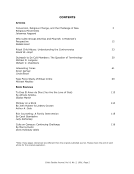
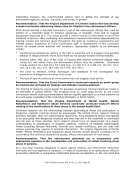
CONTENTS
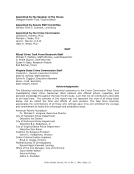
Articles
Conversion, Religious Change, and the Challenge of New 3
Religious Movements
Johannes Aagaard
Why Cultic Groups Develop and Flourish: A Historian‟s
Perspective 12
Natalie Isser
Ritual Child Abuse: Understanding the Controversies 23
David W. Lloyd
Outreach to Ex-Cult Members: The Question of Terminology 30
Michael D. Langone
William V. Chambers
Interesting Times 41
Kevin Garvey
Linda Blood
Task Force Study of Ritual Crime 69
Michael Maddox
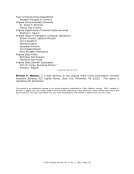
Book Reviews
Tu Eres El Amor de Dios (You Are the Love of God) 113
By Alfredo Silletta.
Gladys Martin
Monkey on a Stick 114
By John Hubner &Lindsey Gruson
Arthur A. Dole
Exit Counseling: A Family Intervention 115
By Carol Giambalvo
Judy Safransky
Cults on Campus: Continuing Challenge 116
By Marcia Rudin
Doris Holloway Abels
*Note: these pages referenced are different than the original published journal. Please check the end of each
article for the original pagination.
Cultic Studies Journal, Vol. 8, No. 2, 1991, Page 3
Conversion, Religious Change, and the Challenge Of New Religious
Movements
Johannes Aagaard, Ph.D.
Aarhus University
Aarhus, Denmark
Abstract
Conversion in the biblical sense is concerned with a change in faith and one's
personal relationship with God. It is a personal experience. Religion is the
orientation, the code, that undergirds cultures. Religious change refers to the
process by which this underlying code is altered. Religious change and
conversion are related but distinct. Contemporary culture is undergoing a
marked religious change in the direction of the "Pacific paradigm," a trans-
syncretism that fuses eastern mysticism and western capitalism. Traditional
churches are largely unaware of this shift and are derelict in their duty to
challenge the new religious movements (NRMs) that represent the paradigm.
Those who do challenge it --the "anti-cult movement --tend to focus on
illegal and evil deeds of NRMs, rather than their creeds. Scholars who form
an "anti-anti-cult movement," however, also pretend to credal neutrality.
Professor Kirsten Haastrup, "Mission and Murder: The Christianization of Iceland in the Year
1000" (Jordens Folk, 1987), concludes:
Religious change in the year 1000 was something entirely different from
conversion from one faith to another. It was not the Christian message that
was the central theme in the religious change. It was rather the recognized
need for a new "code." The new era was colored by the Christian world view
much more than the faith. (p. 75)
The distinction between religious change and conversion has much significance as a model
for understanding Europe and North America in the 90s. While conversion in the biblical
sense is concerned with a change in faith and one's personal relationship with God, religious
change is a process which revolves about the "decoding" of existence, that is, with
cosmology. Cosmology in this sense is not a matter of science or knowledge as much as a
question of explaining and interpreting the world (however, cosmology often professes to be
a kind of science).
Conversions occur at any time, but when they take place in a time of cultural transition to a
new era, conversions as religious transformations become decisive acts. This happens when
two cosmologies are in conflict and one overcomes the other. During such a movement a
change in the understanding of life's meaning takes place, and this change will color a
personal conversion in a decisive way. The conversion includes a change in one's whole
religious outlook and not simply a personal conversion.
One should not assume that a certain number of conversions gradually create a religious
change and the adoption of a new code, nor that religious change is the precondition for
conversions. The two are related but distinct phenomena.

The religious change of a human grouping --i.e., a culture, whether it includes a whole
people or a local community --is a very complex process, and on a large scale it is not
carried out consciously. This does not mean that it happens without awareness, but it is not
necessarily understood as religious change, for its simple elements are not seen as part of
the whole to which they belong.
Previous Page Next Page