Cultic Studies Journal, Vol. 8, No. 2, 1991, Page 39
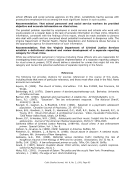
working in the field) disagree considerably about preferred terminology. Our recommending
specific terms at this time might be an exercise in arrogance.
We are willing to recommend, however, that the American Family Foundation organize a
study group on terminology. This study group should examine this study‟s findings,
convene meetings to discuss the pros and cons of various terms for different audiences, and
publish a set of recommendations to be reviewed by professionals and lay activists.
Most cult educational organizations are now more than ten years old. In the early years,
they mainly helped families with children in cults. As time passed, public and preventive
education occupied more and more time. In recent years, as evidenced by AFF‟s “Project
Recovery” (a multi-year program to improve the quality and quantity of services for ex-
cultists), more and more attention has been paid to the needs of cult walk-aways. The
activities of cult educational organizations have changed dramatically over the years.
Perhaps these organizations should now consider adjusting their terminology.
References
Bromley,D., &Richardson, J.(1983).The Brainwashing/Deprogramming Controversy:
Sociological, psychological, legal and historical perspectives. New York: Edwin
Mellen Press.
Conway, F., Siegelman, J.H., Carmichael, C.W., &Coggins, J. (1986). Information disease:
Effects of covert induction and deprogramming. update: A Journal of New Religious
Movements, 10, 45-57.
Delgado, R. (1977). Gentle and ungentle persuasion under the First Amendment. Southern
California Law Review, 5 (1), 1-97.
Dubrow-Eichel, S. (1989). Deprogramming: A case study. Cultic Studies Journal, 6 (2),
1-117.
Galanter, M. (1980). Charismatic religious sects and psychiatry: an overview. American
Journal of Psychiatry, 139 (12), 1539-1548.
Galanter, M. (1983). Unification Church (“Moonie”) dropouts: Psychological readjustment
after leaving a charismatic religious group. American Journal of Psychiatry, 140 (8),
984-989.
Hunter, E.(1953). Brainwashing in Red China: The calculated destruction of men’s minds.
New York: Vanguard.
Langone, M. (1982). Destructive cultism: Questions and answers. Weston, MA: American
Family Foundation.
Langone, M. (1988). Cults: Questions and answers. Weston, MA, American Family
Foundation.
Langone, M., &Clark, J.G. 1985). New religions and public policy: Research implications for
social and behavioral scientists. In B. Kilbourne (Ed.), Scientific research and new
religions: Divergent perspectives, San Francisco: Pacific Division, American
Association for the Advancement of Science, pp. 90-113.
Lifton, R. J. (1961). Thought reform and the psychology of totalism. New York: W. W.
Norton.
Litfin, A. D. (1982). The perils of persuasive preaching. Cultic Studies Journal, 2 (2), 267-
273.
Nelson, G. (1968). The spiritualistic movement and the need for a redefinition of cult.
Journal for the Scientific Study of Religion, 8, 152-160.
Robbins, T. (1969). Eastern mysticism and the resocialization of drug users: The Meher
Baba cult. Journal for the Scientific Study of Religion, 8 (2), 308-317.
Schein, E. (1961). Coercive persuasion. New York: Norton.
Shapiro, E. (1977, February). Destructive cultism. American Family Physician, 15, 80-83.