Cultic Studies Journal, Vol. 12, No. 2, 1995, page 43
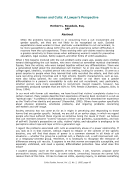
Women and Cults: A Lawyer’s Perspective
Herbert L. Rosedale, Esq.
AFF
Abstract
Often the problems facing women in or recovering from a cult involvement are
gender specific, yet they are not likely to be recognized as such. Societal
expectations cause women to have particular vulnerabilities to cult recruitment, to
be more susceptible to abuse within the cult, and to experience certain difficulties in
recovery from the cult experience. Those working with cult victims need to develop
a greater sensitivity to these issues when addressing women‟s needs for preventive
education, legal counsel, family support, and other forms of victim assistance.
When I first became involved with the cult problem some years ago, people were oriented
toward distinguishing the cult leaders, who were viewed as somewhat mystical charismatic
figures, from the victims, who were lumped together without any differentiation. There was
a generalized belief about the stereotypical cult member: he or she was thought to be a
college-aged, idealistic, troubled person who was seeking, looking for answers. It came as a
great surprise to people when they learned that cults recruited the elderly, and that cults
were recruiting among minorities and in high schools. Specific characteristics, such as sex,
were also being ignored. No one considered whether or not there was a gender
differentiation in a person‟s vulnerability to cults and cult recruitment, and, particularly,
whether women were more susceptible to recruitment. Recent research, however, has
consistently produced samples that are 60% to 70% female (Chambers, Langone, Dole, &
Grice, 1994).
In our work with former cult members, we have found that victims‟ complaints cluster in a
certain manner. Many people describe their experience of having been involved in a cult as
“spiritual rape.” A professor of philosophy at a college in New York described her experience
as the “theft of her identity and persona” (Rosenthal, 1995). Others have spoken specifically
about physical problems, emotional problems, and lingering problems concerning
self-esteem and self-image.
Society certainly has not come as far as it might in perceiving and responding to those
harms that are gender specific. Instead, we are still at an earlier stage, in which we regard
people who have suffered these injuries as somehow being the cause of them: we believe
that cult members became “victims” because of their own gullibility, susceptibility, and lack
of self-will. Society‟s perspective on cults, victims‟ rights, and education is analogous to its
perceptions about rape and rape victims a generation ago.
I regard the problems associated with cults as essentially abuse of a power relationship. If
you look at it in that manner, without regard to religion or the content of the specific
doctrine, you will find that abuse of power is a common element in all kinds of cult
situations --whether the group be a political cult, a lifestyle cult, a self-improvement cult,
or a religiously-oriented group. Therefore, it is necessary to recognize the relevance of
differences among cult recruits. It appears to me that women are especially susceptible, and
especially victimized, and need a special, differentiated protection. Now what does this
mean?
I couldn‟t possibly cover all the aspects of this thesis. I will, however, propose some
provocative issues, and leave them, to some extent, unresolved, because we cannot fully
resolve them at this time. I‟d like to make an initial, opening inquiry, to address something
Women and Cults: A Lawyer’s Perspective
Herbert L. Rosedale, Esq.
AFF
Abstract
Often the problems facing women in or recovering from a cult involvement are
gender specific, yet they are not likely to be recognized as such. Societal
expectations cause women to have particular vulnerabilities to cult recruitment, to
be more susceptible to abuse within the cult, and to experience certain difficulties in
recovery from the cult experience. Those working with cult victims need to develop
a greater sensitivity to these issues when addressing women‟s needs for preventive
education, legal counsel, family support, and other forms of victim assistance.
When I first became involved with the cult problem some years ago, people were oriented
toward distinguishing the cult leaders, who were viewed as somewhat mystical charismatic
figures, from the victims, who were lumped together without any differentiation. There was
a generalized belief about the stereotypical cult member: he or she was thought to be a
college-aged, idealistic, troubled person who was seeking, looking for answers. It came as a
great surprise to people when they learned that cults recruited the elderly, and that cults
were recruiting among minorities and in high schools. Specific characteristics, such as sex,
were also being ignored. No one considered whether or not there was a gender
differentiation in a person‟s vulnerability to cults and cult recruitment, and, particularly,
whether women were more susceptible to recruitment. Recent research, however, has
consistently produced samples that are 60% to 70% female (Chambers, Langone, Dole, &
Grice, 1994).
In our work with former cult members, we have found that victims‟ complaints cluster in a
certain manner. Many people describe their experience of having been involved in a cult as
“spiritual rape.” A professor of philosophy at a college in New York described her experience
as the “theft of her identity and persona” (Rosenthal, 1995). Others have spoken specifically
about physical problems, emotional problems, and lingering problems concerning
self-esteem and self-image.
Society certainly has not come as far as it might in perceiving and responding to those
harms that are gender specific. Instead, we are still at an earlier stage, in which we regard
people who have suffered these injuries as somehow being the cause of them: we believe
that cult members became “victims” because of their own gullibility, susceptibility, and lack
of self-will. Society‟s perspective on cults, victims‟ rights, and education is analogous to its
perceptions about rape and rape victims a generation ago.
I regard the problems associated with cults as essentially abuse of a power relationship. If
you look at it in that manner, without regard to religion or the content of the specific
doctrine, you will find that abuse of power is a common element in all kinds of cult
situations --whether the group be a political cult, a lifestyle cult, a self-improvement cult,
or a religiously-oriented group. Therefore, it is necessary to recognize the relevance of
differences among cult recruits. It appears to me that women are especially susceptible, and
especially victimized, and need a special, differentiated protection. Now what does this
mean?
I couldn‟t possibly cover all the aspects of this thesis. I will, however, propose some
provocative issues, and leave them, to some extent, unresolved, because we cannot fully
resolve them at this time. I‟d like to make an initial, opening inquiry, to address something