Cultic Studies Journal, Vol. 12, No. 2, 1995, page 4
and logs
Biologists, as exemplified by Linnaeus and Darwin, have constructed classification
systems of the natural world based on careful observations
Physicians have a long tradition of reporting unusual medical cases
Writers specialize in telling stories--happenings with antecedents and endings
Philosophers apply reflective thinking, logic, inductive and deductive reasoning, and
theory development
Recently, Denzin and Lincoln (1994) assembled into a handbook a potpourri of specialists --
sociologists, anthropologists, educationists, and social psychologists--who view qualitative
research from the perspective of feminism, Marxism, and deconstructionism. I recommend
especially the chapters by Fine, Huberman and Miles, Punch, and Stake. In her lucid
feminist voice, Fine (1994) calls attention to the parallel between the researched as “other”
and the position of oppressed minorities. Punch (1994) identifies difficult ethical and political
issues. Huberman and Miles (1994) are imaginative in addressing data management and
methods of analysis. Stake (1994) discusses the major conceptual responsibilities of the
qualitative case researcher.
I believe that many specialists can adapt qualitative case methods for the intense study of
members and former members of cultic and other destructive groups. Indeed, the ambiguity
surrounding these concepts calls for qualitative studies, which can be very useful, especially
in a coordinated program of multiple studies, in clarifying terms and theoretical concepts.
This paper provides suggestions for how to apply qualitative methods to cultic studies.
Before proceeding, I would like to note that principles of reliability (interobserver
congruence), validity (proof, verification, confirmation), and replicability are fundamental to
all defensible qualitative methods of inquiry. In my opinion, complete objectivity is difficult,
if not impossible yet, fairness, balance, and open-minded skepticism are still desirable and
attainable. I maintain that also there may be a place for subjectivity, passion, emotion,
imagination, belief, and creativity, if authors openly acknowledge and label them. Thus,
investigators who belong to AFF or the Cult Awareness Network should be open about their
perspectives (e.g., by stating, “My study is presented in the service of exposing cult
abuses”). Just as in the experimental sciences, when reporting a qualitative study, there is
no room for fabrication, concealed sponsorship, or hidden distortion in the interests of a
particular cause.
Strengths and Weaknesses
Qualitative methods are appropriate to questions of how, why, what happened, and who did
what they are less valuable in determining what caused what, how A is related to B, how
many and how much, and in identifying generalizations and universal laws. They are
especially valuable in describing the unusual, exceptional, unique, that is, particular events
or persons. See Yin (1989) and Gilgun (1994) for excellent and thorough treatments of the
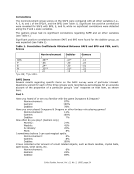
case history as research method (see Table 1).
Yin elaborates case study tactics for each of four “tests” of a research design. Expanding on
the familiar concepts of validity and reliability, he describes methods to establish internal,
construct, and external validities as well as reliability. Such tests are a valuable response to
critics who maintain that a case study is a soft, “not really scientific” design.
and logs
Biologists, as exemplified by Linnaeus and Darwin, have constructed classification
systems of the natural world based on careful observations
Physicians have a long tradition of reporting unusual medical cases
Writers specialize in telling stories--happenings with antecedents and endings
Philosophers apply reflective thinking, logic, inductive and deductive reasoning, and
theory development
Recently, Denzin and Lincoln (1994) assembled into a handbook a potpourri of specialists --
sociologists, anthropologists, educationists, and social psychologists--who view qualitative
research from the perspective of feminism, Marxism, and deconstructionism. I recommend
especially the chapters by Fine, Huberman and Miles, Punch, and Stake. In her lucid
feminist voice, Fine (1994) calls attention to the parallel between the researched as “other”
and the position of oppressed minorities. Punch (1994) identifies difficult ethical and political
issues. Huberman and Miles (1994) are imaginative in addressing data management and
methods of analysis. Stake (1994) discusses the major conceptual responsibilities of the
qualitative case researcher.
I believe that many specialists can adapt qualitative case methods for the intense study of
members and former members of cultic and other destructive groups. Indeed, the ambiguity
surrounding these concepts calls for qualitative studies, which can be very useful, especially
in a coordinated program of multiple studies, in clarifying terms and theoretical concepts.
This paper provides suggestions for how to apply qualitative methods to cultic studies.
Before proceeding, I would like to note that principles of reliability (interobserver
congruence), validity (proof, verification, confirmation), and replicability are fundamental to
all defensible qualitative methods of inquiry. In my opinion, complete objectivity is difficult,
if not impossible yet, fairness, balance, and open-minded skepticism are still desirable and
attainable. I maintain that also there may be a place for subjectivity, passion, emotion,
imagination, belief, and creativity, if authors openly acknowledge and label them. Thus,
investigators who belong to AFF or the Cult Awareness Network should be open about their
perspectives (e.g., by stating, “My study is presented in the service of exposing cult
abuses”). Just as in the experimental sciences, when reporting a qualitative study, there is
no room for fabrication, concealed sponsorship, or hidden distortion in the interests of a
particular cause.
Strengths and Weaknesses
Qualitative methods are appropriate to questions of how, why, what happened, and who did
what they are less valuable in determining what caused what, how A is related to B, how
many and how much, and in identifying generalizations and universal laws. They are
especially valuable in describing the unusual, exceptional, unique, that is, particular events
or persons. See Yin (1989) and Gilgun (1994) for excellent and thorough treatments of the
case history as research method (see Table 1).
Yin elaborates case study tactics for each of four “tests” of a research design. Expanding on
the familiar concepts of validity and reliability, he describes methods to establish internal,
construct, and external validities as well as reliability. Such tests are a valuable response to
critics who maintain that a case study is a soft, “not really scientific” design.