Cultic Studies Journal, Vol. 8, No. 2, 1991, Page 27
Why Aren’t There Criminal Convictions for “Cult Ritual Child Abuse”?
If a phenomenon has not been specifically defined and prohibited in a state‟s criminal code,
there is no reason for law enforcement agencies to investigate it. Instead, police officers
generally investigate only the allegations of specific crimes in the area of groups alleged to
maltreat children the police will only investigate the sexual and assaultive offenses alleged to
have been committed upon the children. Only a few states have attempted to define and
prohibit the crime of “cult behavior” or “ritual child abuse.” When such legislation is enacted,
law enforcement agencies will be obligated to investigate the broader phenomenon.
Cult ritual child abuse is often alleged to have occurred in out-of-home care settings, thus
complicating the investigative process. The roles of the police, child protective services,
mental health therapists, and child care licensing agencies are frequently unclear, creating the
potential for repetitious interviews, withholding of information and evidence, and
inappropriate disclosure of investigative information to the media.
The bizarre nature of the reported events frequently raises questions about the veracity of the
children. The children may be in acute mental health crisis, which compounds the assessment
of their credibility, and may be especially difficult to interview due to their young age and the
use of terroristic threats against disclosure by the abusers.
Thus prosecutors have concerns about filing charges in these cases, since they must prove
the defendants are guilty beyond a reasonable doubt. The combination of unsatisfactory
investigations and children whose credibility can be easily challenged tends to assist the
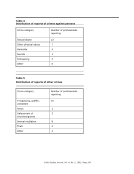
defendant(s). Nonetheless, there have been convictions in Florida, Massachusetts, Nevada,
Illinois and other states for various forms of child maltreatment in cases where the broader
form of ritual child abuse allegedly occurred.
How Can You Tell When a Child Has Been a Victim of Ritual Child Abuse?
There is no single symptom or group of symptoms that conclusively proves that a child has
been a victim of ritual child abuse. If the child has been physically or sexually assaulted there
may be medical evidence, but frequently this has disappeared by the time the child is able to
disclose what has happened.
The child may show behavioral signs of stress, such as sleep disturbances, aggression toward
toys, pets, and humans, regression to such behaviors as thumb sucking and bed wetting, and
especially fears and phobic reactions.
There may be bizarre statements. He or she may talk about demons and monsters who are
watching him/her constantly and have the power to harm him/her and family members. The
child may become preoccupied with the topic of death, and discuss animals and humans being
killed and/or mutilated. He/she may discuss eating feces and drinking urine or blood, masked
and robed figures, chants, rituals, candles and incense.
Some of these behaviors may be attributable to other stresses in the child‟s life, such as a
move, illness or death in the family, or family separation. Other behavioral symptoms may be
symptoms of mental illness. It is unclear whether some behaviors and statements are
reactions to exposure to films and videos depicting graphic violence, Satanic cults, and
demonic powers. Unfortunately, it is difficult to differentiate between children who have
delusions, children who have vivid night terrors, children who are incorporating fictitious film
and video content, and children who recount real events of ritual child abuse by groups.
Some child victims of alleged “cult ritual child abuse” report events that are clearly erroneous
e.g., “people were flying around the room, people were cut up and put back together,” etc.
Whether these reports are hallucinations due to a diagnosable psychiatric illness, from having
unknowingly ingested hallucinogens, misperception of magical illusions performed by the
group, or from an unknown cause may be difficult to determine.