Cultic Studies Journal, Vol. 8, No. 2, 1991, Page 113
Book Reviews
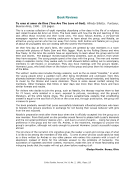
Tu eres el amor de Dios (You Are The Love of God). Alfredo Silletta. Puntosur,
Buenos Aires, 1990. 133 pages.
This is a concise collection of eight vignettes describing a few days in the life of a religious
sect called Jovenes del Amor en Cristo. The book deals with how the life and teaching of this
sect affect those involved and their loved ones. The story follows Andres, a 25-year-old
newspaper reporter who is working undercover to learn about the group, and Natalia, an
attractive young woman who has run away from home. Both Andres and Natalia join a group
of about 30 youngsters who are visiting with the sect for the first time.
On their first day at the sect‟s farm, the visitors are greeted by sect members in a room
covered with pictures of Padre Sam and Mick Jagger. Music by the Rolling Stones and wine
flow freely. At this time the visitors have an opportunity to learn about the group and to tell
their own stories. The dialogue reveals typical family problems, such as divorce, from which
they have escaped. The young people spend a few days with the group. The men and women
sleep in separate rooms they awake early to cold showers before setting out to accompany
members to sell flowers or proselytize. They also have meetings with the group‟s leader,
Hermano Lucas, who briefs them on the history of the group and gives them his interpretation
of the Bible.
The visitors‟ routine also includes therapy sessions, such as the so-called "Celestial," in which
the young people enter a padded room after being blindfolded and undressed. Here they
alternate between inhaling drugs to get closer to God, reading sensual materials, and listening
to music by the Stones and Laurie Anderson. There is some sexual contact among the
members. Other therapies that follow in later days last more than three hours and have
similar formats and results.
For visitors who decide to join the group, such as Natalia, the therapy requires them to fast
for 72 hours, while isolated in a room, exposed to pictures, recordings, and the group‟s
literature, all the while taking drugs. The group‟s paraphernalia explains that prostituting
oneself is equal to the sacrifice of Christ on the cross and, through prostitution, the group will
increase its power.
The book gradually reveals that Lucas successfully blackmails influential politicians who learn
to tolerate the group‟s practices in exchange for not having their sexual behavior with girls
from the sect exposed.
Natalia‟s preparation ends after three days when she is officially accepted into the group as a
new member. From that point on she provides sexual favors to please both Lucas‟s demands
and the corrupted politicians‟ desires until --and due to a twist of events --losing her place of
preference in the group and her own life. Andres, in the meantime, manages to uncover the
group‟s corruption, although not early enough to prevent Hermano Lucas‟s successful escape
abroad.
The structure of the narration into vignettes gives the reader a rapid and concise view of what
it is like to be among the members of this sect. Tu eres el amor de Dios could easily be read
as a diary written by Andres or any other person who enters this scenario with a touch of
skepticism instead of thirst for the ultimate answer to the problems of humanity. The
succession of vignettes and their content, moreover, make this one of those fascinating and
intriguing books that the reader will not put down before reading it all.
Gladys Martin. Berea, Ohio