22 ICSA TODAY
life. Furthermore, they reported difficulty with interpersonal
relationships (2005).
A particularly pervasive issue raised in the literature relates to
dependency (Goldberg, 2006b Landa, 1990–1991 Langone &
Eisenberg, 1993 Perry &Szalavitz, 2007). Second-generation
members have been raised in a strictly controlled environment,
where individual, independent thinking has been suppressed,
and where they have depended on a strong leader to direct
their lives. Their ability to develop a sense of independence and
internal validation has been severely hampered (Herman, 1997).
When leaving these environments, they may find themselves in
relationships that mimic this high degree of control (Goldberg,
2006a). In the case of the Branch Davidian children, Perry and
Szalavitz (2007) observed,
But none of the children knew what to do when faced
with the simplest of choices: when offered a plain
peanut butter sandwich as opposed to one with jelly,
they became confused, even angry. Having never
been allowed the basic choices that most children get
to make as they begin to discover what they like and
who they are, they had no sense of self. The idea of
self-determination was, like all new things for them,
unfamiliar and, therefore, anxiety provoking (para. 44).
Approaching second-generation members from a
psychoanalytic framework, Goldberg (2006b) views as one of the
primary issues their internalization of the harsh views of the cult
and cult leader, which shape their moral capacity.
As a result of this adaptation, the child may adopt a
submissive, masochistic attitude as a response to the
leader’s authority and, therefore, develop an internal
experience of being insignificant or bad. (Goldberg,
2006b, para. 17)
Goldberg (2006a) suggests that second-generation cult
members develop a harsh conscience and lack a loving
conscience that acknowledges and accepts the inherent
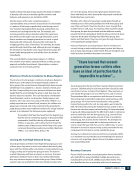
imperfection of being a human being. “I have learned that
second-generation former cultists often have an ideal of
perfection that is impossible to achieve” (Goldberg, 2006a,
para. 19). Lalich and Tobias (2004) add that children raised in
cults do not see compassion and negotiation modeled because
perfect obedience is demanded and harsh consequences are
experienced by adult members of cults when perfect obedience
and behavior is not achieved.
One former member gives an inside glimpse of this “harsh
conscience”: From the outside she was a driven, successful
young woman. She excelled in school and at work. She had a
good marriage and good friends. However, she reported feeling
plagued with feelings of inadequacy and failure. Every correction
on a paper, every missed phone call, every mistake was a
monumental failure. She expected at every turn a catastrophic
consequence for each misstep. She was unable to internalize any
success, instead believing that it was only a matter of time before
she made a mistake and was revealed to be the failure that she
knew she was.
Other recovery concerns revolve around trauma/PTSD, grief
and loss, and isolation. Many second-generation members do
not feel able to share their cultic experiences with new friends
they make outside the group. They may even feel they need
to create a second identity or history to fit in with mainstream
society. “As one Krishna Culture Kid described it is’ ‘like acting a
role in a play but all the while knowing that this is not the real
you’” (McCaig 2002, p. 23 as cited in Horback &Rothery-Jackson,
2007, “Commonalities of Marginals,” para. 1). This experience
exacerbates feelings of isolation.
Culture shock or culture adjustment is a vital issue for second-
generation adults. Culture is an internal experience. It creates a
scaffolding or map with which to make sense of our experiences.
The greater the difference between two cultures, the greater the
culture shock will be:
Thus, one response to this “terminal uniqueness”
may have been the participants’ ability to act as a
“chameleon,” “observer,” and lead “a double life.” It
can be assumed that creating a facade is one means
of adaptation by the marginal to feel accepted by a
cultural group. However, it is important to recognize
that having to culturally transition across environments
can be exhausting to the individual. (Horback &
Rothery-Jackson, 2007, “Layers of Marginality,” para. 2)
It is important to understand that adjusting to a new culture is a
process, not an event. Some may retain this double identity for
many years before integration begins to occur.
Culture shock/distress is exacerbated in former cult members
because cults explicitly ascribe meaning to the culture outside
the group, and that meaning is filled with images of all things
bad, with death of the soul, spirituality, or both. Therefore, former
members must not only learn a new culture, but also a new
morality. They must reject (or at least significantly reevaluate) an
entire worldview and build a new one that can incorporate the
culture outside the group. This is a daunting task. n
Culture shock …
is a vital issue for
second-generation adults.
life. Furthermore, they reported difficulty with interpersonal
relationships (2005).
A particularly pervasive issue raised in the literature relates to
dependency (Goldberg, 2006b Landa, 1990–1991 Langone &
Eisenberg, 1993 Perry &Szalavitz, 2007). Second-generation
members have been raised in a strictly controlled environment,
where individual, independent thinking has been suppressed,
and where they have depended on a strong leader to direct
their lives. Their ability to develop a sense of independence and
internal validation has been severely hampered (Herman, 1997).
When leaving these environments, they may find themselves in
relationships that mimic this high degree of control (Goldberg,
2006a). In the case of the Branch Davidian children, Perry and
Szalavitz (2007) observed,
But none of the children knew what to do when faced
with the simplest of choices: when offered a plain
peanut butter sandwich as opposed to one with jelly,
they became confused, even angry. Having never
been allowed the basic choices that most children get
to make as they begin to discover what they like and
who they are, they had no sense of self. The idea of
self-determination was, like all new things for them,
unfamiliar and, therefore, anxiety provoking (para. 44).
Approaching second-generation members from a
psychoanalytic framework, Goldberg (2006b) views as one of the
primary issues their internalization of the harsh views of the cult
and cult leader, which shape their moral capacity.
As a result of this adaptation, the child may adopt a
submissive, masochistic attitude as a response to the
leader’s authority and, therefore, develop an internal
experience of being insignificant or bad. (Goldberg,
2006b, para. 17)
Goldberg (2006a) suggests that second-generation cult
members develop a harsh conscience and lack a loving
conscience that acknowledges and accepts the inherent
imperfection of being a human being. “I have learned that
second-generation former cultists often have an ideal of
perfection that is impossible to achieve” (Goldberg, 2006a,
para. 19). Lalich and Tobias (2004) add that children raised in
cults do not see compassion and negotiation modeled because
perfect obedience is demanded and harsh consequences are
experienced by adult members of cults when perfect obedience
and behavior is not achieved.
One former member gives an inside glimpse of this “harsh
conscience”: From the outside she was a driven, successful
young woman. She excelled in school and at work. She had a
good marriage and good friends. However, she reported feeling
plagued with feelings of inadequacy and failure. Every correction
on a paper, every missed phone call, every mistake was a
monumental failure. She expected at every turn a catastrophic
consequence for each misstep. She was unable to internalize any
success, instead believing that it was only a matter of time before
she made a mistake and was revealed to be the failure that she
knew she was.
Other recovery concerns revolve around trauma/PTSD, grief
and loss, and isolation. Many second-generation members do
not feel able to share their cultic experiences with new friends
they make outside the group. They may even feel they need
to create a second identity or history to fit in with mainstream
society. “As one Krishna Culture Kid described it is’ ‘like acting a
role in a play but all the while knowing that this is not the real
you’” (McCaig 2002, p. 23 as cited in Horback &Rothery-Jackson,
2007, “Commonalities of Marginals,” para. 1). This experience
exacerbates feelings of isolation.
Culture shock or culture adjustment is a vital issue for second-
generation adults. Culture is an internal experience. It creates a
scaffolding or map with which to make sense of our experiences.
The greater the difference between two cultures, the greater the
culture shock will be:
Thus, one response to this “terminal uniqueness”
may have been the participants’ ability to act as a
“chameleon,” “observer,” and lead “a double life.” It
can be assumed that creating a facade is one means
of adaptation by the marginal to feel accepted by a
cultural group. However, it is important to recognize
that having to culturally transition across environments
can be exhausting to the individual. (Horback &
Rothery-Jackson, 2007, “Layers of Marginality,” para. 2)
It is important to understand that adjusting to a new culture is a
process, not an event. Some may retain this double identity for
many years before integration begins to occur.
Culture shock/distress is exacerbated in former cult members
because cults explicitly ascribe meaning to the culture outside
the group, and that meaning is filled with images of all things
bad, with death of the soul, spirituality, or both. Therefore, former
members must not only learn a new culture, but also a new
morality. They must reject (or at least significantly reevaluate) an
entire worldview and build a new one that can incorporate the
culture outside the group. This is a daunting task. n
Culture shock …
is a vital issue for
second-generation adults.