21 VOLUME 7 |ISSUE 1 |2016
Studies indicate that lack of play impacts the ability of children
to develop self-control, internally regulate emotions and
behavior, and experience joy (Goldstein, 2005).
Another aspect of the cultic socializing system is
unpredictability. One prominent characteristic of cultic leaders
is a pattern of behaving unpredictably, maintaining control
over members by keeping them guessing, raising them one
moment and crushing them the next. For example, one
second-generation former member relates this experience:
One afternoon the leader came through the kitchen as the
former member was chopping tomatoes for lunch. In great
detail and with enthusiasm, he praised her technique for
chopping perfect cubes of tomatoes. The next day, the leader
passed through the kitchen and, although she was chopping
the tomatoes in exactly the same way as the previous day, the
leader loudly denigrated her and told her leave the kitchen
immediately.
This unpredictability creates hypervigilance in children,
who work to sense what is expected of them so they can gain
approval and deflect punishment. Hypervigilance creates a
constant sense of insecurity and fear.
Structure of Cults As Conducive to Abuse/Neglect
The structure of cultic groups is conducive to abusive dynamics.
And because of the physical and psychological isolation of
these groups, the normal avenues through which abuse may be
identified are not available (i.e., doctors, teachers, friends, and
the like). Compounding this issue, because children have been
taught that the world outside the group is bad, they may not
disclose abuse to outsiders. This is an important consideration
for professionals, such as social workers, family lawyers, and
teachers, who may come into contact with these children. In a
widely reported case in Island Pond, Vermont, the children of a
group were removed, only to be returned to the group by the
judge because there was insufficient evidence for a legal-removal
warrant. In a statement, the state prosecutor explained,
The problem that State has faced from the beginning is
that the church community appears to be purposefully
organized to shield the identity of the parents and
children in question, and to allow them to thwart the
ordinary steps of due process which many critics seem
convinced should have worked successfully. (Burchard,
1984, p. 7 as cited in Kent, 2010, p. 40)
Leaving the Cult/High-Demand Group
Second-generation members leave high-demand groups in one
of three ways: they leave on their own without their family, they
leave with their family (either voluntarily or involuntarily because
of age), or they are forced by the group to leave. The manner
in which they leave will have an impact on recovery. If second-
generation members leave on their own without their family,
they may not know anyone outside of the group. Often children
raised in cults are isolated from their own family members who
are not in the group. Even second-generation members who
leave with family are often leaving the only people outside the
family they have ever known.
Members who choose to leave have usually gone through an
internal process of becoming disillusioned with their group and
even their own family. They have found an inner strength that
enables them to walk away. As isolated as they may feel outside
their group, the pain they endured and the disillusion usually
prevent them from going back. But those who are forced to leave
may bear the burden of feeling they failed their group, their
leader, and their family. They have not gone through the process
of recognizing the group’s failure.
However they leave, second-generation former members are
not only losing an entire relational support system, but they are
also in many ways losing an entire world. They are losing the only
belief structure/worldview they have ever known.
Second-generation former members may face distinct practical
concerns. Children raised in cults may not have a Social Security
card, driver’s license, or high-school diploma. They may have no
one outside the group to use as a reference for a job or school.
They may have little or no experience with the use of currency.
One young man recounted his experience upon leaving a cultic
group at age 18: He had no formal education, only sporadic
homeschooling within the cult. His only option was to take the
GED. He looked into joining the military but was unable to do so
because an education paper trail was lacking. He then attempted
to get a job while preparing for the GED, but he had no references
and was unfamiliar with the hiring process (e.g., how to fill out
an application, the appropriate amount of time to wait before
following up, how to dress for the interview). He attempted to
rent an apartment but again did not have any references, no
one to cosign the lease with him, and no credit history. In every
direction he turned, he reports being acutely aware that he was
not prepared to function in society outside the group.
Starting Out in Mainstream America (2010), by Livia Bardin, MSW,
is an excellent resource that discusses everything from practical
concerns such as getting a drivers license to broader concerns
such as parenting skills.
Recovery Concerns
Furnari (2005) found that second-generation former members
who had left their group identified multiple personal losses,
including their sense of self, childhood, and their family. They
also identified the loss of spirituality and a loss of meaning in
“I have learned that second-
generation former cultists often
have an ideal of perfection that is
impossible to achieve”…
Studies indicate that lack of play impacts the ability of children
to develop self-control, internally regulate emotions and
behavior, and experience joy (Goldstein, 2005).
Another aspect of the cultic socializing system is
unpredictability. One prominent characteristic of cultic leaders
is a pattern of behaving unpredictably, maintaining control
over members by keeping them guessing, raising them one
moment and crushing them the next. For example, one
second-generation former member relates this experience:
One afternoon the leader came through the kitchen as the
former member was chopping tomatoes for lunch. In great
detail and with enthusiasm, he praised her technique for
chopping perfect cubes of tomatoes. The next day, the leader
passed through the kitchen and, although she was chopping
the tomatoes in exactly the same way as the previous day, the
leader loudly denigrated her and told her leave the kitchen
immediately.
This unpredictability creates hypervigilance in children,
who work to sense what is expected of them so they can gain
approval and deflect punishment. Hypervigilance creates a
constant sense of insecurity and fear.
Structure of Cults As Conducive to Abuse/Neglect
The structure of cultic groups is conducive to abusive dynamics.
And because of the physical and psychological isolation of
these groups, the normal avenues through which abuse may be
identified are not available (i.e., doctors, teachers, friends, and
the like). Compounding this issue, because children have been
taught that the world outside the group is bad, they may not
disclose abuse to outsiders. This is an important consideration
for professionals, such as social workers, family lawyers, and
teachers, who may come into contact with these children. In a
widely reported case in Island Pond, Vermont, the children of a
group were removed, only to be returned to the group by the
judge because there was insufficient evidence for a legal-removal
warrant. In a statement, the state prosecutor explained,
The problem that State has faced from the beginning is
that the church community appears to be purposefully
organized to shield the identity of the parents and
children in question, and to allow them to thwart the
ordinary steps of due process which many critics seem
convinced should have worked successfully. (Burchard,
1984, p. 7 as cited in Kent, 2010, p. 40)
Leaving the Cult/High-Demand Group
Second-generation members leave high-demand groups in one
of three ways: they leave on their own without their family, they
leave with their family (either voluntarily or involuntarily because
of age), or they are forced by the group to leave. The manner
in which they leave will have an impact on recovery. If second-
generation members leave on their own without their family,
they may not know anyone outside of the group. Often children
raised in cults are isolated from their own family members who
are not in the group. Even second-generation members who
leave with family are often leaving the only people outside the
family they have ever known.
Members who choose to leave have usually gone through an
internal process of becoming disillusioned with their group and
even their own family. They have found an inner strength that
enables them to walk away. As isolated as they may feel outside
their group, the pain they endured and the disillusion usually
prevent them from going back. But those who are forced to leave
may bear the burden of feeling they failed their group, their
leader, and their family. They have not gone through the process
of recognizing the group’s failure.
However they leave, second-generation former members are
not only losing an entire relational support system, but they are
also in many ways losing an entire world. They are losing the only
belief structure/worldview they have ever known.
Second-generation former members may face distinct practical
concerns. Children raised in cults may not have a Social Security
card, driver’s license, or high-school diploma. They may have no
one outside the group to use as a reference for a job or school.
They may have little or no experience with the use of currency.
One young man recounted his experience upon leaving a cultic
group at age 18: He had no formal education, only sporadic
homeschooling within the cult. His only option was to take the
GED. He looked into joining the military but was unable to do so
because an education paper trail was lacking. He then attempted
to get a job while preparing for the GED, but he had no references
and was unfamiliar with the hiring process (e.g., how to fill out
an application, the appropriate amount of time to wait before
following up, how to dress for the interview). He attempted to
rent an apartment but again did not have any references, no
one to cosign the lease with him, and no credit history. In every
direction he turned, he reports being acutely aware that he was
not prepared to function in society outside the group.
Starting Out in Mainstream America (2010), by Livia Bardin, MSW,
is an excellent resource that discusses everything from practical
concerns such as getting a drivers license to broader concerns
such as parenting skills.
Recovery Concerns
Furnari (2005) found that second-generation former members
who had left their group identified multiple personal losses,
including their sense of self, childhood, and their family. They
also identified the loss of spirituality and a loss of meaning in
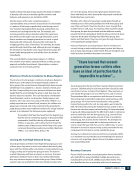
“I have learned that second-
generation former cultists often
have an ideal of perfection that is
impossible to achieve”…