Cultic Studies Journal, Vol. 14, No. 2, 1997, page 42
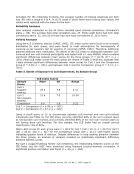
(1996) reviewed 25 studies, the only studies available at the time, and discovered that
every one of them found dissociative amnesia. Since that article was written, five more
studies have appeared, and they, too, reach the same conclusion as to the reality of
dissociative amnesia (Brown et al., 1997). Thus, after a careful search of the scientific
literature directly on point, 30 studies document dissociative amnesia none find against it.
Whitfield (1997) has recently raised the number to 36 studies, and Henderson (1997) has
reported on study 37.
While objections may always be raised concerning the methodology of any particular study,
these 36 studies reflect a variety of methodological procedures, not just one common
experimental design. The first round of studies were surveys using clinical samples of
persons in therapy (Albach, Moorman, &Bermond, in press Briere &Conte, 1993
Cameron, 1994 Draijer, 1990 Ensink, 1992 Herman &Schatzow, 1987 Kluft, 1997
Loftus, Polonsky, &Fullilove, 1994 Roe &Schwartz, 1996 Pomerantz, 1996) or using
therapists (Feldman-Summers &Pope, 1994 Fish &Scott, 1996 Polusny &Follette, 1996
Westerhof, Woertman, &van der Hart, in press). False memory advocates criticized this
method on the grounds that it involved people who were in psychotherapy.
A second round of studies sought to correct for this point by asking survey questions of
people entering psychotherapy (Gold, Hughes, &Hohnecker, 1994). False memory
advocates criticized this method on the grounds that there was still sample selection and
experimenter bias because of the psychotherapy setting.
A third round of experiments answered this objection by surveying nonclinical targeted
and/or random samples --people not in or entering therapy (Golding, 1995). College
student populations in the United States (Bernet, Deutscher, Ingram, &Litrownik, 1993
Elliott &Fox, 1994 Golding, Sanchez, &Sego, 1996 Melchert, 1996) and Canada (Belicki,
Correy, Boucock, Cuddy, &Dunlop, 1994) provided the resource for some of these survey
studies, while others used random samples of people who responded to advertisements in
newspapers (Hovdestad &Kristiansen, 1996 Kristiansen, Felton, Hovdestad, &Allard,
1995 Van der Kolk &Fisler, 1995), to toll-free telephone numbers (Roesler &Wind, 1994),
to random telephone numbers (Elliott &Briere, 1995), or to mailed questionnaires sent to
targeted persons who claimed to be victims of Father Porter, a priest who confessed and
was convicted of sexually molesting dozens of boys and girls decades earlier (Grassian &
Holtzen, 1996), or to targeted people claiming ritual abuse (Goodman, Qin, Bottoms, &
Shaver, 1995). Once again, however, false memory advocates complained that these types
of studies failed to document the existence of the alleged childhood sexual abuse.
To correct for this objection, a fourth round of studies was conducted, this time involving
prospective designs which started with hospital records of actual abuse and involved
tracking down the victims decades later (Burgess, Hartman, &Baker, 1995 Widom &
Morris, in press L. M. Williams, 1994). Once again, however, the false memory critics
rejected this method because it failed to add a follow-up “clarification” interview as
described by Femina, Yeager, and Lewis (1990). Scheflin and Brown (1996) have pointed
out, however, that the use of such a “clarification” interview is unduly suggestive because it
signals to the subject the answer the questioner wants to receive.
Taken as a whole, and especially considering the variety of designs, and the different
methods within each design, these studies constitute a formidable body of research work
demonstrating that proponents of repression have met their burden of proof.
Opponents of repression, who have failed to cite a single study in the world memory
literature supporting their view, as a final attempt to save their belief that repressed
memory does not exist, have argued that the scientific studies demonstrate only
“forgetting,” not “repression.” This approach was adopted by a recent Maryland court to
deny the existence of repression on the grounds that it is indistinguishable from forgetting.