Cultic Studies Journal, Vol. 14, No. 2, 1997, page 20
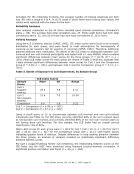
of the demand effects operating during stringent cross-examination in Experiment 2,
not those of Experiment 1. Thus, contrary to the conclusions of Spanos et al. (1989),
their study suggests that rigorous cross-examination will be largely ineffective in
countering misidentifications influenced by hypnosis in real- world courtrooms, as it
was in Experiment 2. This study also illustrates how important it is to consider the
details of experimental contexts in reviewing the hypnosis and memory literature.
4. We are referring here to spontaneously occurring cases outside the forensic arena.
5. Moreover, in correlational research the direction of causality may, in reality, be the
reverse of that originally deemed plausible that is B can cause A, rather than A
causing B. For example, combat veterans who report PTSD also report more severe
exposure to combat. The usual conclusion is that severe combat exposure causes
PTSD. This view is supported, for example, by studies of our Vietnam soldiers who
volunteered to explore tunnels occupied by the enemy, a particularly dangerous and
frightening duty. Almost universally, our tunnel soldiers developed PTSD. However,
while no one doubts the reality of PTSD in many such cases, the length and severity
of stress necessary for a diagnosis of PTSD has decreased over time. For example,
studies of PTSD have been conducted with Gulf War veterans, few of whom
underwent combat as severe as that seen by the average Vietnam combat infantry
soldier. Southwick and his colleagues recently reported a prospective study (as
opposed to the usual retrospective study) of memory for exposure to severe combat
and the development of PTSD among Gulf War veterans. They obtained memories of
whether or not soldiers had endured any or all of 19 combat-related traumatic
events at 1 month and 2 years after combat ended. Those who developed PTSD
symptomology amplified their memories of combat stress, changing their responses
from “no” at 1 month to “yes” at 2 years more often than did those with fewer
symptoms (Southwick, Morgan, Nicolaou, &Charney, 1997). They concluded:
These findings do not support the position that traumatic memories are fixed
or indelible. Further, the data suggest that as PTSD symptoms increase, so
does amplification of memory for traumatic events. This study raises questions
about the accuracy of recall for traumatic events, as well as about the
well-established, but retrospectively determined relationship between level of
exposure to trauma and degree of PTSD symptoms. (p. 173.)
In other words, PTSD symptoms caused memories of heightened combat trauma
instead of exposure to trauma causing symptoms. These findings are not surprising
from a methodological point of view. But correlation fools us into believing we know
things when we don‟t and these findings surprised many clinicians. In response to
the Southwick et al. (1997) study, the American Journal of Psychiatry published an
editorial which read, in part:
If the findings of Southwick et al. are replicated and it is verified that patients
with greater PTSD symptoms amplify or distort memories of traumatic
stressors, our most basic assumptions about the relationship between trauma
and PTSD will be challenged. Commonly, a central focus in the clinical
evaluation of patients is the linking of current symptoms to traumatic events
that occurred months or years before treatment and an exploration of those
events. In light of these new findings, our approach to assessing and treating
the disorder requires reexamination. Because the recollections of past trauma
may be distorted, findings by Southwick et al. encourage us to shift our
attention to the assessment of current symptoms and their impact on current
functioning and quality of life. (Hales &Zatzick, 1997, p. 144)