Cultic Studies Review, Vol. 4, No. 1, 2005, Page 71
Book Reviews
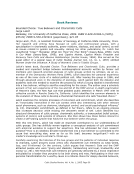
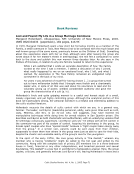
Lost and Found: My Life in a Group Marriage Commune
Margaret Hollenbach. Albuquerque, NM: University of New Mexico Press, 2004.
ISBN 0826334636 (paperback), 184 pages, $16.95
In 1970, Margaret Hollenbach spent a few short but formative months as a member of The
Family, a small commune in Taos, New Mexico (not to be confused with the much larger and
well-known group of the same name, previously known as the Children of God). Something
about this experience stuck with her so that, although soon after leaving the group she
wrote about it for her master‘s thesis in anthropology, she still felt a compulsion to come
back to the story and publish this new memoir three decades later. As she says in the
Preface of this book, in relation to why she felt she needed to return to this experience:
While I am satisfied that I wrote an accurate description of how The Family
worked at the time I was a member, I tabled a discussion of why I joined,
what really happened to me on an emotional level, why I left, and what I
learned. My experience in The Taos Family remained an undigested lump
somewhere in the back of my mind.
For years I was ashamed of myself for having chosen [...]a group that turned
out to have millenarian beliefs that I thought were foolish and a charismatic
leader who, in spite of all that was said about his reluctance to lead and his
voluntary giving up of power, wielded considerable authority and gave the
group the characteristics of a cult (p. ix).
Hollenbach‘s lively and quite gripping memoir is a useful and honest study of a small,
loosely organized, and yet highly controlling group. Although the analytical portion of this
book isn‘t particularly strong, her personal narrative is a helpful and interesting addition to
the cultic-studies literature.
Hollenbach recounts the details of cultic control with which we are, in a general way,
familiar. The leader, Lord Byron (leadership personnel, oddly, were given titles such as Lord,
Lady, Mistress, and Sir), is an ex-con who, she suggests, may have learned his
manipulative techniques while doing time for armed robbery in San Quentin prison. She
describes Lord Byron as both charismatic and authoritarian, with an underlying violence that
he seemingly consciously suppresses. Lord Byron uses sex—he sleeps with all the women in
the commune—as part of his system of control. Assuring his dominance in the group, he
breaks apart couples who have ―special bonds‖ because a ―tight couple takes energy away
from the group.‖ In a similar vein, parents could be sent away from their children,
supposedly to show them how others in the group were just as able to care for their kids,
despite the chaotic and unreliable reality of the group‘s care for the youngsters.
In the spirit of the early 1970s, the core group activity is ―the Gestalt,‖ wherein any
member who is having ―problems‖ might be called to the hot seat and grilled by the
community. Along with the complete lack of privacy (55 members live in a three-bedroom
house in Taos), financial or any other independence, and breached personal and sexual
boundaries, ―the Gestalt‖ is a key tool in Lord Byron‘s manipulative arsenal. Here, the group
cajoles, criticizes, and generally enforces Lord Byron‘s will, leaving Hollenbach in tears and a
Book Reviews
Lost and Found: My Life in a Group Marriage Commune
Margaret Hollenbach. Albuquerque, NM: University of New Mexico Press, 2004.
ISBN 0826334636 (paperback), 184 pages, $16.95
In 1970, Margaret Hollenbach spent a few short but formative months as a member of The
Family, a small commune in Taos, New Mexico (not to be confused with the much larger and
well-known group of the same name, previously known as the Children of God). Something
about this experience stuck with her so that, although soon after leaving the group she
wrote about it for her master‘s thesis in anthropology, she still felt a compulsion to come
back to the story and publish this new memoir three decades later. As she says in the
Preface of this book, in relation to why she felt she needed to return to this experience:
While I am satisfied that I wrote an accurate description of how The Family
worked at the time I was a member, I tabled a discussion of why I joined,
what really happened to me on an emotional level, why I left, and what I
learned. My experience in The Taos Family remained an undigested lump
somewhere in the back of my mind.
For years I was ashamed of myself for having chosen [...]a group that turned
out to have millenarian beliefs that I thought were foolish and a charismatic
leader who, in spite of all that was said about his reluctance to lead and his
voluntary giving up of power, wielded considerable authority and gave the
group the characteristics of a cult (p. ix).
Hollenbach‘s lively and quite gripping memoir is a useful and honest study of a small,
loosely organized, and yet highly controlling group. Although the analytical portion of this
book isn‘t particularly strong, her personal narrative is a helpful and interesting addition to
the cultic-studies literature.
Hollenbach recounts the details of cultic control with which we are, in a general way,
familiar. The leader, Lord Byron (leadership personnel, oddly, were given titles such as Lord,
Lady, Mistress, and Sir), is an ex-con who, she suggests, may have learned his
manipulative techniques while doing time for armed robbery in San Quentin prison. She
describes Lord Byron as both charismatic and authoritarian, with an underlying violence that
he seemingly consciously suppresses. Lord Byron uses sex—he sleeps with all the women in
the commune—as part of his system of control. Assuring his dominance in the group, he
breaks apart couples who have ―special bonds‖ because a ―tight couple takes energy away
from the group.‖ In a similar vein, parents could be sent away from their children,
supposedly to show them how others in the group were just as able to care for their kids,
despite the chaotic and unreliable reality of the group‘s care for the youngsters.
In the spirit of the early 1970s, the core group activity is ―the Gestalt,‖ wherein any
member who is having ―problems‖ might be called to the hot seat and grilled by the
community. Along with the complete lack of privacy (55 members live in a three-bedroom
house in Taos), financial or any other independence, and breached personal and sexual
boundaries, ―the Gestalt‖ is a key tool in Lord Byron‘s manipulative arsenal. Here, the group
cajoles, criticizes, and generally enforces Lord Byron‘s will, leaving Hollenbach in tears and a