Cultic Studies Review, Vol. 4, No. 1, 2005, Page 39
Book Reviews
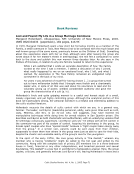
Bounded Choice: True Believers and Charismatic Cults
Janja Lalich
Berkeley, CA: University of California Press, 2004. ISBN 0-520-23194-5 (cloth),
$55.00 ISBN 9-520-24018-9 (paperback), $21.95
Janja Lalich, Ph.D., is Assistant Professor of Sociology at California State University, Chico.
Her research and writing have focused on cults and controversial groups, with a
specialization in charismatic authority, power relations, ideology, and social control, as well
as issues related to gender and sexuality. Among her other publications, Dr. Lalich has
coauthored “Crazy” Therapies: What Are They? Do They Work? (Jossey-Bass, 1996) Cults
in Our Midst (Jossey-Bass, 1995) and Captive Hearts, Captive Minds: Freedom and
Recovery from Cults and Abusive Relationships (Hunter House, 1994). She served as the
guest editor of a special issue of Cultic Studies Journal (vol. 14, no. 1, 1997) entitled
Women Under the Influence: A Study of Women’s Lives in Totalist Groups.
Lalich‘s latest book, Bounded Choice: True Believers and Charismatic Cults, provides a
needed and important bridge between autobiographical accounts written by former cult
members and research-oriented analyses of cultic groups written by scholars. As an ex-
member of the Democratic Workers Party (DWP), Lalich describes her personal experience
as one of the inner circle of a radical political cult. After leaving the group in 1986, and
through advanced work in the discipline of sociology, Lalich gained both the distance and
academic tools she needed to examine the process by which a young idealist is transformed
into a true believer, willing to sacrifice everything for the cause. The author uses a scholarly
account of her own experience of the rise and fall of the DWP and an in-depth examination
of Heaven‘s Gate, the New Age cult that grabbed public attention in March 1997 with its
collective suicide in Rancho Santa Fe, California. Lalich identifies the common elements in
the evolution of these cults to develop a theoretical framework she calls ―bounded choice.‖
Lalich examines the complex processes of conversion and commitment, which she describes
as ―inextricably intertwined in the cult context while also intersecting with other relevant
social phenomena, such as charisma, ideological control, and social-psychological influence‖
(p. 15). Charismatic commitment, as defined in her theory, refers to an ongoing process
that increases devotion while eroding the devotee‘s sense of self. Lalich identifies four
structural dimensions of cultic groups: charismatic authority, a transcendent belief system,
systems of control, and systems of influence. She then shows how these factors interact to
create a self-sealing system that holds the true believer within the group.
With this new theory, Lalich has made an important contribution to our understanding of
cultic groups. She has skillfully woven together a conceptual analysis of cult commitment
with empirical evidence to support her assertions. She has addressed her main research
question—How is an idealistic devotee transformed into a true believer so committed to the
cause that everything else, even as far as life itself, becomes insignificant?—with an
insider‘s knowledge and a scholar‘s critical eye.
Carefully examining the histories of the two groups and the patterns of individual response
to charisma, Lalich answers social critics who characterize cult members as weak-willed,
lazy, and ill-informed. On the contrary, Lalich argues that Heaven‘s Gate and the DWP
attracted people who were ―giving and idealistic, hardworking and loyal, trustworthy and
loving‖ (p. 261). She finds that cult members are generally attracted by a moral imperative
articulated by a leader they perceive to be both strong and wise. Participating in their own
personal transformation for a worthy cause is a rational choice for deeply devoted believers,
Book Reviews
Bounded Choice: True Believers and Charismatic Cults
Janja Lalich
Berkeley, CA: University of California Press, 2004. ISBN 0-520-23194-5 (cloth),
$55.00 ISBN 9-520-24018-9 (paperback), $21.95
Janja Lalich, Ph.D., is Assistant Professor of Sociology at California State University, Chico.
Her research and writing have focused on cults and controversial groups, with a
specialization in charismatic authority, power relations, ideology, and social control, as well
as issues related to gender and sexuality. Among her other publications, Dr. Lalich has
coauthored “Crazy” Therapies: What Are They? Do They Work? (Jossey-Bass, 1996) Cults
in Our Midst (Jossey-Bass, 1995) and Captive Hearts, Captive Minds: Freedom and
Recovery from Cults and Abusive Relationships (Hunter House, 1994). She served as the
guest editor of a special issue of Cultic Studies Journal (vol. 14, no. 1, 1997) entitled
Women Under the Influence: A Study of Women’s Lives in Totalist Groups.
Lalich‘s latest book, Bounded Choice: True Believers and Charismatic Cults, provides a
needed and important bridge between autobiographical accounts written by former cult
members and research-oriented analyses of cultic groups written by scholars. As an ex-
member of the Democratic Workers Party (DWP), Lalich describes her personal experience
as one of the inner circle of a radical political cult. After leaving the group in 1986, and
through advanced work in the discipline of sociology, Lalich gained both the distance and
academic tools she needed to examine the process by which a young idealist is transformed
into a true believer, willing to sacrifice everything for the cause. The author uses a scholarly
account of her own experience of the rise and fall of the DWP and an in-depth examination
of Heaven‘s Gate, the New Age cult that grabbed public attention in March 1997 with its
collective suicide in Rancho Santa Fe, California. Lalich identifies the common elements in
the evolution of these cults to develop a theoretical framework she calls ―bounded choice.‖
Lalich examines the complex processes of conversion and commitment, which she describes
as ―inextricably intertwined in the cult context while also intersecting with other relevant
social phenomena, such as charisma, ideological control, and social-psychological influence‖
(p. 15). Charismatic commitment, as defined in her theory, refers to an ongoing process
that increases devotion while eroding the devotee‘s sense of self. Lalich identifies four
structural dimensions of cultic groups: charismatic authority, a transcendent belief system,
systems of control, and systems of influence. She then shows how these factors interact to
create a self-sealing system that holds the true believer within the group.
With this new theory, Lalich has made an important contribution to our understanding of
cultic groups. She has skillfully woven together a conceptual analysis of cult commitment
with empirical evidence to support her assertions. She has addressed her main research
question—How is an idealistic devotee transformed into a true believer so committed to the
cause that everything else, even as far as life itself, becomes insignificant?—with an
insider‘s knowledge and a scholar‘s critical eye.
Carefully examining the histories of the two groups and the patterns of individual response
to charisma, Lalich answers social critics who characterize cult members as weak-willed,
lazy, and ill-informed. On the contrary, Lalich argues that Heaven‘s Gate and the DWP
attracted people who were ―giving and idealistic, hardworking and loyal, trustworthy and
loving‖ (p. 261). She finds that cult members are generally attracted by a moral imperative
articulated by a leader they perceive to be both strong and wise. Participating in their own
personal transformation for a worthy cause is a rational choice for deeply devoted believers,