Cultic Studies Review, Vol. 4, No. 1, 2005, Page 4
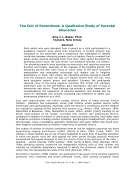
The Cult of Parenthood: A Qualitative Study of Parental
Alienation
Amy J. L. Baker, Ph.D.
Teaneck, New Jersey
Abstract
Forty adults who were alienated from a parent as a child participated in a
qualitative research study about their experience. A content analysis was
conducted on the transcripts and a comparison was undertaken to identify
similarities between alienating parents and cult leaders. Results revealed that
adults whose parents alienated them from their other parent described the
alienating parent much the way former cult members describe cult leaders.
The alienating parents were described as narcissistic and requiring excessive
devotion and loyalty, especially at the expense of the targeted parent. The
alienating parents also were found to utilize many of the same emotional
manipulation and persuasion techniques cult leaders use to heighten
dependency on them. And, finally, the alienating parents seemed to benefit
from the alienation much the way cult leaders benefit from the cult: they
have excessive control, power, and adulation. Likewise, the participants
reported many of the same negative outcomes that former cult members
experience such as low self-esteem, guilt, depression, and lack of trust in
themselves and others. These findings can provide a useful framework for
conceptualizing the experience of parental alienation and should also be
useful for therapists who provide counseling and treatment to adults who
experienced alienation as a child.
Each year approximately one million couples divorce. Many of these divorces involve
children. Research has consistently shown that children whose parents divorce suffer
emotionally and psychologically, especially when the divorce is contentious and the children
are exposed to ongoing conflict between their parents (e.g., Amato, 1994 Johnston, 1994,
Wallerstein &Blakeslee, 1996 Wallerstein &Lewis, 2004). Amato (1994), building on an
earlier meta-analysis of 92 studies, concluded that children who experienced divorce,
compared to samples of children in continuously intact two-parent families, had higher rates
of negative outcomes including conduct problems, psychological maladjustment, and poorer
self-concepts. Using a qualitative approach, Wallerstein and Lewis (2004) also found long-
term negative consequences of children‘s experience of parental divorce.
One subset of children of divorce considered most at risk for negative outcomes are those
experiencing ongoing post-divorce conflict (Garrity &Baris, 1994, Turkat, 2002). The
children in these families are at risk of being subjected to some form of parental alienation
in which one parent turns the child against the other parent through powerful emotional
manipulation techniques designed to bind the child to them at the exclusion of the other –
targeted --parent (Darnall, 1998 Gardner, 1998 Garrity &Baris, 1994 Warshak, 2001).
These alienating parents undermine the independent thinking skills of their children and
cultivate an unhealthy dependency designed to satisfy the emotional needs of the adult
rather than the developmental needs of the child (Warshak, 2001).
According to Gardner (1998) children can experience three levels of the parental alienation
syndrome: mild, moderate, and severe (although Turkat, 2002 outlined conceptual issues
The Cult of Parenthood: A Qualitative Study of Parental
Alienation
Amy J. L. Baker, Ph.D.
Teaneck, New Jersey
Abstract
Forty adults who were alienated from a parent as a child participated in a
qualitative research study about their experience. A content analysis was
conducted on the transcripts and a comparison was undertaken to identify
similarities between alienating parents and cult leaders. Results revealed that
adults whose parents alienated them from their other parent described the
alienating parent much the way former cult members describe cult leaders.
The alienating parents were described as narcissistic and requiring excessive
devotion and loyalty, especially at the expense of the targeted parent. The
alienating parents also were found to utilize many of the same emotional
manipulation and persuasion techniques cult leaders use to heighten
dependency on them. And, finally, the alienating parents seemed to benefit
from the alienation much the way cult leaders benefit from the cult: they
have excessive control, power, and adulation. Likewise, the participants
reported many of the same negative outcomes that former cult members
experience such as low self-esteem, guilt, depression, and lack of trust in
themselves and others. These findings can provide a useful framework for
conceptualizing the experience of parental alienation and should also be
useful for therapists who provide counseling and treatment to adults who
experienced alienation as a child.
Each year approximately one million couples divorce. Many of these divorces involve
children. Research has consistently shown that children whose parents divorce suffer
emotionally and psychologically, especially when the divorce is contentious and the children
are exposed to ongoing conflict between their parents (e.g., Amato, 1994 Johnston, 1994,
Wallerstein &Blakeslee, 1996 Wallerstein &Lewis, 2004). Amato (1994), building on an
earlier meta-analysis of 92 studies, concluded that children who experienced divorce,
compared to samples of children in continuously intact two-parent families, had higher rates
of negative outcomes including conduct problems, psychological maladjustment, and poorer
self-concepts. Using a qualitative approach, Wallerstein and Lewis (2004) also found long-
term negative consequences of children‘s experience of parental divorce.
One subset of children of divorce considered most at risk for negative outcomes are those
experiencing ongoing post-divorce conflict (Garrity &Baris, 1994, Turkat, 2002). The
children in these families are at risk of being subjected to some form of parental alienation
in which one parent turns the child against the other parent through powerful emotional
manipulation techniques designed to bind the child to them at the exclusion of the other –
targeted --parent (Darnall, 1998 Gardner, 1998 Garrity &Baris, 1994 Warshak, 2001).
These alienating parents undermine the independent thinking skills of their children and
cultivate an unhealthy dependency designed to satisfy the emotional needs of the adult
rather than the developmental needs of the child (Warshak, 2001).
According to Gardner (1998) children can experience three levels of the parental alienation
syndrome: mild, moderate, and severe (although Turkat, 2002 outlined conceptual issues