Cultic Studies Review, Vol. 4, No. 1, 2005, Page 20
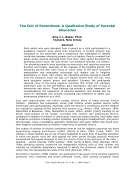
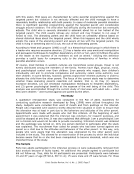
Terrorists Are Made, Not Born: Creating Terrorists Using
Social Psychological Conditioning
Anthony Stahelski, Ph.D.
Central Washington University
Abstract
Sociologists and social psychologists have discovered that terrorist groups
use cult-like conditioning techniques to convert normal individuals into
remorseless killers. The limited global counterterrorism resources should
focus on eradicating the terrorist group training camps where the
conditioning takes place, rather than on trying to find terrorists after they
have already been conditioned.
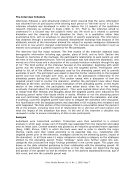
Psychologists have thus far been unable to verify the existence of an individual-level
universal terrorist profile. This disappointing finding makes the search for terrorists who
appear and act normally in a larger population of non-terrorists much more difficult.
However, sociologists and social psychologists have discovered that terrorist groups use
cult-like conditioning techniques to convert normal individuals into remorseless killers. The
premise of this article is that the limited global counterterrorism resources should focus on
eradicating the terrorist group training camps where the conditioning takes place, rather
than on trying to find terrorists after they have already been conditioned. Five phases of
conditioning are described: depluralization, self-deindividuation, other-deindividuation,
dehumanization, and demonization. All conditioning phases are supported by powerful group
dynamics that reinforce the effectiveness of the conditioning. It appears that most terrorist
groups use all or most of the social psychological conditioning and support processes
described here. Since the cult-conditioned products of these processes are currently the
most dangerous individuals on the planet, the article concludes with several
recommendations for disrupting and possibly eliminating the groups and the training
facilities, in order to stop the production of terrorist operators.
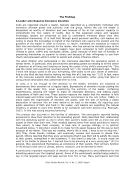
Terrorism researchers have generally concluded that most terrorists are not initially
psychopaths,1 that most terrorists are not obviously or consistently mentally ill,2,3 and that
there is as of yet no identified universal terrorist personality pattern.4
These findings are unfortunate. Counterterrorism efforts would be enhanced if likely
terrorist candidates could be preemptively identified on a precise individual basis.
However, less universal efforts at individual terrorist characteristic identification have been
somewhat more successful. In the 1970s, German and Italian researchers had access to
captured members of and government documents about the Red Army Faction and the Red
Brigades. The researchers identified some family background commonalities: Many
terrorists came from families where the father was absent or, even when the father was
present, the children were estranged from the father.5,6 More recent observations of modern
terrorist groups indicate that some terrorists come from ―broken‖ homes, where the father
is absent, estranged, or economically or politically impotent.7
Additionally, some terrorist group joiners are individuals who have had difficulty forming
consistent group identities outside the home, such as school or the workplace.8
Terrorists Are Made, Not Born: Creating Terrorists Using
Social Psychological Conditioning
Anthony Stahelski, Ph.D.
Central Washington University
Abstract
Sociologists and social psychologists have discovered that terrorist groups
use cult-like conditioning techniques to convert normal individuals into
remorseless killers. The limited global counterterrorism resources should
focus on eradicating the terrorist group training camps where the
conditioning takes place, rather than on trying to find terrorists after they
have already been conditioned.
Psychologists have thus far been unable to verify the existence of an individual-level
universal terrorist profile. This disappointing finding makes the search for terrorists who
appear and act normally in a larger population of non-terrorists much more difficult.
However, sociologists and social psychologists have discovered that terrorist groups use
cult-like conditioning techniques to convert normal individuals into remorseless killers. The
premise of this article is that the limited global counterterrorism resources should focus on
eradicating the terrorist group training camps where the conditioning takes place, rather
than on trying to find terrorists after they have already been conditioned. Five phases of
conditioning are described: depluralization, self-deindividuation, other-deindividuation,
dehumanization, and demonization. All conditioning phases are supported by powerful group
dynamics that reinforce the effectiveness of the conditioning. It appears that most terrorist
groups use all or most of the social psychological conditioning and support processes
described here. Since the cult-conditioned products of these processes are currently the
most dangerous individuals on the planet, the article concludes with several
recommendations for disrupting and possibly eliminating the groups and the training
facilities, in order to stop the production of terrorist operators.
Terrorism researchers have generally concluded that most terrorists are not initially
psychopaths,1 that most terrorists are not obviously or consistently mentally ill,2,3 and that
there is as of yet no identified universal terrorist personality pattern.4
These findings are unfortunate. Counterterrorism efforts would be enhanced if likely
terrorist candidates could be preemptively identified on a precise individual basis.
However, less universal efforts at individual terrorist characteristic identification have been
somewhat more successful. In the 1970s, German and Italian researchers had access to
captured members of and government documents about the Red Army Faction and the Red
Brigades. The researchers identified some family background commonalities: Many
terrorists came from families where the father was absent or, even when the father was
present, the children were estranged from the father.5,6 More recent observations of modern
terrorist groups indicate that some terrorists come from ―broken‖ homes, where the father
is absent, estranged, or economically or politically impotent.7
Additionally, some terrorist group joiners are individuals who have had difficulty forming
consistent group identities outside the home, such as school or the workplace.8