Cultic Studies Journal, Vol. 9, No. 1, 1992, Page 62
v. persons working for sects should be registered with social welfare bodies and
guaranteed social welfare coverage, and such social welfare provision should
also be available to those deciding to leave the sects.
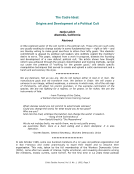
1. Introductory Remarks
Should this report have been called "freedom of religion" or "sects and new religious
movements"?
The two motions for recommendations which provided the report with its starting point were
headed "freedom of religion," but they both concerned sects. We shall see, in fact, that the
two things are closely linked.
Andre Malraux's famous phrase, "The 21st century will be spiritual, or it will be nothing," is
proving prophetic. As the 21st century approaches, sects are proliferating, while the
fundamentalist tendencies inherent in all religions are growing stronger. The phenomenon
may not be a new one, but it is growing and spreading internationally in a way which has
often brought it to the headlines. Very recently, indeed, sects were reported to be threatening
the very basis of government in Latin America.
Sociologists and churchmen who have looked at the reasons for the trend have come up with
two possible explanations which complement each other:
Firstly, there is a waning of interest in and support for churches of the traditional
kind, which are blamed for failing to keep pace with social trends, losing their purity,
and shedding their mystery, thus leaving a yawning gap in the field of spiritual quest
Secondly, secular alternatives to religion have not been properly considered, and this
has left an ethical void.
These two explanations may be put in a nutshell by saying that sects have taken advantage
of the vacuum left by waning interest in the traditional institutions which once answered the
great questions of existence.
Before we look at the problem in more depth, some preliminary points should be clarified.
The Rapporteur has deliberately chosen not to provide a list of sects, or to name and describe
some of the best known. Lists of this kind can easily be found in published sources, such as
the Vivien report, Sects in France: Expressions of Moral Freedom or Means of Manipulation?,
prepared for the French Prime Minister in 1985. Most sects are actually found in many
countries, since the phenomenon undeniably has an international dimension.
Similarly, he has chosen not to describe the activities of these sects or the abuses of which
some of them are accused, which are detailed in the Cottrell report presented to the European
Parliament (doc. 1-47/84).
At one stage, it was also suggested that a hearing of representatives of sects might be
organized. This would have spared the Assembly the criticism levelled at Mr. Alain Vivien,
namely, that he had derived his information solely from the Ministry of the Interior, anti-sect
groups, and former members of sects and had not interviewed representatives of the various
well-known movements. It would have also met the wishes of the sects themselves.
Various problems would, however, have arisen. It might have seemed that anti-sect
movements should be heard to balance the hearing of sects. Above all, what sects should
have been invited? Any choice would have been arbitrary, since there were no obvious criteria
for making it: membership, public impact, controversies generated? There was a real danger
of providing a platform for sects already well equipped to publicize themselves, which would
have lost no time in making use of the "recognition" thus accorded them by the Council of
v. persons working for sects should be registered with social welfare bodies and
guaranteed social welfare coverage, and such social welfare provision should
also be available to those deciding to leave the sects.
1. Introductory Remarks
Should this report have been called "freedom of religion" or "sects and new religious
movements"?
The two motions for recommendations which provided the report with its starting point were
headed "freedom of religion," but they both concerned sects. We shall see, in fact, that the
two things are closely linked.
Andre Malraux's famous phrase, "The 21st century will be spiritual, or it will be nothing," is
proving prophetic. As the 21st century approaches, sects are proliferating, while the
fundamentalist tendencies inherent in all religions are growing stronger. The phenomenon
may not be a new one, but it is growing and spreading internationally in a way which has
often brought it to the headlines. Very recently, indeed, sects were reported to be threatening
the very basis of government in Latin America.
Sociologists and churchmen who have looked at the reasons for the trend have come up with
two possible explanations which complement each other:
Firstly, there is a waning of interest in and support for churches of the traditional
kind, which are blamed for failing to keep pace with social trends, losing their purity,
and shedding their mystery, thus leaving a yawning gap in the field of spiritual quest
Secondly, secular alternatives to religion have not been properly considered, and this
has left an ethical void.
These two explanations may be put in a nutshell by saying that sects have taken advantage
of the vacuum left by waning interest in the traditional institutions which once answered the
great questions of existence.
Before we look at the problem in more depth, some preliminary points should be clarified.
The Rapporteur has deliberately chosen not to provide a list of sects, or to name and describe
some of the best known. Lists of this kind can easily be found in published sources, such as
the Vivien report, Sects in France: Expressions of Moral Freedom or Means of Manipulation?,
prepared for the French Prime Minister in 1985. Most sects are actually found in many
countries, since the phenomenon undeniably has an international dimension.
Similarly, he has chosen not to describe the activities of these sects or the abuses of which
some of them are accused, which are detailed in the Cottrell report presented to the European
Parliament (doc. 1-47/84).
At one stage, it was also suggested that a hearing of representatives of sects might be
organized. This would have spared the Assembly the criticism levelled at Mr. Alain Vivien,
namely, that he had derived his information solely from the Ministry of the Interior, anti-sect
groups, and former members of sects and had not interviewed representatives of the various
well-known movements. It would have also met the wishes of the sects themselves.
Various problems would, however, have arisen. It might have seemed that anti-sect
movements should be heard to balance the hearing of sects. Above all, what sects should
have been invited? Any choice would have been arbitrary, since there were no obvious criteria
for making it: membership, public impact, controversies generated? There was a real danger
of providing a platform for sects already well equipped to publicize themselves, which would
have lost no time in making use of the "recognition" thus accorded them by the Council of