Cultic Studies Review, Vol. 8, No. 2, 2009, Page 8
abusive. The reliability coefficients identified for the Spanish version applied to a group of
former members of various manipulative groups, and which have been used in this study,
were, in general, satisfactory, fluctuating between 0.70 for the Exploitation subscale, to
0.75 for that of Mind Control, and 0.86 for that of Compliance. We administered the test
twice, separated by varying time intervals.
We used the Symptom Checklist—90—Revised (SCL—90—R Derogatis, 1983—Spanish
version adapted by González de Rivera et al., 2002). This self-report inventory contains 90
items designed to detect and measure current symptoms of psychopathology and symptom
patterns. Each item is a description of a psychological symptom and is rated by the subject
on a Likert scale, from 0 (total absence of problems related to the symptom) to 4 (severe
problems), in accordance with the severity of the problem experienced over the preceding
seven days. Based on these 90 items, a summary index of psychological distress, the Global
Severity Index (GSI), is obtained. The index is typically used as a simple sensitive measure
of a subject‘s overall psychological distress.
Procedure
We collected the data over a fairly long period (June 2001 to May 2005). The participants,
who lived in a number of different Spanish provinces, were, in those instances where they
were interviewed face-to-face by the first author, assessed in suitable locations. Because of
the characteristics of the sample, among which we should highlight the difficulties in making
contact with the participants, and a certain reluctance on the part of some subjects to
participate in person, we included two modes of participation in the study: face-to-face and
by mail. A total of 58 subjects (57.4%) participated face-to-face and 43 individuals (42.6%)
replied to the instruments and returned their responses by mail. This latter group was
informed of the nature of the study by telephone. They all completed an informed-consent
form, participating voluntarily and without recompense in the study. Only two people who
met the inclusion criteria refused to participate in the study (in either mode) during the
initial telephone interview. All those who agreed to be interviewed in person came to the
interview at the time and place assigned. Of the 62 packages sent to be completed by mail,
either directly to the participant or indirectly to a research collaborator, 43 were returned
and successfully completed, and two were incorrectly completed. This gave us a return rate
of 72.58% for the mail mode and an effective response rate of 69.35%.
The material for the test-retest study was sent to those participants among the 101 former
members who gave a standard mailing address in the first contact (70 subjects). Of these,
50 respondents returned the tests correctly filled in, giving an effective response rate of
71.4%. The time intervals between evaluation varied greatly from one subject to another,
ranging between 1.25 months and 32.32 months, with the average time elapsed being
15.52 months (SD: 7.26).
Results
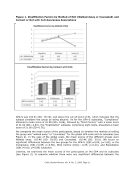
Because we found no significant differences in the variables of interest between the
methods of response (in person or by mail), we consider the data together in the rest of the
analysis (GPA: Mean Mail Score: 103.37 Mean In-person Score: 103.79 t(99)=-0.12
p=0.91) (GSI males: 0.70 0.66 t(41)=0.17 p=0.87) (GSI females: 0.99 0.86
t(37)=0.58 p=0.57).
Sample Characteristics
The sample comprised a total of 101 subjects, self-identified as former members of one of a
total of 27 abusive manipulative groups ranging from religious, to new age, to
rehabilitative/ pseudotherapeutic, to political and/or commercial. Fifty-five subjects were
male (54.5%), and 46 subjects were female (45.5%). Their mean age on participation was
43.47 years (SD: 12.22). The mean age of the subjects when they joined their respective
abusive. The reliability coefficients identified for the Spanish version applied to a group of
former members of various manipulative groups, and which have been used in this study,
were, in general, satisfactory, fluctuating between 0.70 for the Exploitation subscale, to
0.75 for that of Mind Control, and 0.86 for that of Compliance. We administered the test
twice, separated by varying time intervals.
We used the Symptom Checklist—90—Revised (SCL—90—R Derogatis, 1983—Spanish
version adapted by González de Rivera et al., 2002). This self-report inventory contains 90
items designed to detect and measure current symptoms of psychopathology and symptom
patterns. Each item is a description of a psychological symptom and is rated by the subject
on a Likert scale, from 0 (total absence of problems related to the symptom) to 4 (severe
problems), in accordance with the severity of the problem experienced over the preceding
seven days. Based on these 90 items, a summary index of psychological distress, the Global
Severity Index (GSI), is obtained. The index is typically used as a simple sensitive measure
of a subject‘s overall psychological distress.
Procedure
We collected the data over a fairly long period (June 2001 to May 2005). The participants,
who lived in a number of different Spanish provinces, were, in those instances where they
were interviewed face-to-face by the first author, assessed in suitable locations. Because of
the characteristics of the sample, among which we should highlight the difficulties in making
contact with the participants, and a certain reluctance on the part of some subjects to
participate in person, we included two modes of participation in the study: face-to-face and
by mail. A total of 58 subjects (57.4%) participated face-to-face and 43 individuals (42.6%)
replied to the instruments and returned their responses by mail. This latter group was
informed of the nature of the study by telephone. They all completed an informed-consent
form, participating voluntarily and without recompense in the study. Only two people who
met the inclusion criteria refused to participate in the study (in either mode) during the
initial telephone interview. All those who agreed to be interviewed in person came to the
interview at the time and place assigned. Of the 62 packages sent to be completed by mail,
either directly to the participant or indirectly to a research collaborator, 43 were returned
and successfully completed, and two were incorrectly completed. This gave us a return rate
of 72.58% for the mail mode and an effective response rate of 69.35%.
The material for the test-retest study was sent to those participants among the 101 former
members who gave a standard mailing address in the first contact (70 subjects). Of these,
50 respondents returned the tests correctly filled in, giving an effective response rate of
71.4%. The time intervals between evaluation varied greatly from one subject to another,
ranging between 1.25 months and 32.32 months, with the average time elapsed being
15.52 months (SD: 7.26).
Results
Because we found no significant differences in the variables of interest between the
methods of response (in person or by mail), we consider the data together in the rest of the
analysis (GPA: Mean Mail Score: 103.37 Mean In-person Score: 103.79 t(99)=-0.12
p=0.91) (GSI males: 0.70 0.66 t(41)=0.17 p=0.87) (GSI females: 0.99 0.86
t(37)=0.58 p=0.57).
Sample Characteristics
The sample comprised a total of 101 subjects, self-identified as former members of one of a
total of 27 abusive manipulative groups ranging from religious, to new age, to
rehabilitative/ pseudotherapeutic, to political and/or commercial. Fifty-five subjects were
male (54.5%), and 46 subjects were female (45.5%). Their mean age on participation was
43.47 years (SD: 12.22). The mean age of the subjects when they joined their respective