Cultic Studies Review, Vol. 8, No. 2, 2009, Page 3
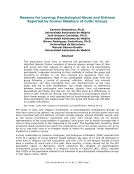
Reasons for Leaving: Psychological Abuse and Distress
Reported by Former Members of Cultic Groups
Carmen Almendros, Ph.D.
Universidad Autónoma de Madrid
José Antonio Carrobles, Ph.D.
Universidad Autónoma de Madrid
Álvaro Rodríguez-Carballeira, Ph.D.
Universidad de Barcelona
Manuel Gámez-Guadix
Universidad Autónoma de Madrid
Abstract
This exploratory study aims to examine the perceptions that 101 self-
identified Spanish former members of diverse abusive groups have of their
past group and their reasons for leaving it, as well as the psychological
distress they experienced following their exit. In addition, we compare the
participants‘ responses according to their methods of exiting the group and
according to whether or not they received any assistance from cult-
awareness organizations. Most of our participants walked away from the
group following a period of personal reflection, without any external
intervention, and they considered their own disillusionment as the main
factor that led to their disaffiliation. Our results showed no differences
between those participants who received support from cult-awareness
associations and those who did not nor did they show any differences, in
terms of their motives for leaving, their perceptions of psychological abuse in
their former groups, or their reported level of psychological distress, between
those participants who walked away from the group and those who left after
an outside intervention.
Key words: Cults New religious movements Cult disaffiliation Method of exit
The study of cults, new religious movements, or psychologically manipulative groups, as
they have come to be labeled, has acquired increasing relevance as society grows more and
more concerned with the behavior of some of these groups. Various dramatic events, such
as the ―group immolations‖ associated with cults, even though they are not exactly
representative of the social problem in question, have given rise to media coverage that is
more or less proportional to the magnitude of the event. The bewilderment caused by these
occasional deeds promotes the search for explanations as to how certain persons can go so
far as to lose their lives or to threaten those of others for supposed ―moral imperatives‖
dictated by a leader or group.
A study undertaken by Canteras, Rodríguez, and Rodríguez-Carballeira (1992) reported that
0.5% of a sample of young Spanish people between the ages of 14 and 29 belonged to
some kind of religious cult-like association, and that 1.5% of the sample claimed to have
been a member at some time in the past. More recently, a study carried out for the AIS
association based in Barcelona, which examined the situation of psychologically
manipulative groups (not solely of a religious nature) in Catalonia (AIS, 2005), reported
that 0.82% of the population claimed to be members of psychologically manipulative groups
in that region (Jansà, 2004).
Reasons for Leaving: Psychological Abuse and Distress
Reported by Former Members of Cultic Groups
Carmen Almendros, Ph.D.
Universidad Autónoma de Madrid
José Antonio Carrobles, Ph.D.
Universidad Autónoma de Madrid
Álvaro Rodríguez-Carballeira, Ph.D.
Universidad de Barcelona
Manuel Gámez-Guadix
Universidad Autónoma de Madrid
Abstract
This exploratory study aims to examine the perceptions that 101 self-
identified Spanish former members of diverse abusive groups have of their
past group and their reasons for leaving it, as well as the psychological
distress they experienced following their exit. In addition, we compare the
participants‘ responses according to their methods of exiting the group and
according to whether or not they received any assistance from cult-
awareness organizations. Most of our participants walked away from the
group following a period of personal reflection, without any external
intervention, and they considered their own disillusionment as the main
factor that led to their disaffiliation. Our results showed no differences
between those participants who received support from cult-awareness
associations and those who did not nor did they show any differences, in
terms of their motives for leaving, their perceptions of psychological abuse in
their former groups, or their reported level of psychological distress, between
those participants who walked away from the group and those who left after
an outside intervention.
Key words: Cults New religious movements Cult disaffiliation Method of exit
The study of cults, new religious movements, or psychologically manipulative groups, as
they have come to be labeled, has acquired increasing relevance as society grows more and
more concerned with the behavior of some of these groups. Various dramatic events, such
as the ―group immolations‖ associated with cults, even though they are not exactly
representative of the social problem in question, have given rise to media coverage that is
more or less proportional to the magnitude of the event. The bewilderment caused by these
occasional deeds promotes the search for explanations as to how certain persons can go so
far as to lose their lives or to threaten those of others for supposed ―moral imperatives‖
dictated by a leader or group.
A study undertaken by Canteras, Rodríguez, and Rodríguez-Carballeira (1992) reported that
0.5% of a sample of young Spanish people between the ages of 14 and 29 belonged to
some kind of religious cult-like association, and that 1.5% of the sample claimed to have
been a member at some time in the past. More recently, a study carried out for the AIS
association based in Barcelona, which examined the situation of psychologically
manipulative groups (not solely of a religious nature) in Catalonia (AIS, 2005), reported
that 0.82% of the population claimed to be members of psychologically manipulative groups
in that region (Jansà, 2004).