Cultic Studies Journal, Vol. 15, No. 1, 1998, page 41
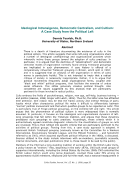
Residence Halls and Cults: Fact or Fiction?
Russell K. Elleven, Ed.D.
University of North Texas
Carolyn W. Kern, Ph.D.
University of North Texas
Katherine Claunch Moore
University of North Texas
Abstract
This article examines the perceptions of 414 chief housing officers of
residence hall (dormitory) systems across the United States with regard to
cult activity on college and university campuses. These individuals are in a
unique position to see first-year students struggle with the need to belong.
Sometimes this need leads to the college student joining a cult. The results of
the survey indicate that only about one-half of the responding chief housing
officers understand the cult issue on college campuses. The need is apparent
for further cult education for these college and university administrators.
With the exception of the concerted efforts of AFF (American Family Foundation),
particularly its preventive education program, the International Cult Education Program
(Rudin, 1996), little has been written recently in the student affairs literature concerning
cults on the college and university campus. At the same time there seems to be little
indication that cults are becoming less of an issue for institutions of higher education. Cults
can be destructive to both the individual and the institution. In fact, most cults are
antithetical to the mission of higher education. Generally, loss in the ability for abstract
thinking occurs when memorization of cult doctrine is put upon new recruits (Blimling,
1981).
Cults can be defined as groups having a “close allegiance to a charismatic leader, an
inordinate preoccupation on the part of the group with the attainment of money, and the
use of behavior modification practices and brainwashing techniques to convert and retain
members” (Blimling, 1995, p. 394). The leaders have an extraordinary amount of power
over their followers (Lewis, 1989). The process of conversion is typically described in terms
of unfreezing the recruit‟s beliefs, shaping, and then refreezing the cult‟s beliefs into the
new member‟s psyche. Cults are potentially dangerous to all students regardless of
upbringing – (Wright &Piper, 1986). Langone (1992) reports that 11% of 308 subjects in
one of his studies were recruited on a college campus. Altogether, 43% of the subjects
were students when they joined their groups: 10% high school 27% undergraduates and
6% graduate students.
According to Janosik (1993), students who become involved in cults will sometimes manifest
characteristics such as loss of free will, return to dependency, loss of spontaneity, inability
to form relationships, decreased intellectual ability, physical and psychological deterioration,
defacto slavery, and neurotic, psychotic, or suicidal tendencies. A great deal of time and
energy must be given to educating the former cult member (Goldberg &Goldberg, 1982),
not to mention the policy implications for administrators in higher education (Blimling,
1981, 1990 Johnson &Nelson, 1984). Deviant groups that become recognized student
organizations create additional concerns for college and university administrators (Kaplin &
Lee, 1995).
Many religious ideals and attitudes change for individuals during the college years
(Pascarella &Terenzini, 1991). Cult ideologies are often at least partially based on the
beliefs of mainstream religions (Rudin, 1990). Students may then feel they are becoming
Residence Halls and Cults: Fact or Fiction?
Russell K. Elleven, Ed.D.
University of North Texas
Carolyn W. Kern, Ph.D.
University of North Texas
Katherine Claunch Moore
University of North Texas
Abstract
This article examines the perceptions of 414 chief housing officers of
residence hall (dormitory) systems across the United States with regard to
cult activity on college and university campuses. These individuals are in a
unique position to see first-year students struggle with the need to belong.
Sometimes this need leads to the college student joining a cult. The results of
the survey indicate that only about one-half of the responding chief housing
officers understand the cult issue on college campuses. The need is apparent
for further cult education for these college and university administrators.
With the exception of the concerted efforts of AFF (American Family Foundation),
particularly its preventive education program, the International Cult Education Program
(Rudin, 1996), little has been written recently in the student affairs literature concerning
cults on the college and university campus. At the same time there seems to be little
indication that cults are becoming less of an issue for institutions of higher education. Cults
can be destructive to both the individual and the institution. In fact, most cults are
antithetical to the mission of higher education. Generally, loss in the ability for abstract
thinking occurs when memorization of cult doctrine is put upon new recruits (Blimling,
1981).
Cults can be defined as groups having a “close allegiance to a charismatic leader, an
inordinate preoccupation on the part of the group with the attainment of money, and the
use of behavior modification practices and brainwashing techniques to convert and retain
members” (Blimling, 1995, p. 394). The leaders have an extraordinary amount of power
over their followers (Lewis, 1989). The process of conversion is typically described in terms
of unfreezing the recruit‟s beliefs, shaping, and then refreezing the cult‟s beliefs into the
new member‟s psyche. Cults are potentially dangerous to all students regardless of
upbringing – (Wright &Piper, 1986). Langone (1992) reports that 11% of 308 subjects in
one of his studies were recruited on a college campus. Altogether, 43% of the subjects
were students when they joined their groups: 10% high school 27% undergraduates and
6% graduate students.
According to Janosik (1993), students who become involved in cults will sometimes manifest
characteristics such as loss of free will, return to dependency, loss of spontaneity, inability
to form relationships, decreased intellectual ability, physical and psychological deterioration,
defacto slavery, and neurotic, psychotic, or suicidal tendencies. A great deal of time and
energy must be given to educating the former cult member (Goldberg &Goldberg, 1982),
not to mention the policy implications for administrators in higher education (Blimling,
1981, 1990 Johnson &Nelson, 1984). Deviant groups that become recognized student
organizations create additional concerns for college and university administrators (Kaplin &
Lee, 1995).
Many religious ideals and attitudes change for individuals during the college years
(Pascarella &Terenzini, 1991). Cult ideologies are often at least partially based on the
beliefs of mainstream religions (Rudin, 1990). Students may then feel they are becoming