Cultic Studies Journal, Vol. 15, No. 1, 1998, page 20
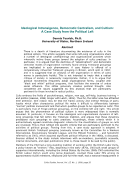
Ideological Intransigence, Democratic Centralism, and Cultism:
A Case Study from the Political Left
Dennis Tourish, Ph.D.
University of Ulster, Northern Ireland
Abstract
There is a dearth of literature documenting the existence of cults in the
political sphere. This article suggests that some left-wing organizations share
a number of ideological underpinnings and organizational practices which
inherently incline these groups toward the adoption of cultic practices. In
particular, it is argued that the doctrines of “catastrophism” and democratic
centralist modes of organization normally found among Trotskyist groupings
are implicated in such phenomenon. A case history is offered of a
comparatively influential Trotskyist grouping in Britain, which split in 1992
and it is suggested that an analysis of the organization in terms of cultic
norms is particularly fruitful. This is not intended to imply that a radical
critique of society is necessarily inappropriate. Rather, it is to argue that
political movements frequently adopt organizational forms, coupled with
“black and white” political programs, that facilitate the exercise of undue
social influence. This stifles genuinely creative political thought. Also
considered are issues suggested by this analysis that are particularly
pertinent for those involved in radical politics.
Cults embrace the fields of psychotherapy, religion, new age, self-help, business training --
and politics (Hassan, 1988 Singer with Lalich, 1995). Thus far, the latter area has attracted
little attention. One reason may be that the frantic activity and intense feelings of party
loyalty which often characterize political life make it difficult to differentiate between
“normal” political involvement and that which qualifies groups to be regarded as cultic. This
is particularly true of fringe political groupings, on the extreme left and right. This article
argues that the phenomenon of political cultism is more widespread than is normally
assumed. In particular, it focuses on the ideological and organizational dynamics of left-
wing groupings that fall within the Trotskyist tradition, and argues that these dynamics
predispose such groupings to cultic practices. Accordingly, those criteria which it is
authoritatively agreed constitute diagnostic criteria for the classification of groups as cults
are reviewed. This is then refined into specific criteria that are particularly pertinent to the
activities of political groups. Flowing from this, a case study approach is adopted. A
prominent British Trotskyist grouping (variously known as the Committee for a Workers
International, Revolutionary Socialist League, and the Militant Tendency --and henceforth
referred to as CWI), which acquired significant political influence in the 1980s, is discussed.
Sources utilized in the study include interviews with ex-members, journalistic accounts,
internal documents, and open publications (that is, those meant to be read by the public).
Members of the CWI had a long-standing tradition of working within the British Labor Party,
a policy known as “entrism.” Also, beginning in the early 1970s, CWI built small groups of
supporters internationally, including the United States. By the late 1980s CWI controlled the
British Labour Party‟s youth wing (since dissolved), counted three Labor MPs among its
approximately 8,000 members, employed 200 full-time staff, had a national headquarters in
Ideological Intransigence, Democratic Centralism, and Cultism:
A Case Study from the Political Left
Dennis Tourish, Ph.D.
University of Ulster, Northern Ireland
Abstract
There is a dearth of literature documenting the existence of cults in the
political sphere. This article suggests that some left-wing organizations share
a number of ideological underpinnings and organizational practices which
inherently incline these groups toward the adoption of cultic practices. In
particular, it is argued that the doctrines of “catastrophism” and democratic
centralist modes of organization normally found among Trotskyist groupings
are implicated in such phenomenon. A case history is offered of a
comparatively influential Trotskyist grouping in Britain, which split in 1992
and it is suggested that an analysis of the organization in terms of cultic
norms is particularly fruitful. This is not intended to imply that a radical
critique of society is necessarily inappropriate. Rather, it is to argue that
political movements frequently adopt organizational forms, coupled with
“black and white” political programs, that facilitate the exercise of undue
social influence. This stifles genuinely creative political thought. Also
considered are issues suggested by this analysis that are particularly
pertinent for those involved in radical politics.
Cults embrace the fields of psychotherapy, religion, new age, self-help, business training --
and politics (Hassan, 1988 Singer with Lalich, 1995). Thus far, the latter area has attracted
little attention. One reason may be that the frantic activity and intense feelings of party
loyalty which often characterize political life make it difficult to differentiate between
“normal” political involvement and that which qualifies groups to be regarded as cultic. This
is particularly true of fringe political groupings, on the extreme left and right. This article
argues that the phenomenon of political cultism is more widespread than is normally
assumed. In particular, it focuses on the ideological and organizational dynamics of left-
wing groupings that fall within the Trotskyist tradition, and argues that these dynamics
predispose such groupings to cultic practices. Accordingly, those criteria which it is
authoritatively agreed constitute diagnostic criteria for the classification of groups as cults
are reviewed. This is then refined into specific criteria that are particularly pertinent to the
activities of political groups. Flowing from this, a case study approach is adopted. A
prominent British Trotskyist grouping (variously known as the Committee for a Workers
International, Revolutionary Socialist League, and the Militant Tendency --and henceforth
referred to as CWI), which acquired significant political influence in the 1980s, is discussed.
Sources utilized in the study include interviews with ex-members, journalistic accounts,
internal documents, and open publications (that is, those meant to be read by the public).
Members of the CWI had a long-standing tradition of working within the British Labor Party,
a policy known as “entrism.” Also, beginning in the early 1970s, CWI built small groups of
supporters internationally, including the United States. By the late 1980s CWI controlled the
British Labour Party‟s youth wing (since dissolved), counted three Labor MPs among its
approximately 8,000 members, employed 200 full-time staff, had a national headquarters in