Cultic Studies Journal, Vol. 15, No. 1, 1998, page 3
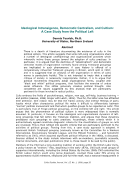
Women, the Law, and Cults: Three Avenues of Legal Recourse:
New Rape Laws, Violence Against Women Act, and Antistalking Laws
Robin A. Boyle, J.D.
St. John’s University School of Law
And Fordham University’s College of Liberal Studies
Abstract
The author examines three avenues of legal recourse that are available to
society at large, but may not be well-known to women in cults, their families,
and their potential mental health providers. These avenues for recourse are
improved rape laws now available in every state recently-enacted federal
legislation --the 1994 Violence Against Women Act and recently-enacted
state and federal antistalking laws. The author developed this article from
her speech delivered at the annual American Family Foundation conference on
May 30, 1997, in Philadelphia, PA.
There are no state or federal laws that prohibit cults. Yet, there are laws prohibiting certain
kinds of conduct in society at large that can be used by members, or former members, of
cults to bring about either criminal penalties or civil remedies against other cult members
and cult leaders. These three avenues for recourse are state rape laws, which have
undergone significant changes in the past 20 years the 1994 federal Violence Against
Women Act1 and recent state and federal antistalking laws.
In reviewing literature on cults and reported court cases, it appears that cult victims have
not made use of these three avenues for recourse. Experts in the field of cultic studies
acknowledge that few mental health professionals or family members of those assisting cult
victims are aware of the recent legislative and institutional changes. In order to bring about
justice, knowledge is essential. Hopefully, the information offered on legal remedies in this
article will be useful to exit counselors, prosecutors, family members of cult victims, and
cult victims themselves.
Why focus on women as victims in this article? Men are also victims of stalking, rape, and
other crimes, but not in the same proportion as women. For example, for domestic violence
crimes, women are approximately six times more likely than men to experience violence
committed by an “intimate.”2 Nevertheless, men may use the same legal recourse described
in this article because the laws, for the most part, are gender neutral.
This article includes, in its hypothetical examples, crimes committed by men. This is not to
say that women have not committed such crimes. In fact, women have committed violent
domestic crimes, not only against men but also against their homosexual partners.
However, the subject of homosexual domestic violence is beyond the scope of this article.3
Data on violence toward women in cults are sparse because there is no cohesive, national
data-recording system. Although 40% of the women in a recent postcult recovery workshop
claimed to have been sexually abused in their cults, Janja Lalich, a cult information
specialist and educator who regularly speaks with former cult members, estimates that the
percentage is higher.4 Violence and abuse towards women in cults needs to be addressed.5
This article is divided into three parts. Rape is addressed in Part I. Part IA discusses the
former rape laws and the recent changes to those state laws. Part IB explores the lingering
problems with the reformed rape laws, and, in particular, the standards for rape victims in
demonstrating that they did not consent to the act. As explained in IC, the difficulty in
Women, the Law, and Cults: Three Avenues of Legal Recourse:
New Rape Laws, Violence Against Women Act, and Antistalking Laws
Robin A. Boyle, J.D.
St. John’s University School of Law
And Fordham University’s College of Liberal Studies
Abstract
The author examines three avenues of legal recourse that are available to
society at large, but may not be well-known to women in cults, their families,
and their potential mental health providers. These avenues for recourse are
improved rape laws now available in every state recently-enacted federal
legislation --the 1994 Violence Against Women Act and recently-enacted
state and federal antistalking laws. The author developed this article from
her speech delivered at the annual American Family Foundation conference on
May 30, 1997, in Philadelphia, PA.
There are no state or federal laws that prohibit cults. Yet, there are laws prohibiting certain
kinds of conduct in society at large that can be used by members, or former members, of
cults to bring about either criminal penalties or civil remedies against other cult members
and cult leaders. These three avenues for recourse are state rape laws, which have
undergone significant changes in the past 20 years the 1994 federal Violence Against
Women Act1 and recent state and federal antistalking laws.
In reviewing literature on cults and reported court cases, it appears that cult victims have
not made use of these three avenues for recourse. Experts in the field of cultic studies
acknowledge that few mental health professionals or family members of those assisting cult
victims are aware of the recent legislative and institutional changes. In order to bring about
justice, knowledge is essential. Hopefully, the information offered on legal remedies in this
article will be useful to exit counselors, prosecutors, family members of cult victims, and
cult victims themselves.
Why focus on women as victims in this article? Men are also victims of stalking, rape, and
other crimes, but not in the same proportion as women. For example, for domestic violence
crimes, women are approximately six times more likely than men to experience violence
committed by an “intimate.”2 Nevertheless, men may use the same legal recourse described
in this article because the laws, for the most part, are gender neutral.
This article includes, in its hypothetical examples, crimes committed by men. This is not to
say that women have not committed such crimes. In fact, women have committed violent
domestic crimes, not only against men but also against their homosexual partners.
However, the subject of homosexual domestic violence is beyond the scope of this article.3
Data on violence toward women in cults are sparse because there is no cohesive, national
data-recording system. Although 40% of the women in a recent postcult recovery workshop
claimed to have been sexually abused in their cults, Janja Lalich, a cult information
specialist and educator who regularly speaks with former cult members, estimates that the
percentage is higher.4 Violence and abuse towards women in cults needs to be addressed.5
This article is divided into three parts. Rape is addressed in Part I. Part IA discusses the
former rape laws and the recent changes to those state laws. Part IB explores the lingering
problems with the reformed rape laws, and, in particular, the standards for rape victims in
demonstrating that they did not consent to the act. As explained in IC, the difficulty in