Cultic Studies Journal, Vol. 8, No. 1, 1991, Page 26
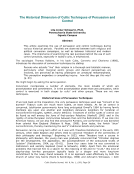
The Historical Dimension of Cultic Techniques of Persuasion and
Control
Lita Linzer Schwartz, Ph.D.
Pennsylvania State University
Ogontz Campus
Abstract
This article examines the use of persuasion and control techniques during
various historical periods. Parallels are observed between both religious and
political conversion campaigns, as well as between historical and modern
cases. The importance of examining the real purposes behind the use of such
control practices, especially in today‟s cults, is emphasized.
The sociologist Thomas Robbins, in his book Cults, Converts and Charisma (1986),
introduces his discussion of conversion techniques by stating:
Persons who actually “live” their religion in a thorough and totalistic manner,
particularly when marginal exotic groups and deviant perspectives are
involved, are perceived as having undergone an unnatural metamorphosis.
This perception engenders a compelling inquiry: how did they get this way?
(p. 63)
We might begin by asking the same question.
Conversion incorporates a number of elements, the most notable of which are
proselytization and commitment. It is the proselytization phase that uses persuasion, while
control is exercised in both stages by cults1 and other groups. These are not new
techniques.
Historical Uses of Persuasive Techniques
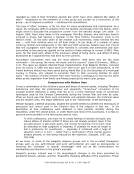
If we look back at the Inquisition, the very persuasive technique used was “Convert or be
burned!” Today‟s cults are much more subtle, at least initially. As far as control is
concerned, totalitarian governments have long anticipated Orwell‟s 1984 by having family
members spy upon one another and neighbors denounce neighbors for heretical or
nonconformist thoughts, speech, and/or behavior. Instances of similar types of control can
be found as well among the Jews of first-century Palestine (Hankoff, 1983) and in the
rigidity of some European communities between then and the Reformation. If we look into
American history, we can also find that among the Puritans, one conformed or was banished
from colonial New England (Pattison &Ness, 1989). Even today, the Amish “shun”
nonconformists, thereby maintaining the sect‟s2 traditional beliefs and practices.
Persuasion can be a long-term effort as it was with Theodore Ratisbonne in the early 19th
century, when Abbe Bautain and others tried to convince Theodore of the correctness of
their philosophy and theology.3 Beginning in 1823, when Theodore took a course in
philosophy with Bautain, the young man was gradually convinced that “Christian dogmas
are the development, the application, the accomplishment of the announced truths of
Judaism” (Ratisbonne, 1904, pp. 60-61). Some four years later he was converted to
Catholicism and secretly baptized (Isser &Schwartz, 1988). Apart from the emotional
problems that had led him to a search for the meaning of life and for “truth,” this kind of
step-by-step low-key persuasion typically leads to a deeper and more long-term
commitment to the newly found answers. It is an approach used effectively by both the
Church of Latter Day Saints (Stark &Bainbridge, 1980) and Jehovah‟s Witnesses --both
The Historical Dimension of Cultic Techniques of Persuasion and
Control
Lita Linzer Schwartz, Ph.D.
Pennsylvania State University
Ogontz Campus
Abstract
This article examines the use of persuasion and control techniques during
various historical periods. Parallels are observed between both religious and
political conversion campaigns, as well as between historical and modern
cases. The importance of examining the real purposes behind the use of such
control practices, especially in today‟s cults, is emphasized.
The sociologist Thomas Robbins, in his book Cults, Converts and Charisma (1986),
introduces his discussion of conversion techniques by stating:
Persons who actually “live” their religion in a thorough and totalistic manner,
particularly when marginal exotic groups and deviant perspectives are
involved, are perceived as having undergone an unnatural metamorphosis.
This perception engenders a compelling inquiry: how did they get this way?
(p. 63)
We might begin by asking the same question.
Conversion incorporates a number of elements, the most notable of which are
proselytization and commitment. It is the proselytization phase that uses persuasion, while
control is exercised in both stages by cults1 and other groups. These are not new
techniques.
Historical Uses of Persuasive Techniques
If we look back at the Inquisition, the very persuasive technique used was “Convert or be
burned!” Today‟s cults are much more subtle, at least initially. As far as control is
concerned, totalitarian governments have long anticipated Orwell‟s 1984 by having family
members spy upon one another and neighbors denounce neighbors for heretical or
nonconformist thoughts, speech, and/or behavior. Instances of similar types of control can
be found as well among the Jews of first-century Palestine (Hankoff, 1983) and in the
rigidity of some European communities between then and the Reformation. If we look into
American history, we can also find that among the Puritans, one conformed or was banished
from colonial New England (Pattison &Ness, 1989). Even today, the Amish “shun”
nonconformists, thereby maintaining the sect‟s2 traditional beliefs and practices.
Persuasion can be a long-term effort as it was with Theodore Ratisbonne in the early 19th
century, when Abbe Bautain and others tried to convince Theodore of the correctness of
their philosophy and theology.3 Beginning in 1823, when Theodore took a course in
philosophy with Bautain, the young man was gradually convinced that “Christian dogmas
are the development, the application, the accomplishment of the announced truths of
Judaism” (Ratisbonne, 1904, pp. 60-61). Some four years later he was converted to
Catholicism and secretly baptized (Isser &Schwartz, 1988). Apart from the emotional
problems that had led him to a search for the meaning of life and for “truth,” this kind of
step-by-step low-key persuasion typically leads to a deeper and more long-term
commitment to the newly found answers. It is an approach used effectively by both the
Church of Latter Day Saints (Stark &Bainbridge, 1980) and Jehovah‟s Witnesses --both