28 ICSA TODAY
Profile On...
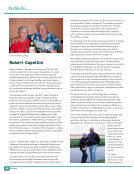
Robert Capellini is friendly and forthcoming (“Call me Cap—
everyone always has”) as he answers my questions in a lively
voice. Early on, he quips that, at 90, he’s trying marijuana.
“Medical marijuana! For my back.” But he quickly, naturally, veers
to talking about his wife, Joan Capellini, who passed away in
2014, and their children Steve, Tina, and Jim. “We’ve always been
a close family,” he says. It becomes clear that any profile about
Mr. Capellini will necessarily be about him and his loved ones, so
much a part of him.
Cap was born in 1928. He spent the first 7 years of his life in
Rockville Center, Long Island, moving to California with his
family when he was 8 years old. After the Second World War, he
began working for the phone company now known as Verizon,
where he met Joan, to whom he was married for 56 years. They
had three children. Cap was promoted a few times. They lived in
Chicago for 6 years. Cap was eventually promoted to a position
in Tampa, Florida. He worked for the company for 37 years,
retiring at 59. A Time magazine article about older adults using
the Internet, published in 1998 when he was 70, featured Cap
prominently. He had discovered the Internet and email, and had
gotten quite adept at using both, volunteering to teach others.
Part of the article reads, “…A product of the Depression, he shops
at Sears and clips coupons despite having earned a comfortable
retirement for himself and his wife…”
~
It was in 1978 that Cap’s middle son, Steve, was recruited into the
Unification Church, aka the Moonies, setting off a family crisis.
Cap speaks with tremendous pride and affection about Steve.
“When he was only 12, he asked, ‘Why is there anything?’ He was
reading Plato and Socrates at that age! He was always a seeker.”
Cap paints Steve as a “free spirit” and explains that he went
to college directly after high school but stayed for only one
semester, leaving to sail the Caribbean for a few months, then
hitchhike from Miami to San Francisco. While in San Francisco, he
encountered Rev. Moon’s organization. The members engaged
the inquisitive young man, taking him to their farm 100 miles
north of the city. Steve continued to call his parents every
weekend, so Cap at first suspected nothing. Joan, however,
with a mother’s intuition, pronounced after the first phone call,
“Something is wrong.”
To isolate Steve from his parents, the group sent him to Colorado.
After 6 months, Steve finally told his parents the name of the
organization. There was little information about the group
then however, in doing research, they came upon a book
entitled ominously Let Our Children Go, by Ted Patrick. The Moon
organization was covered in the book on page 113.
Thoroughly alarmed, Cap and Joan tried to tell Steve about what
they’d found. He spurned the information. The Moonies had
already made a lot of headway. They were, however, unsuccessful
in turning him completely away from his parents. Cap relates,
“Everything they said about his mom he rejected.”
The Capellinis realized the depth of the situation. After a family
conference, they arrived at a sobering, frightening conclusion:
They would have to take the extreme measure of rescuing their
son via kidnapping and deprogramming. Unlike today, when
parents have access to a range of resources to help them deal
with a loved one in a group, in those days, deprogramming often
seemed like the only option for families.
This part of the story is in turn terrifying, funny, and heart-
rending. With Joan at home holding down the fort, Cap, the
loving and devoted father, left everything behind and set off
alone on a journey to save his son’s life. He travelled to a place
he’d never been had to put his trust in people he didn’t know
and had to be at times incredibly patient, at others as quick and
fleet-footed as the protagonist in a spy novel.
He met with strangers who were part of a kind of underground
railroad at the time and willing to help. They managed to
grab Steve, take him to a safe house, and proceed, led by the
deprogrammer, Ted Patrick. A crucial point in the rescue finally
came when Cap
broke down in tears
in front of his boy.
“He’d never seen his
father cry. I think
it shocked him it
moved him.” That
was the beginning
of Steve’s return to
himself.
They were
successful at getting
Steve home. It was
Christmas time. As
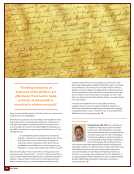
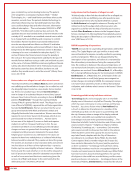
Robert Capellini
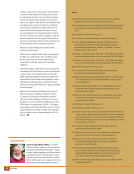
Joan and Robert Capellini.