VOLUME 10 |ISSUE 1 |2019 79
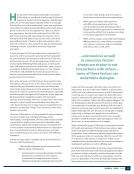
Cults and extremist groups
function on one continuum,
which means that efforts to make
a clear-cut difference between
them will be impossible,
inaccurate, and unhelpful.
Challenges to Further Cross-Fertilization
Exit work related to both cults and extremism faces challenges
when it comes to legitimizing that work to the general public
or policymakers. Because samples are small, few standardized
methods exist and the number of evidence-based interventions is
limited, so both aspects have problems in terms of proving their
added value.
The legitimation challenge takes different forms. For nonviolent
cults, the belief that (former) members pose no great harm to
society as a whole has posed challenges in terms of accessing
government funding. For extremism, more resources are available,
but expectations are also high because of the perceived threat
to society, especially when it comes to returning foreign terrorist
fighters (who go back home after fighting). Both forms of exit
work also have a few unpopular messages to convey: Compulsory
treatment without any intrinsic motivation is most likely to fail
treatment takes time and there are multiple pathways for leaving
a group, largely depending upon circumstances and biographical
elements.
A specific challenge is working with the second-generation
former members—those who know only the cult or extremist
milieu. Recovery work with individuals from this group has
been taking place for some time. For violent extremism, the
phenomenon is quite new (e.g., children returning from the
caliphate or being raised in a völkische Siedlung, or patriotic
settlement). For children of extremists, the challenge can be
amplified if parents or other family members are prosecuted and
imprisoned.
Means of Further Cross-Fertilization
Cults and extremist groups function on one continuum, which
means that efforts to make a clear-cut difference between them
will be impossible, inaccurate, and unhelpful. Some groups
exhibit clear characteristics of both groupings. For example,
the place of the apocalypse in Daesh ideology and the role of
invisible leader Al-Baghdadi could be considered rather cultic.
In other words, there are cults that commit acts of violent
extremism and are considered terrorist groups (e.g., Daesh or
Aum Shinrikyo). Meanwhile, differences also remain concerning
(a) the perception of societal danger posed by groups and (b)
the legitimization of violence that they attempt.
Likewise, there are similarities between the two groupings
when it comes to (a) vulnerable target groups who are lured
into a unit, (b) manipulative strategies for recruitment and
retention of and psychological changes in members, and (c)
guiding principles of how to work as professionals and families
to help individuals leave the group/movement and return to
mainstream society. Further cooperation between experts
in general, or more specifically, between RAN and ICSA, on
working with those leaving cultic and extremist groups could
be fruitful in supporting the individuals affected by improving
programs, methods, and activities.
Looking at the similarities, an exchange of case studies to grow
the data pool would benefit both cult and extremism exit work.
The same applies to exchanges about which methods and
tools are effective, including the training of staff in both exit
and recovery work. For these efforts to bear fruit, it is key to
first bridge the vocabulary divide and to consider developing a
common terminology that applies to these overlapping fields.
Finally, further exchange about involving former members—
who are active in both fields—could be beneficial. Some former
members from nonviolent cults are already working with
former extremists, which indicates the importance of further
work to establish when the role of former members has the
most added value alongside other roles (such as that of mental
health professionals, who have been active for many years in
exit and recovery work).
Appendix 1: Definitions Concerning Cults and Radical
or Extremist Groups—Clarifying Overlapping Terms
Across related and overlapping fields of practice and inquiry
concerning cults, radical and extremist groups, and violent
extremism multiple terms have been variously defined at
different stages of history and through different forms of
practical intervention and research.
The term cult (or sect) is widely acknowledged as an imperfect
term with a degree of ambiguity and associations with media
stereotypes that are sometimes unhelpful. For example, the
word cult often conjures up the notion of a religious group such
as those that proliferated in the 1960s and often originated in
the United States. The International Cultic Studies Association
(ICSA) does not use the term cult to label particular groups
but instead sees cult-like practice or cultic influence on a
continuum of undue influence and draws on research which
has defined key psychological aspects of coercive persuasion
and control and thought reform (as discussed in Robert J
Lifton’s seminal work [1989/1961]). The focus for ICSA is on the
group modus operandi and practice, and on the psychological
changes in cults and extremist groups (as in the totalistic
identity theory), which allows the term cult to be applied to a
wide range of groups, some of which are religious, political,
psychotherapeutic, business focused, or terrorist in their nature
and activity, and which sometimes involve a combination of
these features.
Cults and extremist groups
function on one continuum,
which means that efforts to make
a clear-cut difference between
them will be impossible,
inaccurate, and unhelpful.
Challenges to Further Cross-Fertilization
Exit work related to both cults and extremism faces challenges
when it comes to legitimizing that work to the general public
or policymakers. Because samples are small, few standardized
methods exist and the number of evidence-based interventions is
limited, so both aspects have problems in terms of proving their
added value.
The legitimation challenge takes different forms. For nonviolent
cults, the belief that (former) members pose no great harm to
society as a whole has posed challenges in terms of accessing
government funding. For extremism, more resources are available,
but expectations are also high because of the perceived threat
to society, especially when it comes to returning foreign terrorist
fighters (who go back home after fighting). Both forms of exit
work also have a few unpopular messages to convey: Compulsory
treatment without any intrinsic motivation is most likely to fail
treatment takes time and there are multiple pathways for leaving
a group, largely depending upon circumstances and biographical
elements.
A specific challenge is working with the second-generation
former members—those who know only the cult or extremist
milieu. Recovery work with individuals from this group has
been taking place for some time. For violent extremism, the
phenomenon is quite new (e.g., children returning from the
caliphate or being raised in a völkische Siedlung, or patriotic
settlement). For children of extremists, the challenge can be
amplified if parents or other family members are prosecuted and
imprisoned.
Means of Further Cross-Fertilization
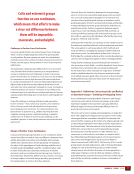
Cults and extremist groups function on one continuum, which
means that efforts to make a clear-cut difference between them
will be impossible, inaccurate, and unhelpful. Some groups
exhibit clear characteristics of both groupings. For example,
the place of the apocalypse in Daesh ideology and the role of
invisible leader Al-Baghdadi could be considered rather cultic.
In other words, there are cults that commit acts of violent
extremism and are considered terrorist groups (e.g., Daesh or
Aum Shinrikyo). Meanwhile, differences also remain concerning
(a) the perception of societal danger posed by groups and (b)
the legitimization of violence that they attempt.
Likewise, there are similarities between the two groupings
when it comes to (a) vulnerable target groups who are lured
into a unit, (b) manipulative strategies for recruitment and
retention of and psychological changes in members, and (c)
guiding principles of how to work as professionals and families
to help individuals leave the group/movement and return to
mainstream society. Further cooperation between experts
in general, or more specifically, between RAN and ICSA, on
working with those leaving cultic and extremist groups could
be fruitful in supporting the individuals affected by improving
programs, methods, and activities.
Looking at the similarities, an exchange of case studies to grow
the data pool would benefit both cult and extremism exit work.
The same applies to exchanges about which methods and
tools are effective, including the training of staff in both exit
and recovery work. For these efforts to bear fruit, it is key to
first bridge the vocabulary divide and to consider developing a
common terminology that applies to these overlapping fields.
Finally, further exchange about involving former members—
who are active in both fields—could be beneficial. Some former
members from nonviolent cults are already working with
former extremists, which indicates the importance of further
work to establish when the role of former members has the
most added value alongside other roles (such as that of mental
health professionals, who have been active for many years in
exit and recovery work).
Appendix 1: Definitions Concerning Cults and Radical
or Extremist Groups—Clarifying Overlapping Terms
Across related and overlapping fields of practice and inquiry
concerning cults, radical and extremist groups, and violent
extremism multiple terms have been variously defined at
different stages of history and through different forms of
practical intervention and research.
The term cult (or sect) is widely acknowledged as an imperfect
term with a degree of ambiguity and associations with media
stereotypes that are sometimes unhelpful. For example, the
word cult often conjures up the notion of a religious group such
as those that proliferated in the 1960s and often originated in
the United States. The International Cultic Studies Association
(ICSA) does not use the term cult to label particular groups
but instead sees cult-like practice or cultic influence on a
continuum of undue influence and draws on research which
has defined key psychological aspects of coercive persuasion
and control and thought reform (as discussed in Robert J
Lifton’s seminal work [1989/1961]). The focus for ICSA is on the
group modus operandi and practice, and on the psychological
changes in cults and extremist groups (as in the totalistic
identity theory), which allows the term cult to be applied to a
wide range of groups, some of which are religious, political,
psychotherapeutic, business focused, or terrorist in their nature
and activity, and which sometimes involve a combination of
these features.