33 VOLUME 10 |ISSUE 1 |2019
registration of cases. This range of methodologies and the
limited number of cases makes looking at adjacent fields
interesting.
One field that is similar to those noted in terms of the process
observed for leaving a group is that of cults, or sects.1 Here,
there is a longer tradition of trying to help people get out, and
also a longer history of academic research on both the cultic
environment and leaving mechanisms. When scholar Tore
Bjørgo designed one of the first European exit programs (in
Norway, later implemented in Sweden and Germany), he found
his inspiration in cultic studies.
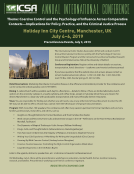
Providing a platform for an exchange of views on what those
doing exit work can learn from cults—and vice versa—the
RAN [Radicalization Awareness Network] EXIT working group
organized a meeting in close cooperation with the International
Cultic Studies Association (ICSA). That meeting took place June
27–28 in Bordeaux, France.
Cults and Other Extremist/Radical Groups:
Similarities and Differences
To a certain extent, it is difficult to distinguish between cults
and other extremist or radical groups. Some cults do commit
violent acts that can be considered as disruptive for society,
such as the sarin attack on a Tokyo metro station in 1995 by
members of the cult movement Aum Shinrikyo.
Like cults, many extremist or radical groups also have strong
internal control mechanisms, create psychological changes in
their members (such as a dependence on and a strong degree
of identification with the group leader), and have a guru
personality as leader, just like the invisible but always-present
figure of Al-Baghdadi in Daesh (ISIL, or ISIS). So there is no
clear-cut line between the two there is instead a continuum
on which groups can be placed. For both cults and extremist or
radical groups, the groups concerned will sometimes categorize
themselves in that way but most are more likely to reject the
label they are given by the outside world as either prejudiced or
pejorative.
Bringing two fields together also implies bringing together
two vocabularies, both of which have their own rich history
of debate when it comes to definitions. To leapfrog these
challenges and keep the paper understandable, we note the
differing history of work on cults and recovery (i.e., leaving the
cult) and extremist groups and exit (again, leaving the group),
whilst also noting the overlaps between the two, including that
of definitions.2
In this paper, we zoom in on the similarities and differences in
terms associated with leaving cultic and radical groups. Before
we concentrate on exit work/recovery, we first look at the
group mechanisms that are typical for both extremist groups
and cults, and the variations that can be found here. In the final
sections, we explore challenges and opportunities for further
cross-fertilization.
The Manipulative Group
Both cults and extremist groups use tactics to attract and retain
members in a manipulative way. In general, people in the group
are gradually pushed in one direction. Once they are lured in,
stepping back seems difficult or is made impossible. In this
section we deal with how this group manipulation functions.
Because there is a huge variety of cults and extremist groups,
not all mechanisms are used by all groups with the same
intensity at the same time.
Recruiting Members. One of the recruitment techniques
that is applied is deindividuation. With this strategy, members
of the group are given bounded choices, and violation of
the boundaries is unacceptable. Several forms of violence
may be present: sexual, physical, psychological, spiritual,
educational, financial, social, and family related. There is a moral
reorientation and a demonization of the “other” (creating an “us
and them” thinking pattern).3
To keep order within the group, intragroup surveillance
techniques are used. Members spy on each other, and internal
court systems are not unknown. Punishment can result from
this court system, or it can be part of the set of rules within the
group. People are restricted in their behavior in order not to
trigger safety hazards for the group.4
However, it is important to underline that not all people are
equally susceptible to manipulation and strategic recruitment.
Personal ties such as friendship networks can play a role, as can
psychological vulnerability (although overall psychopathology
is no more prevalent among cult members than in society as a
whole).5 Finally, it is of course possible that persons join of their
own free will.6 Therefore, a kaleidoscope of both pull and push
factors can drive an individual toward such a group. Second-
generation members—those who become members by birth
into the group—are, however, a special category. They grow
up with the idea that the group is normal because this is where
they receive their education and socialization.
Like cults, many extremist or
radical groups also have strong
internal control mechanisms,
create psychological changes
in their members (such as a
dependence on and a strong
degree of identification with
the group leader), and have a
guru personality as leader...
personality as leader,
registration of cases. This range of methodologies and the
limited number of cases makes looking at adjacent fields
interesting.
One field that is similar to those noted in terms of the process
observed for leaving a group is that of cults, or sects.1 Here,
there is a longer tradition of trying to help people get out, and
also a longer history of academic research on both the cultic
environment and leaving mechanisms. When scholar Tore
Bjørgo designed one of the first European exit programs (in
Norway, later implemented in Sweden and Germany), he found
his inspiration in cultic studies.
Providing a platform for an exchange of views on what those
doing exit work can learn from cults—and vice versa—the
RAN [Radicalization Awareness Network] EXIT working group
organized a meeting in close cooperation with the International
Cultic Studies Association (ICSA). That meeting took place June
27–28 in Bordeaux, France.
Cults and Other Extremist/Radical Groups:
Similarities and Differences
To a certain extent, it is difficult to distinguish between cults
and other extremist or radical groups. Some cults do commit
violent acts that can be considered as disruptive for society,
such as the sarin attack on a Tokyo metro station in 1995 by
members of the cult movement Aum Shinrikyo.
Like cults, many extremist or radical groups also have strong
internal control mechanisms, create psychological changes in
their members (such as a dependence on and a strong degree
of identification with the group leader), and have a guru
personality as leader, just like the invisible but always-present
figure of Al-Baghdadi in Daesh (ISIL, or ISIS). So there is no
clear-cut line between the two there is instead a continuum
on which groups can be placed. For both cults and extremist or
radical groups, the groups concerned will sometimes categorize
themselves in that way but most are more likely to reject the
label they are given by the outside world as either prejudiced or
pejorative.
Bringing two fields together also implies bringing together
two vocabularies, both of which have their own rich history
of debate when it comes to definitions. To leapfrog these
challenges and keep the paper understandable, we note the
differing history of work on cults and recovery (i.e., leaving the
cult) and extremist groups and exit (again, leaving the group),
whilst also noting the overlaps between the two, including that
of definitions.2
In this paper, we zoom in on the similarities and differences in
terms associated with leaving cultic and radical groups. Before
we concentrate on exit work/recovery, we first look at the
group mechanisms that are typical for both extremist groups
and cults, and the variations that can be found here. In the final
sections, we explore challenges and opportunities for further
cross-fertilization.
The Manipulative Group
Both cults and extremist groups use tactics to attract and retain
members in a manipulative way. In general, people in the group
are gradually pushed in one direction. Once they are lured in,
stepping back seems difficult or is made impossible. In this
section we deal with how this group manipulation functions.
Because there is a huge variety of cults and extremist groups,
not all mechanisms are used by all groups with the same
intensity at the same time.
Recruiting Members. One of the recruitment techniques
that is applied is deindividuation. With this strategy, members
of the group are given bounded choices, and violation of
the boundaries is unacceptable. Several forms of violence
may be present: sexual, physical, psychological, spiritual,
educational, financial, social, and family related. There is a moral
reorientation and a demonization of the “other” (creating an “us
and them” thinking pattern).3
To keep order within the group, intragroup surveillance
techniques are used. Members spy on each other, and internal
court systems are not unknown. Punishment can result from
this court system, or it can be part of the set of rules within the
group. People are restricted in their behavior in order not to
trigger safety hazards for the group.4
However, it is important to underline that not all people are
equally susceptible to manipulation and strategic recruitment.
Personal ties such as friendship networks can play a role, as can
psychological vulnerability (although overall psychopathology
is no more prevalent among cult members than in society as a
whole).5 Finally, it is of course possible that persons join of their
own free will.6 Therefore, a kaleidoscope of both pull and push
factors can drive an individual toward such a group. Second-
generation members—those who become members by birth
into the group—are, however, a special category. They grow
up with the idea that the group is normal because this is where
they receive their education and socialization.
Like cults, many extremist or
radical groups also have strong
internal control mechanisms,
create psychological changes
in their members (such as a
dependence on and a strong
degree of identification with
the group leader), and have a
guru personality as leader...
personality as leader,