23 VOLUME 10 |ISSUE 1 |2019
Edited by Mary O’Connell
into the human condition, and by deep compassion. And
with that realization, as the poet Lucille Clifton said, “my
soul got happy.” I felt inspired, hopeful, convinced that,
even in my sixties, I might still accomplish my goals if I just
go for them. Such is her quickening effect.
~
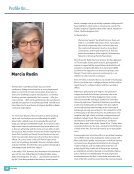
With her usual openness, Ms. Rudin gamely agreed to
answer some questions and didn’t balk at the somewhat
random nature of the subject matter. Here is a sampling
(using our respective initials to identify who is speaking):
MO: One of your daughters mentioned that she was raised
to believe in herself and her ability to achieve whatever
she wanted. Were you yourself raised that way?
MR: I think so. My parents were ahead-of-their-time
feminists. My mom had to work for financial reasons, so I
had the model of a working mother.
MO: Have you ever had writer’s block?
MR: Yes.
MO: How do you deal with it?
MR: Walk away from the computer. Sleep or nap. Then go
back to the project.
MO: What is your writing process?
MR: Hmm… Hard to describe. I have no process per se. I
work best in the morning although sometimes, if I wake
up in the middle of the night, I am very creative in my
writing then, perhaps because rational thought doesn’t
get in the way of … creativity then.
You go into a sort of zone. Your unconscious sort of takes
over. I don’t know how to describe it. Especially if you are
writing fiction—you sort of become your characters. It
is very difficult to describe the creative writing process. I
have been to many writing workshops where people have
tried to teach it, but you can’t teach it.
I do not have my own room to write in either in Manhattan
or [in] Fort Myers. In Manhattan, I write in a corner of the
living room facing a wall. In Florida, I have a corner of our
bedroom. However, when I was writing more, I went to
libraries, both in New York City and in Fort Myers, so I could
focus.
MO: Can you tell a little about your daily schedule?
MR: I wake up very early. …Like to work at the computer in
the morning, my best mental time. I try to exercise every
day, either by walking or riding the exercise bike at our
nearby gym, or swimming in our condo pool. I need to nap
a bit every day. We eat an early dinner, watch our cable
news channel every night, or old movies on TCM [Turner
Classic Movies]. …Rarely go out at night except for dinner
with friends. We are very busy with our synagogue on
Sanibel so when season starts (November), I go to classes
and lectures there. …Also other activities and committees
on Sanibel and in Fort Myers.
MO: What one thing would you suggest to protect young
people from getting involved with cults?
MR: Find out as much as you can about the group
before you commit. That is easier now that we have the
Internet. Take the criticisms seriously. Don’t let yourself be
manipulated. Don’t join quickly or leave your present life
and relationships.
MO: What positive things can former cult members take
from their experience?
MR: Probably if they survive the experience they learned
to adjust to difficult circumstances and to be strong. Also,
I know they have often developed real friendships and
communal experiences, and some happy memories. They
usually have learned great self-discipline.
~
An address Marcia gave to congregants at her synagogue
ends with reflections on the difficulties life presents to us
all, and the positive yet complex way Judaism responds
to those difficulties, concluding, as it does, that life is a
blessing:
It takes great courage to affirm this position in the
light of so much trouble and sorrow and grief… In
the uncertainty and sometimes apparent randomness
of existence, and in spite of it, we proclaim our
determination to live life, to keep going, to improve
ourselves and our world.
In writing about three great women of the 20th century,
Laura Jacobs observed in an article in Vanity Fair1 that
“each gave existential comfort [emphasis added] by her
very presence.” In Marcia Rudin’s case, we would have to
add “hope, courage, and joy.”
Note
[1] In “Our Lady of the Kitchen,” Vanity Fair, July 6, 2009
(see https://www.vanityfair.com/culture/2009/08/julia-
child200908). n
Edited by Mary O’Connell
into the human condition, and by deep compassion. And
with that realization, as the poet Lucille Clifton said, “my
soul got happy.” I felt inspired, hopeful, convinced that,
even in my sixties, I might still accomplish my goals if I just
go for them. Such is her quickening effect.
~
With her usual openness, Ms. Rudin gamely agreed to
answer some questions and didn’t balk at the somewhat
random nature of the subject matter. Here is a sampling
(using our respective initials to identify who is speaking):
MO: One of your daughters mentioned that she was raised
to believe in herself and her ability to achieve whatever
she wanted. Were you yourself raised that way?
MR: I think so. My parents were ahead-of-their-time
feminists. My mom had to work for financial reasons, so I
had the model of a working mother.
MO: Have you ever had writer’s block?
MR: Yes.
MO: How do you deal with it?
MR: Walk away from the computer. Sleep or nap. Then go
back to the project.
MO: What is your writing process?
MR: Hmm… Hard to describe. I have no process per se. I
work best in the morning although sometimes, if I wake
up in the middle of the night, I am very creative in my
writing then, perhaps because rational thought doesn’t
get in the way of … creativity then.
You go into a sort of zone. Your unconscious sort of takes
over. I don’t know how to describe it. Especially if you are
writing fiction—you sort of become your characters. It
is very difficult to describe the creative writing process. I
have been to many writing workshops where people have
tried to teach it, but you can’t teach it.
I do not have my own room to write in either in Manhattan
or [in] Fort Myers. In Manhattan, I write in a corner of the
living room facing a wall. In Florida, I have a corner of our
bedroom. However, when I was writing more, I went to
libraries, both in New York City and in Fort Myers, so I could
focus.
MO: Can you tell a little about your daily schedule?
MR: I wake up very early. …Like to work at the computer in
the morning, my best mental time. I try to exercise every
day, either by walking or riding the exercise bike at our
nearby gym, or swimming in our condo pool. I need to nap
a bit every day. We eat an early dinner, watch our cable
news channel every night, or old movies on TCM [Turner
Classic Movies]. …Rarely go out at night except for dinner
with friends. We are very busy with our synagogue on
Sanibel so when season starts (November), I go to classes
and lectures there. …Also other activities and committees
on Sanibel and in Fort Myers.
MO: What one thing would you suggest to protect young
people from getting involved with cults?
MR: Find out as much as you can about the group
before you commit. That is easier now that we have the
Internet. Take the criticisms seriously. Don’t let yourself be
manipulated. Don’t join quickly or leave your present life
and relationships.
MO: What positive things can former cult members take
from their experience?
MR: Probably if they survive the experience they learned
to adjust to difficult circumstances and to be strong. Also,
I know they have often developed real friendships and
communal experiences, and some happy memories. They
usually have learned great self-discipline.
~
An address Marcia gave to congregants at her synagogue
ends with reflections on the difficulties life presents to us
all, and the positive yet complex way Judaism responds
to those difficulties, concluding, as it does, that life is a
blessing:
It takes great courage to affirm this position in the
light of so much trouble and sorrow and grief… In
the uncertainty and sometimes apparent randomness
of existence, and in spite of it, we proclaim our
determination to live life, to keep going, to improve
ourselves and our world.
In writing about three great women of the 20th century,
Laura Jacobs observed in an article in Vanity Fair1 that
“each gave existential comfort [emphasis added] by her
very presence.” In Marcia Rudin’s case, we would have to
add “hope, courage, and joy.”
Note
[1] In “Our Lady of the Kitchen,” Vanity Fair, July 6, 2009
(see https://www.vanityfair.com/culture/2009/08/julia-
child200908). n