ICSA TODAY 20
By Michael D. Langoneconflicts
Editor’s Corner
(A response to “When Critical Thinking Doesn’t Help: Why It Fails and How to Make It Happen,”
by Millard J. Melnyk, IT 6.2, pp. 8–11)
In his article “When Critical Thinking Doesn’t Help: Why
It Fails and How to Make It Happen,” Millard J. Melnyk
makes some valid points about attempting to intervene
with cult members and to show them that they have been
manipulated. However, Mr. Melnyk’s article is a bit unfair to
those of us who advocate the use of critical thinking when
one is working with former members and families.
Mr. Melnyk’s recognition of the importance of beginning
where the cult member is, and of not talking down to
the cult member, are sound guidelines, but his assertion
that critical thinking is antithetical to these guidelines
is inaccurate. I agree with Mr. Melnyk that speaking to
someone in a cult in a bullying, adversarial manner is
counterproductive, but he conflates critical thinking with
being adversarial or with speaking critically. Sound, critical
thinking is compatible with friendly, supportive exchanges.
Mr. Melnyk describes the critical thinker as evaluative,
challenging, and objectively detached. The image that
he creates is of a stern, Spock-like, humorless know-it-all.
Some family members, and even some professionals, may
speak from this position. I would argue, however, that this
approach inappropriately applies the critical thinking of
the physical scientist to the arena of relationships. Persons
distort the reality of the unconscious, unfeeling, “dead”
cosmos by injecting emotion into their observations
and conclusions. However, persons distort the reality of
a relationship by ignoring the complex, uncertain, and
ambiguous emotions that are an unavoidable part of being
human. Spock would have flunked counseling 101.
I maintain that the psychologically aware critical thinker
is accepting of humanness, is engaged, and is humble.
The critical thinker is not unwavering, certain, overly self-
assured, or under the delusion that he is infallible. The
critical thinker recognizes that we all are wrong sometimes,
and that we all can be fooled. The critical thinker recognizes
what poor data-collection devices human beings are and
tries, ironically, to guard against the emotion-generated
need for certainty that leads some to apply Spock-like
thinking to human interactions. Critical thinking is an
adaptive, creative, liberating, and positive mental attitude
that helps us to recognize human fallibilities and to guard
against them. Critical thinking, when presented properly,
is filled with warmth, shared humor, and acceptance. It is a
celebration of our common humanity, not an indictment of
our frailties.
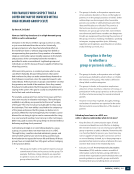
Critical thinking is a defense against the powerful forces
that contribute to our propensity for self-delusion. It
liberates us from our self-delusions. Mr. Melnyk states that
critical thinking with the imaginative validation-
and connection-seeking interests of those attracted to
On Critical Thinking...
By William Goldberg
By Michael D. Langoneconflicts
Editor’s Corner
(A response to “When Critical Thinking Doesn’t Help: Why It Fails and How to Make It Happen,”
by Millard J. Melnyk, IT 6.2, pp. 8–11)
In his article “When Critical Thinking Doesn’t Help: Why
It Fails and How to Make It Happen,” Millard J. Melnyk
makes some valid points about attempting to intervene
with cult members and to show them that they have been
manipulated. However, Mr. Melnyk’s article is a bit unfair to
those of us who advocate the use of critical thinking when
one is working with former members and families.
Mr. Melnyk’s recognition of the importance of beginning
where the cult member is, and of not talking down to
the cult member, are sound guidelines, but his assertion
that critical thinking is antithetical to these guidelines
is inaccurate. I agree with Mr. Melnyk that speaking to
someone in a cult in a bullying, adversarial manner is
counterproductive, but he conflates critical thinking with
being adversarial or with speaking critically. Sound, critical
thinking is compatible with friendly, supportive exchanges.
Mr. Melnyk describes the critical thinker as evaluative,
challenging, and objectively detached. The image that
he creates is of a stern, Spock-like, humorless know-it-all.
Some family members, and even some professionals, may
speak from this position. I would argue, however, that this
approach inappropriately applies the critical thinking of
the physical scientist to the arena of relationships. Persons
distort the reality of the unconscious, unfeeling, “dead”
cosmos by injecting emotion into their observations
and conclusions. However, persons distort the reality of
a relationship by ignoring the complex, uncertain, and
ambiguous emotions that are an unavoidable part of being
human. Spock would have flunked counseling 101.
I maintain that the psychologically aware critical thinker
is accepting of humanness, is engaged, and is humble.
The critical thinker is not unwavering, certain, overly self-
assured, or under the delusion that he is infallible. The
critical thinker recognizes that we all are wrong sometimes,
and that we all can be fooled. The critical thinker recognizes
what poor data-collection devices human beings are and
tries, ironically, to guard against the emotion-generated
need for certainty that leads some to apply Spock-like
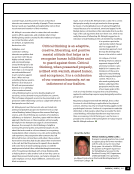
thinking to human interactions. Critical thinking is an
adaptive, creative, liberating, and positive mental attitude
that helps us to recognize human fallibilities and to guard
against them. Critical thinking, when presented properly,
is filled with warmth, shared humor, and acceptance. It is a
celebration of our common humanity, not an indictment of
our frailties.
Critical thinking is a defense against the powerful forces
that contribute to our propensity for self-delusion. It
liberates us from our self-delusions. Mr. Melnyk states that
critical thinking with the imaginative validation-
and connection-seeking interests of those attracted to
On Critical Thinking...
By William Goldberg