Cultic Studies Review, Vol. 1, No. 1, 2002, Page 42
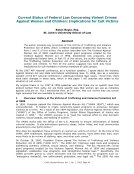
Current Status of Federal Law Concerning Violent Crimes
Against Women and Children: Implications for Cult Victims
Robin Boyle, Esq.
St. John’s University School of Law
Abstract
The author presents key provisions of The Victims of Trafficking and Violence
Protection Act of 2000, which is federal legislation divided into two Acts. In
Parts I and II of this article, the author describes how The Violence Against
Women Act of 2000 reauthorized critical grant programs created by the
Violence Against Women Act of 1994, established new programs, and
strengthened federal laws. In Part III of this article, the author explains that
The Trafficking Victims Protection Act of 2000 prevents the trafficking of
women and children. In Part IV the author suggests how both Acts have
implications for cult members or former members of cultic groups.
At the 1997 AFF national conference, as a luncheon speaker, I spoke about the Violence
Against Women Act and state and federal antistalking laws. In 1998, also as a luncheon
speaker at the AFF national conference, I addressed related legal issues.1 Since then, there
have been changes in these laws, which in this paper I will describe and relate to the
situation of cult victims.
My original thesis in my 1997 &1998 speeches was that there are no specific laws that
protect women from cults, nor are there specific laws that women can use as remedies
against cults per se. But I maintained then, as I do now, that cult victims may use certain
legal remedies that are available to society at large.
I. Overview: History of the Victims of Trafficking and Violence Protection Act
of 2000
In 1994, Congress passed the Violence Against Women Act (―VAWA 1994‖),2 which was
unprecedented. It helped to create community-based programs to prosecute domestic
violence as a crime. As a result of the 1994 legislation, the Violence Against Women Office
(―VAWO‖) of the Office of Justice Programs, United States Department of Justice was
created in 1995.3 The VAWO‘s purpose is to ―lead the national effort to stop domestic
violence, sexual assault, and stalking of women.‖4
The VAWO works with the Office of the U.S. Attorney to ensure enforcement of federal
criminal statutes. It also administers grants to states, Indian tribes, and local communities
amounting to over $270 million.5
Why does the legislation focus primarily on women as victims of crime? At the time of the
VAWA 1994 enactment, national reports showed that women, more often than men, were
more likely to be victims of stalking, rape, and other such crimes.6
On October 28, 2000, President Clinton signed The Victims of Trafficking and Violence
Protection Act of 2000 (―2000 Act‖).7 The 2000 Act ―improves legal tools and programs
addressing domestic violence, sexual assault, and stalking. The Act reauthorizes critical
grant programs created by the Violence Against Women Act of 1994 and subsequent
legislation, establishes new programs, and strengthens federal laws.‖8 Specifically, the
VAWO provides grants to victim advocates and law enforcement for programs such as:
―emergency shelter[s], law enforcement protection, and legal aid.‖9 The 2000 Act also
Current Status of Federal Law Concerning Violent Crimes
Against Women and Children: Implications for Cult Victims
Robin Boyle, Esq.
St. John’s University School of Law
Abstract
The author presents key provisions of The Victims of Trafficking and Violence
Protection Act of 2000, which is federal legislation divided into two Acts. In
Parts I and II of this article, the author describes how The Violence Against
Women Act of 2000 reauthorized critical grant programs created by the
Violence Against Women Act of 1994, established new programs, and
strengthened federal laws. In Part III of this article, the author explains that
The Trafficking Victims Protection Act of 2000 prevents the trafficking of
women and children. In Part IV the author suggests how both Acts have
implications for cult members or former members of cultic groups.
At the 1997 AFF national conference, as a luncheon speaker, I spoke about the Violence
Against Women Act and state and federal antistalking laws. In 1998, also as a luncheon
speaker at the AFF national conference, I addressed related legal issues.1 Since then, there
have been changes in these laws, which in this paper I will describe and relate to the
situation of cult victims.
My original thesis in my 1997 &1998 speeches was that there are no specific laws that
protect women from cults, nor are there specific laws that women can use as remedies
against cults per se. But I maintained then, as I do now, that cult victims may use certain
legal remedies that are available to society at large.
I. Overview: History of the Victims of Trafficking and Violence Protection Act
of 2000
In 1994, Congress passed the Violence Against Women Act (―VAWA 1994‖),2 which was
unprecedented. It helped to create community-based programs to prosecute domestic
violence as a crime. As a result of the 1994 legislation, the Violence Against Women Office
(―VAWO‖) of the Office of Justice Programs, United States Department of Justice was
created in 1995.3 The VAWO‘s purpose is to ―lead the national effort to stop domestic
violence, sexual assault, and stalking of women.‖4
The VAWO works with the Office of the U.S. Attorney to ensure enforcement of federal
criminal statutes. It also administers grants to states, Indian tribes, and local communities
amounting to over $270 million.5
Why does the legislation focus primarily on women as victims of crime? At the time of the
VAWA 1994 enactment, national reports showed that women, more often than men, were
more likely to be victims of stalking, rape, and other such crimes.6
On October 28, 2000, President Clinton signed The Victims of Trafficking and Violence
Protection Act of 2000 (―2000 Act‖).7 The 2000 Act ―improves legal tools and programs
addressing domestic violence, sexual assault, and stalking. The Act reauthorizes critical
grant programs created by the Violence Against Women Act of 1994 and subsequent
legislation, establishes new programs, and strengthens federal laws.‖8 Specifically, the
VAWO provides grants to victim advocates and law enforcement for programs such as:
―emergency shelter[s], law enforcement protection, and legal aid.‖9 The 2000 Act also