Cultic Studies Review, Vol. 1, No. 1, 2002, Page 34
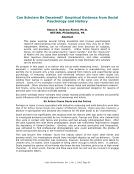
Can Scholars Be Deceived? Empirical Evidence from Social
Psychology and History
Steve K. Dubrow Eichel, Ph.D.
RETIRN, Philadelphia, PA
Abstract
This paper explores several telling anecdotes and reviews psychological
research demonstrating that scholars, however proud they may be of their
independent thinking, can be influenced and even deceived by subjects,
events, and processes in their research. Arthur Conan Doyle‘s belief in
fairies, Uri Geller the so-called psychic ―spoon bender,‖ and the ―discovery‖
of Noah‘s Ark are cases that exemplify how researchers can be influenced.
Next cognitive dissonance, demand characteristics, and other variables
studied by social psychologists are discussed to help illuminate why scholars
can be deceived.
My purpose in this paper is to deliver this not-so-earth-shattering news: Scholars can be
deceived --sometimes quite spectacularly. The evidence is overwhelming, and space
permits me to present only a few examples, gleaned from history and experimental social
psychology, of everyday scientists and renowned scholars who have been duped into
believing the unbelievable, accepting the unacceptable, and, in the worst cases, enticed into
lending their names in support of the perpetrators of the worst evils of the twentieth
century. Some of my examples involve well-intended scholars who were hoodwinked and
bamboozled. Other scholars have actively if naively aided and abetted fraudulent research.
And finally, some have knowingly permitted or even perpetrated deception for reasons of
personal gain or to advance a private agenda.
But some--perhaps many--scholars have simply reacted predictably to ordinary yet powerful
social influences with varying degrees of awareness and hubris.
Sir Arthur Conan Doyle and the Fairies
Perhaps no name is more associated with deductive reasoning and solid detective work than
that of Sir Arthur Conan Doyle, the creator of Sherlock Holmes. Doyle was also, however, a
believer in spiritualism who declared the evidence for life after death to be ―overwhelming.‖
Doyle proved to be significantly less studious than his literary alter ego when he was asked
to investigate evidence provided by two Yorkshire girls, Frances and Elsie, who claimed that
they were in contact with fairies and gnomes and had actually photographed them. After
the girls supplied him with these photographs, Doyle was sufficiently impressed to engage
the assistance of Edward Gardner. Gardner, also an avowed spiritualist and theosophist,
was entrusted to find professional photographers who could authenticate the photos of
fairies and gnomes dancing in the Yorkshire woodlands.
This was Doyle‘s first mistake: Given the radical nature of the claim (that fairies and
gnomes exist), his investigators should have included skeptics as well as believers. Doyle
did not believe this precaution was necessary, however, because the photos were taken by
children who, he stated, were incapable of being clever enough to falsify them. In addition,
Doyle trusted the opinion of his friends who knew the two Yorkshire girls to be of high moral
character. In other words, Frances and Elsie were both too dull and too innocent to engage
in photographic fakery.
Can Scholars Be Deceived? Empirical Evidence from Social
Psychology and History
Steve K. Dubrow Eichel, Ph.D.
RETIRN, Philadelphia, PA
Abstract
This paper explores several telling anecdotes and reviews psychological
research demonstrating that scholars, however proud they may be of their
independent thinking, can be influenced and even deceived by subjects,
events, and processes in their research. Arthur Conan Doyle‘s belief in
fairies, Uri Geller the so-called psychic ―spoon bender,‖ and the ―discovery‖
of Noah‘s Ark are cases that exemplify how researchers can be influenced.
Next cognitive dissonance, demand characteristics, and other variables
studied by social psychologists are discussed to help illuminate why scholars
can be deceived.
My purpose in this paper is to deliver this not-so-earth-shattering news: Scholars can be
deceived --sometimes quite spectacularly. The evidence is overwhelming, and space
permits me to present only a few examples, gleaned from history and experimental social
psychology, of everyday scientists and renowned scholars who have been duped into
believing the unbelievable, accepting the unacceptable, and, in the worst cases, enticed into
lending their names in support of the perpetrators of the worst evils of the twentieth
century. Some of my examples involve well-intended scholars who were hoodwinked and
bamboozled. Other scholars have actively if naively aided and abetted fraudulent research.
And finally, some have knowingly permitted or even perpetrated deception for reasons of
personal gain or to advance a private agenda.
But some--perhaps many--scholars have simply reacted predictably to ordinary yet powerful
social influences with varying degrees of awareness and hubris.
Sir Arthur Conan Doyle and the Fairies
Perhaps no name is more associated with deductive reasoning and solid detective work than
that of Sir Arthur Conan Doyle, the creator of Sherlock Holmes. Doyle was also, however, a
believer in spiritualism who declared the evidence for life after death to be ―overwhelming.‖
Doyle proved to be significantly less studious than his literary alter ego when he was asked
to investigate evidence provided by two Yorkshire girls, Frances and Elsie, who claimed that
they were in contact with fairies and gnomes and had actually photographed them. After
the girls supplied him with these photographs, Doyle was sufficiently impressed to engage
the assistance of Edward Gardner. Gardner, also an avowed spiritualist and theosophist,
was entrusted to find professional photographers who could authenticate the photos of
fairies and gnomes dancing in the Yorkshire woodlands.
This was Doyle‘s first mistake: Given the radical nature of the claim (that fairies and
gnomes exist), his investigators should have included skeptics as well as believers. Doyle
did not believe this precaution was necessary, however, because the photos were taken by
children who, he stated, were incapable of being clever enough to falsify them. In addition,
Doyle trusted the opinion of his friends who knew the two Yorkshire girls to be of high moral
character. In other words, Frances and Elsie were both too dull and too innocent to engage
in photographic fakery.